
Drop Weight Impact Tester: Can a Pipe Survive a Job-Site Knock? — BRT LC-400
[Shenyang, China] – One bump on the job site — does the drain pipe just crack open?
Drainage and irrigation pipes go through a lot before they ever get installed — loading, unloading, hauling, stacking — and installation itself rarely goes without the occasional bump from a tool or a drop from half a meter onto hard ground. Would a knock like that be enough to crack the pipe open right then and there? It sounds like a minor concern, but it directly determines whether the pipe holds up down the road — especially for drainage lines buried underground, where an invisible hairline crack picked up during installation can sit there quietly until it becomes a leak or a full crack years later, by which point the cost of digging it up and fixing it is enough to make anyone wince.
As a professional manufacturer of testing instruments, Shenyang Baoruitong Automation Equipment Co., Ltd. (BRT) presents this guide to pipe impact testing and introduces the LC-400 Drop Weight Impact Tester — engineered to turn “can this batch of pipe survive an accidental knock” into quantifiable, repeatable cracking-rate data.
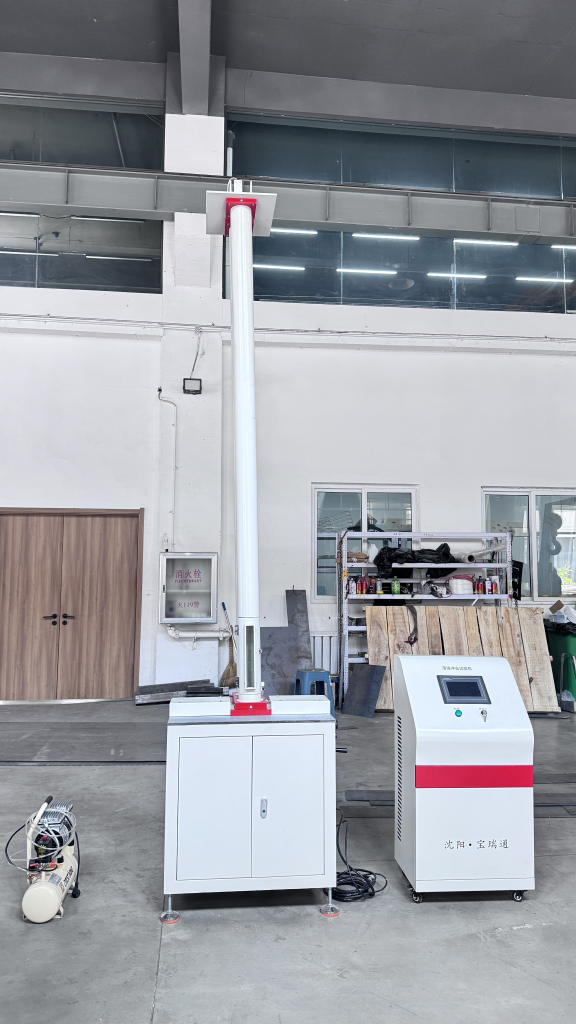
What Is the Drop Weight Impact Test?
Determining whether a pipe’s impact resistance is up to standard relies on the drop weight impact test. Under GB/T 14152, GB/T 5836.1 and related standards:
- A pipe specimen is mounted on a V-shaped support set at a specific angle
- A weight of standard mass is dropped from a set height straight onto the sample surface
- The system tracks the cracking rate across a batch of specimens to determine whether that batch meets the required impact-resistance grade
The principle isn’t complicated, but what actually determines whether the resulting data can be trusted comes down to how precisely the drop height is controlled, whether the weight matches the standard exactly, and how tightly the deviation between the impact point and fixture center is held — the standard specifies precise weight-to-height combinations for each pipe size, and any drift throws off whether the measured cracking rate actually reflects the pipe’s real performance.
LC-400: Built Around Getting These Details Right
The BRT LC-400 Drop Weight Impact Tester was designed specifically to control these variables.
CNC-controlled impact execution
- The control system runs on CNC technology, with drop height digitally preset and displayed
- Automatically handles zero return, hammer lift, hammer drop and impact execution while effectively preventing secondary impacts from skewing results
- A dual-column structure keeps the unit compact with minimal energy loss and a faster test cycle than older layouts
Broad specimen and hammer compatibility
- Supports D25 and D90 hammer diameters, with SR5 to SR30 hammer heads available
- Workbench travel spanning 0 to 400 mm
- Sample diameter compatibility from 20 to 400 mm
- Adjustable drop height from 500 to 2000 mm
- Deviation between the impact center and fixture center held within 2 mm — leaving plenty of margin for precision
Standard-matched supports and weight configuration
- Three companion 120° V-shaped support plates adapt to different pipe sizes
- Weight configuration ranges from 0.075 kg to 2 kg, with multiple pieces available for flexible combination
- Weight-to-diameter requirements matched precisely across GB/T 5836.1, GB/T 20221, GB/T 13664 and GB/T 16800 — no risk of an incorrect weight combination pulling the test off standard
- The whole unit weighs 400 kg net, giving it the structural heft needed for long-term stability
Who Needs the LC-400?
- Pipe manufacturers verifying impact resistance of PVC and other plastic pipes before shipment
- Third-party testing laboratories performing drop weight impact tests for pipe certification
- Municipal drainage and irrigation projects where pipe reliability in buried service is critical
For pipe manufacturers and third-party testing labs, what this equipment really solves is turning “can this batch of pipe survive an accidental knock” into quantifiable, repeatable cracking-rate data — data that directly determines whether a product can be certified and trusted in municipal drainage applications where reliability matters a great deal.
Why Choose Shenyang Baoruitong (BRT)?
Founded in 2012 and headquartered in Shenyang, Liaoning Province, China, Shenyang Baoruitong Automation Equipment Co., Ltd. (BRT) specializes in the independent R&D, manufacturing and global export of testing instruments covering pipes, plastics, cables, textiles and building materials.
- The impact control system, support structure and weight mechanism are all engineered and quality-controlled in-house, backed by years of focused R&D in testing equipment
- 3,000 m² standardized production workshop and a professional engineering R&D team of 20+ specialists
- All products pass ISO 9001 quality certification and CE safety approval
- Stable supply to testing laboratories and manufacturers across Europe, Southeast Asia, North America and Australia
- A dedicated pre-sales and after-sales team tailors solutions to different industry testing needs, so every data point your equipment produces holds up under scrutiny
- 1-year warranty on all instruments, with responsive global technical support
- Address: Kaifa 22nd Rd., Tiexi Dist., Shenyang, Liaoning Province, China
FAQ
What is a drop weight impact test for pipes? A drop weight impact test drops a standard weight from a set height onto a pipe specimen mounted on a V-shaped support, then measures the cracking rate across a batch of specimens to determine whether the pipe batch meets the required impact-resistance grade per GB/T 14152 and related standards.
Which standards apply to pipe drop weight impact testing? Key standards include GB/T 14152 and GB/T 5836.1, with weight-to-diameter requirements across GB/T 20221, GB/T 13664 and GB/T 16800. The international equivalent for thermoplastics pipe impact resistance is ISO 3127.
Which pipe sizes can the LC-400 test? The LC-400 handles sample diameters from 20 to 400 mm, with drop heights from 500 to 2000 mm, D25/D90 hammer diameters, SR5–SR30 hammer heads and a 0–400 mm workbench travel.
Why is impact center deviation important? The standard requires the impact point to align tightly with the fixture center — the LC-400 holds this deviation within 2 mm. Misaligned impacts produce cracking rates that don’t reflect the pipe’s real impact resistance.
Why does the weight configuration need to match the standard? Each pipe size specifies a precise weight-to-height combination. The LC-400’s 0.075–2 kg weight set, with flexible combination logic matched to GB/T 5836.1, GB/T 20221, GB/T 13664 and GB/T 16800, prevents incorrect loading that would pull the test off standard.
Get a Quote
Need a reliable drop weight impact tester for pipe impact resistance testing or certification? Contact Shenyang Baoruitong Automation Equipment Co., Ltd. today for the LC-400 datasheet, test procedure guidance and a customized quotation. Every BRT instrument is backed by a 1-year warranty, installation guidance, operation training and long-term after-sales support.
Email: info@brt-test.com | WhatsApp: +86 15604057553 | Web: www.brt-test.com