
Smoke Density Tester: In a Fire, Smoke Kills Before the Flames Do
In a fire, smoke kills before the flames do.
Fire statistics tell a sobering story: the majority of fire casualties are caused not by direct flame contact, but by smoke — inhalation of toxic gases and loss of visibility that traps people before they can escape. That is why the smoke concentration and obscuration ability produced when a material is heated or burned are among the most important indicators for evaluating fire hazard levels. In the field of building safety, the flammability performance of materials is one of the key parameters used to assess their potential risk — and measuring how much smoke a material generates in a fire is essential data for building design, fire certification and product compliance.
As a professional manufacturer of fire testing instruments, Baoruitong Automation Equipment Co., Ltd. (BRT) presents this guide to smoke density testing and its Smoke Density Tester — engineered to turn “how dangerous is this material’s smoke” into quantifiable, repeatable measurement data.
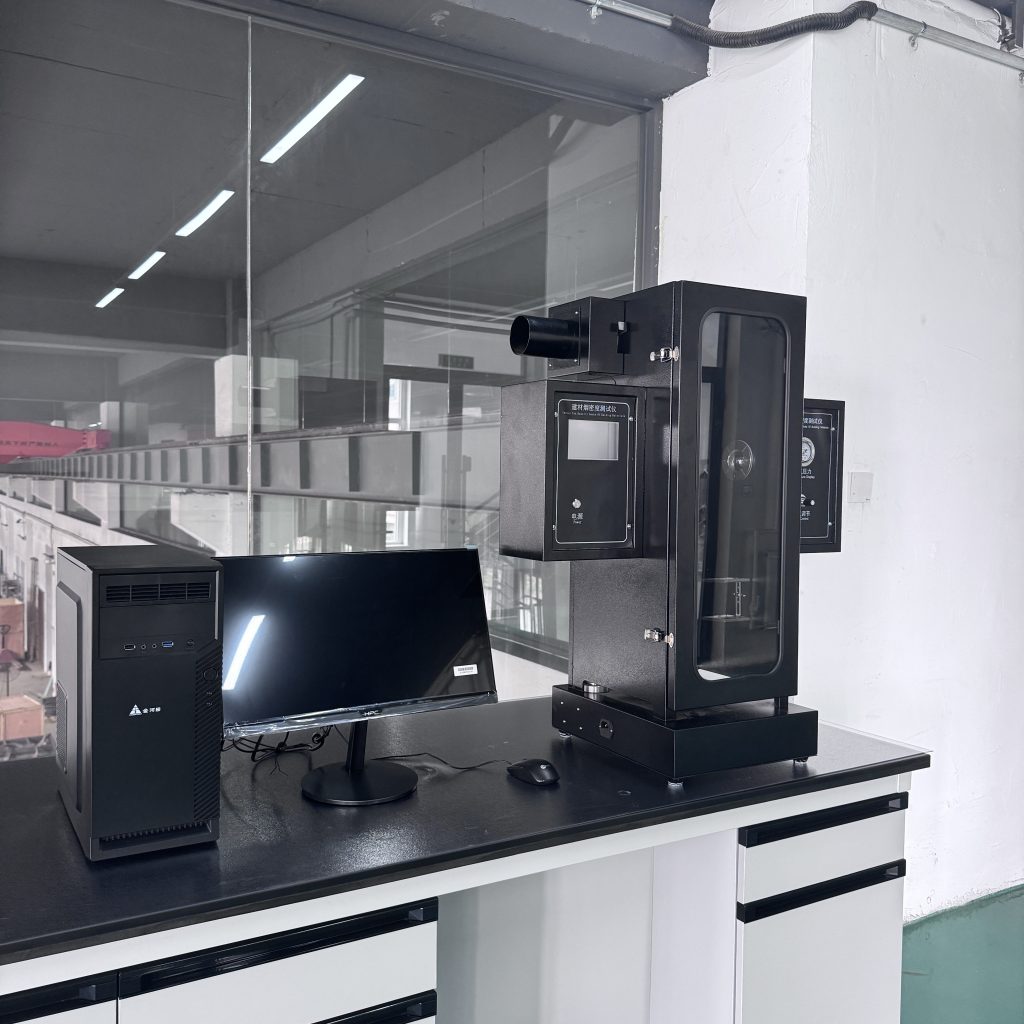
What Is a Smoke Density Tester?
A smoke density tester is a specialized laboratory instrument used to measure the smoke concentration generated during the combustion or pyrolysis of materials. It is widely applied in fields such as building materials, plastics and petroleum-based materials, providing essential data for fire safety assessment.
The instrument is based on optical measurement technology — it determines smoke density by emitting a directed light beam and measuring the attenuation of the light after it passes through the test specimen. Using the refraction and scattering properties of light, it evaluates the scattering or absorption ratio at different wavelengths, supported by high-precision optical components and advanced data processing algorithms.
The core structure includes a control unit, combustion chamber, smoke chamber, exhaust and purification system, specimen holder, ignition system and photoelectric system, plus a PLC-based programming and touchscreen control system. Together they complete the smoke density measurement process and output key indicators such as Maximum Smoke Density (MSD) and Smoke Density Rating (SDR).
How Smoke Density Testing Works
Under standardized combustion conditions:
- The specimen is ignited using a Bunsen burner or radiant heat source
- A built-in light source (typically a 6V/15W incandescent lamp) and a photoelectric sensor (such as a silicon photocell with a human-eye response filter) monitor real-time changes in light transmittance through the smoke
- The system automatically calculates smoke density indicators and generates test curves and reports
Key outputs include transmittance (%), specific optical density (Ds), Maximum Smoke Density (MSD) and Smoke Density Rating (SDR) — the figures used for fire performance classification and safety evaluation.
Key Technical Features
- Sealed 304 stainless steel smoke chamber (approximately 300 × 300 × 790 mm) with a blackened inner wall for accurate optical measurement
- Bunsen burner combustion system — nozzle diameter φ0.13 mm, 45° angle, operating under 276 kPa pressure for a 4-minute flame exposure
- Photoelectric measurement system with measurement range of 0–100% and accuracy of ±3%
- Automatic exhaust system with airflow ≥ 1700 L/min
- PLC + touchscreen dual-control system supporting automatic ignition, timing, smoke extraction, data acquisition and report generation
- Automatic calibration using 25% / 50% / 75% standard filters, with data logging every 15 seconds and real-time smoke density–time curve plotting
- Test gas: propane with purity ≥ 95%; ambient conditions 0–40 °C, relative humidity ≤ 85%
- Designed in line with GB/T 8627-2007, ASTM E662 and ISO 5659-2 testing requirements
Where Smoke Density Testing Is Used
- Building materials and construction products — wall materials, thermal insulation materials, decorative panels and PVC pipes, providing essential data for building fire classification per GB 8624
- Transportation — automotive and rail transit materials (metro, high-speed rail), and aircraft interior components including seats, carpets, ceilings and dashboards
- Plastics and polymer materials — plastics, rubber, foams and composite materials, supporting flame-retardant rating certification and product development
- Electrical wires and cables / insulating materials — testing the smoke generation of cable sheaths and insulation layers for the power, telecommunications and rail transit industries
- Textiles and soft furnishing materials — carpets, curtains and protective clothing for public spaces such as hotels, cinemas and theaters
- Fire safety products, CNAS-accredited third-party laboratories, research institutions and universities — combustion safety testing services, fire dynamics research and new flame-retardant material development
FAQ
What is a smoke density tester? A smoke density tester is a laboratory instrument that measures the smoke concentration generated by materials during combustion or pyrolysis, using optical light-attenuation technology. It outputs indicators such as maximum smoke density (MSD), smoke density rating (SDR) and light transmittance, supporting fire safety assessment of building materials, plastics, cables and more.
What is maximum smoke density (MSD)? MSD is the maximum smoke density reached by a material during a standardized smoke density test, expressed as a percentage. It is a key indicator of how severely a material can obscure visibility and reduce escape options in a fire.
What is smoke density rating (SDR)? SDR is a dimensionless rating that summarizes the overall smoke generation behavior of a material over the test period. Together with MSD and transmittance–time curves, it feeds into fire performance classification such as GB 8624.
Which standards apply to smoke density testing? Common standards include GB/T 8627-2007 for building materials, ASTM E662 (the NBS smoke density chamber method) and ISO 5659-2 for plastics. Test conditions typically use propane fuel with ≥ 95% purity under controlled ambient conditions.
Which materials can be tested? Building materials, plastics, rubber, foams, composites, wire and cable sheaths, insulating materials, textiles and automotive/rail/aircraft interior components — any solid material where smoke generation in a fire is a safety concern.
Why is smoke density testing important for fire safety? Most fire casualties result from smoke inhalation and visibility loss rather than direct flame contact. Measuring smoke density helps designers, regulators and manufacturers select materials that keep escape routes visible and give occupants more time to evacuate.
Get a Quote
Need a reliable smoke density tester for building material, cable or plastic smoke testing? Contact Baoruitong Automation Equipment Co., Ltd. today for the datasheet, test procedure guidance and a customized quotation. Every BRT instrument is backed by a 1-year warranty, installation guidance, operation training and long-term after-sales support.
Email: info@brt-test.com | WhatsApp: +86 15604057553 | Web: www.brt-test.com