
Melt Flow Rate Tester: Why the Same Plastic Molds Differently — BRT BNR-400B
Same plastic, different batch — why does it mold differently?
Anyone who runs injection molding has probably hit this frustrating scenario: same supplier, same resin grade, just a different batch — and suddenly the molding results are off. Either the material flows poorly and underfills the cavity, or it flows too fast and produces flash, and no amount of process tweaking seems to find the root cause. More often than not, the answer is hiding in a metric that’s easy to overlook: melt flow rate. This figure reflects how a plastic melt flows under a specific temperature and load — in a real sense, it’s a resin’s fingerprint. If that number drifts noticeably between batches, downstream processing parameters need to shift with it, or product quality is going to be hard to keep consistent.
As a professional manufacturer of testing instruments, Baoruitong Automation Equipment Co., Ltd. (BRT) presents this guide to melt flow testing and introduces the BNR-400B Melt Flow Rate Tester — engineered to turn “is this batch of material actually good to use” into a quantifiable number that goes straight into an incoming material inspection report.
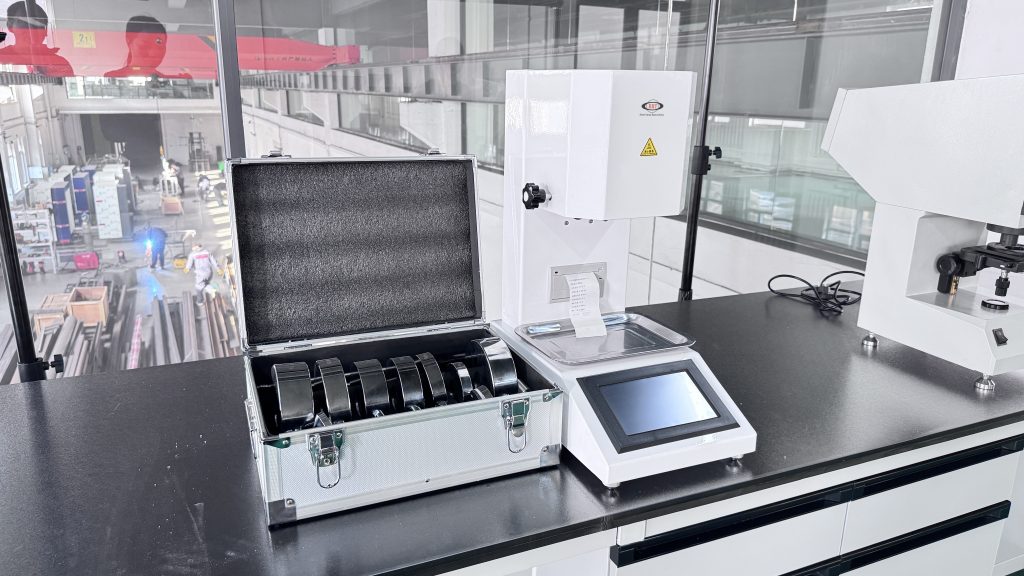
What Is the Melt Flow Rate Test?
Under GB/T 3682 and ISO 1133, the melt flow rate test principle is fairly simple — heat a plastic sample to a specific temperature, extrude it through a precisely sized die under a standard load, and measure the mass or volume extruded per unit time. Higher numbers mean better flow.
Simple in principle, but what actually determines whether the resulting data holds up comes down to how precise the equipment’s temperature control is, how accurate the load weights are, and how tightly the die dimensions are toleranced — the standard specifies die diameter and length tolerances down to the micron, and if the equipment itself can’t keep up with that precision, the data isn’t going to survive review.
BNR-400B: Precision That Survives Review
The BRT BNR-400B Melt Flow Rate Tester holds up well on exactly these details.
Micron-level die and barrel tolerances
- Die diameter 2.095 ± 0.005 mm, die length 8.000 ± 0.025 mm
- Barrel diameter 9.550 ± 0.025 mm, barrel length 152 ± 0.1 mm
- Piston rod head dimensions held to the same tight tolerances — details that look unremarkable on paper but form the actual foundation of data credibility
Eight standard load levels for full resin coverage
- 8 levels of standard test load from 0.325 kg up to 21.600 kg, covering the testing needs of polyethylene, polypropylene, polyoxymethylene, ABS resin, polycarbonate, nylon, fluoroplastics and other thermoplastics across their various standard load requirements
- Weight relative error held within 0.5%, with combination logic strictly matching each standard load’s conversion — no risk of loading the wrong weight combination and throwing off the result
Wide, stable temperature control
- Temperature control spans a wide 30 °C to 450 °C range, with constant-temperature accuracy held at ±0.2 °C — a genuinely important spec for melt flow testing, since even a degree or two of drift can noticeably skew results for temperature-sensitive resins
Compact bench footprint
- Overall dimensions of 250 × 360 × 514 mm don’t take up much bench space — which matters for quality departments or small-to-mid-size molding shops working with limited room
Who Needs the BNR-400B?
- Resin manufacturers verifying melt flow consistency across production batches
- Injection molding shops performing incoming material inspection to catch batch variation before it becomes a production problem
- Third-party testing laboratories issuing melt flow test reports for material certification and supplier evaluation
For resin manufacturers, injection molding shops and third-party testing labs, the real value of this equipment is turning “is this batch of material actually good to use” — a question that used to rely on an experienced operator’s feel — into a quantifiable number. Once batch-to-batch consistency is under control, the odds of running into trouble downstream in processing drop significantly.
FAQ
What is melt flow rate (MFR)? Melt flow rate (MFR), also called melt flow index (MFI), measures how much plastic melt is extruded through a standard die under a specified temperature and load per unit time. It reflects a resin’s flowability — a key fingerprint for batch-to-batch consistency in injection molding and material selection.
Which standards apply to melt flow rate testing? The melt flow rate test is defined in ISO 1133 and GB/T 3682, with the equivalent US standard ASTM D1238. The BNR-400B meets the requirements of ISO 1133 and GB/T 3682 with tight die, barrel and piston tolerances.
Which materials can be tested? Polyethylene (PE), polypropylene (PP), polyoxymethylene (POM), ABS resin, polycarbonate (PC), nylon and fluoroplastics, among other thermoplastics — with 8 standard load levels from 0.325 kg to 21.600 kg covering each material’s load requirements.
Why is temperature precision critical in melt flow testing? Even one or two degrees of temperature drift can noticeably skew melt flow results for temperature-sensitive resins. The BNR-400B holds constant-temperature accuracy at ±0.2 °C across a 30–450 °C range.
How does melt flow testing help injection molding? Incoming material inspection with a melt flow rate tester catches batch-to-batch resin variation before it causes underfill, flash or inconsistent part quality downstream — turning an operator’s guess into a quantifiable, reportable number.
Get a Quote
Need a reliable melt flow rate tester for resin QC or incoming material inspection? Contact Baoruitong Automation Equipment Co., Ltd. today for the BNR-400B datasheet, test procedure guidance and a customized quotation. Every BRT instrument is backed by a 1-year warranty, installation guidance, operation training and long-term after-sales support.
Email: info@brt-test.com | WhatsApp: +86 15604057553 | Web: www.brt-test.com