
BRT 890 FT-IR Spectrometer for Pharmaceutical Tablet and Liquid Formulation Testing
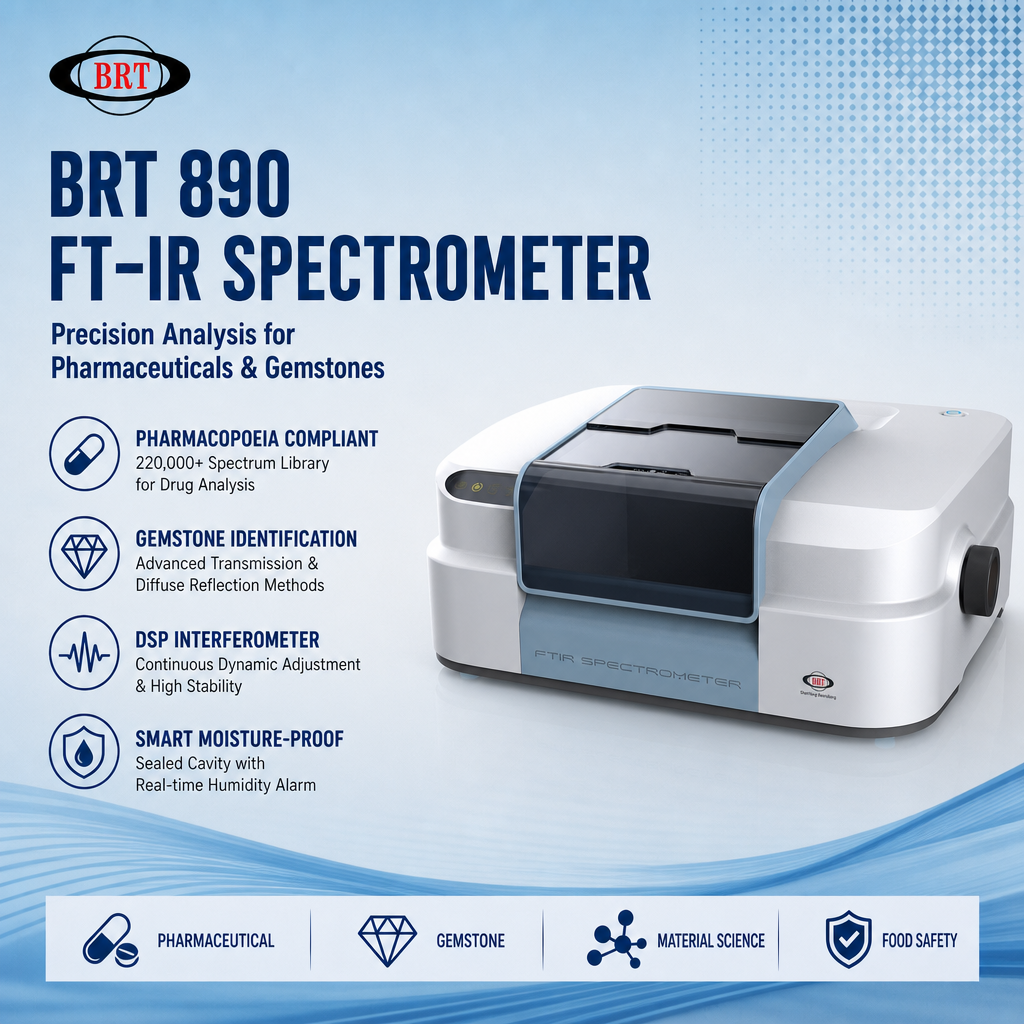
FT-IR Spectrometer Supports Pharmaceutical Testing of Solid Tablets and Liquid Formulations
Pharmaceutical laboratories need analytical tools that can support material identification, routine quality screening and repeatable comparison of spectral data across research and quality-control workflows. The BRT 890 Fourier Transform Infrared Spectrometer is designed for spectral analysis in biomedicine, material science, food safety, petrochemical research and other laboratory applications.
For pharmaceutical testing, the instrument can be used to examine solid tablets and liquid formulations through infrared spectral fingerprints. By comparing characteristic absorption bands with qualified reference spectra, laboratory teams can support qualitative identification and investigate whether incoming materials, in-process samples or finished products show the expected spectral profile.
The BRT 890 document describes the instrument as using a Michelson interferometer. Light from the source is converted into interference light, interacts with the sample, and is received with sample information. Computer software then obtains the spectrum through Fourier transformation. This workflow provides the basis for comparing the chemical-bond information reflected in the infrared spectrum.
Testing Solid Tablets with FT-IR
Solid tablets can present challenges for routine screening because the sample may contain an active pharmaceutical ingredient, excipients, coatings and other formulation components. The BRT 890 supports a flexible measurement workflow that can be selected according to the sample form and accessory configuration.
1. Prepare the tablet sample
A laboratory may test an intact tablet, a prepared portion or a representative powdered sample according to its internal method. Sample preparation should follow the laboratory’s validated procedure and the purpose of the test. The product document lists a sample-bin size of 190 × 160 mm, providing a defined space for sample-accessory configurations.
2. Select a suitable measurement configuration
The BRT 890 supports transmission accessories, attenuated total reflection accessories (ATR), diffuse-reflection accessories and plane-reflection accessories. For a solid tablet or prepared tablet sample, the laboratory can select the configuration that best matches the sample’s geometry, surface and analytical objective.
The supplied document also describes a transmission workflow in which a sample is placed in the optical path and measured to obtain an infrared spectrum. A laboratory can then compare characteristic peaks with qualified reference spectra for qualitative identification or screening.
3. Compare characteristic spectral features
The resulting spectrum can be reviewed against a reference spectrum or a laboratory-defined spectral library. This can support questions such as:
- Does the tablet show the expected infrared fingerprint?
- Are the main spectral features consistent with the intended material or formulation?
- Does a sample show unexpected spectral differences that require further investigation?
- Is the batch-to-reference comparison suitable for a follow-up quality-control decision?
FT-IR screening should be interpreted within the laboratory’s validated method and should not be treated as a substitute for every quantitative, microbiological or pharmacopoeial test.
Testing Liquid Formulations with FT-IR
Liquid pharmaceutical products—including solutions, suspensions and other liquid formulations—can also be evaluated through an appropriate infrared measurement configuration. Depending on the formulation and the laboratory method, a liquid sample may be measured using a suitable transmission arrangement or an ATR accessory.
1. Introduce the liquid sample into the selected accessory
The operator places the liquid formulation into the selected measurement configuration according to the laboratory’s sampling procedure. The objective is to obtain a stable spectrum while limiting external interference and avoiding unnecessary exposure of moisture-sensitive optical components.
2. Collect the formulation spectrum
The BRT 890 uses a digitally controlled Michelson interferometer and a high-sensitivity DLATGS receiver with a polymer moisture-proof membrane, as described in the product document. The instrument also uses digital signal acquisition with a 24-bit, 500 kHz A/D conversion and a high-speed USB interface for real-time spectral data acquisition.
3. Review the infrared fingerprint
A liquid formulation’s spectrum can be compared with an approved reference spectrum or an internal library entry. This approach can help laboratories screen for expected spectral characteristics, compare samples during development and flag differences for additional investigation.
The result should be interpreted with awareness of formulation complexity. Water, solvents, active ingredients, excipients and concentration differences can influence the measured spectrum. The correct accessory, sampling procedure and reference method should therefore be established by the responsible laboratory.
Instrument Features Relevant to Pharmaceutical Laboratories
The BRT 890 combines optical, electronic and environmental-control features that are relevant to routine spectral analysis.
Moisture protection for sensitive optical components
The document describes a fully sealed cavity, an industrial temperature-and-humidity display with humidity alarm, special coatings on the window, detector and beam splitter, and a reusable 304 stainless-steel desiccant box. Together, these design elements are intended to help reduce moisture-related risk to sensitive components, including potassium-bromide-based optical components.
Stable infrared source
The instrument uses a silicon-carbide rod infrared light source with electronically stabilized power supply technology. The documented design goal is to provide stable and reliable power support for the source and contribute to long service life.
Dynamic interferometer control
The interferometer uses DSP-controlled electromagnetic drive and continuous dynamic adjustment. The system automatically optimizes energy without requiring manual adjustment, according to the product document.
Optical compensation and sealed sample handling
Three-dimensional right-angle gold-plated mirror compensation technology and a fixed mirror design are described as helping maintain optical alignment. The push-pull sample-chamber door is designed to reduce interference from water and carbon dioxide in the surrounding air during testing.
Spectral library support
The product document states that the instrument can provide a range of professional infrared spectrum libraries, with approximately 220,000 spectra, including a national pharmacopoeia atlas library, organic and inorganic libraries, polymer libraries, protein and amino-acid libraries, solvent libraries, food-additive libraries and other industry-focused collections. Users can also create a customized spectrum library for retrieval.
For pharmaceutical laboratories, this can support reference-spectrum management, material screening and more consistent comparison across routine workflows. The suitability of any library entry should be confirmed against the laboratory’s approved reference method.
Documented Specifications
| Item | Documented specification |
|---|---|
| Spectral range | 7800–350 cm⁻¹ |
| Resolution | Better than 0.85 cm⁻¹; 0.5 cm⁻¹ optional |
| Signal-to-noise ratio | 45000:1; P-P value, 4 cm⁻¹, 1-minute scan |
| Wavenumber accuracy | Better than 0.01 cm⁻¹ |
| Transmission accuracy | Better than 0.05 τ% |
| Interferometer | Non-orthogonal Michelson interferometer |
| Data interface | High-speed USB 2.0, compatible with USB 3.0 |
| Power supply | 100–240 V, 50/60 Hz broadband power supply |
| Sample-bin size | 190 × 160 mm |
| Instrument dimensions | 520 × 430 × 250 mm |
| Weight | 19 kg |
Building a Practical Pharmaceutical FT-IR Workflow
A practical workflow can be organized into five stages:
- Define the analytical objective — for example, identity screening, incoming-material comparison, formulation development or finished-product investigation.
- Select the sample preparation and accessory — choose transmission, ATR, diffuse reflection or plane reflection according to the solid tablet or liquid formulation.
- Collect the spectrum — use consistent sampling, background collection and instrument settings within the laboratory method.
- Compare against qualified references — review characteristic peaks and use the appropriate spectrum-library or reference-spectrum procedure.
- Document and escalate differences — retain the spectral record and route unexpected differences to the responsible QC, QA or R&D process for further investigation.
This workflow helps connect the instrument’s measurement capabilities with the laboratory’s quality system without overstating what a single FT-IR measurement can prove.
Conclusion
The BRT 890 FT-IR Spectrometer provides a flexible platform for pharmaceutical laboratories working with solid tablets and liquid formulations. Its documented spectral range, resolution, signal-to-noise ratio, moisture-protection features, accessory expansion options and professional spectrum-library support can help laboratories build practical qualitative identification and routine screening workflows.
To discuss a suitable transmission, ATR or reflection configuration for your pharmaceutical sample, contact Shenyang Baoruitong Automation Equipment Co., Ltd. for technical information and an application-oriented solution.