
Bunched Wire & Cable Burning Tester: Stopping Flame Spread in Cable Trays — BRT CS380
One cable catches fire — does the whole cable tray go up with it?
Inside a cable tray, wires and cables are often bundled together by the hundreds, sometimes thousands, running in parallel. If one section catches fire from overload or a short circuit, does the flame race up the bundle and turn the entire tray into a wall of fire? That question turns genuinely dangerous in places where cables run dense — data centers, subway tunnels, ship engine rooms. If a bundled cable run fails to stop vertical flame spread, the fallout usually isn’t a single circuit fault — it’s a cascading failure across an entire zone’s power and communication systems.
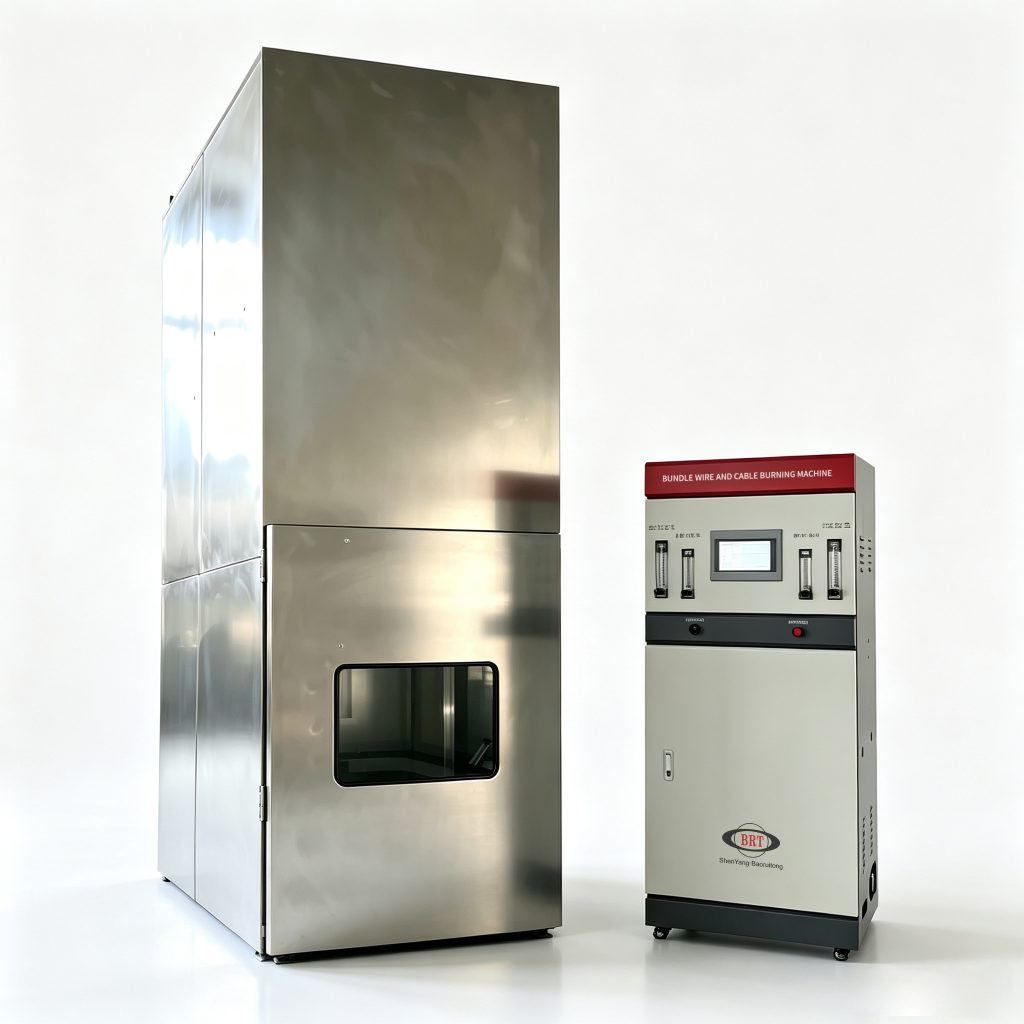
As a professional manufacturer of fire testing instruments, Baoruitong Automation Equipment Co., Ltd. (BRT) presents this guide to bunched cable fire testing and introduces the CS380 Bunched Wire and Cable Burning Tester — engineered to faithfully reproduce the fire behavior of densely installed cables under standard test conditions.
What Is a Bunched Wire and Cable Burning Test?
Under GB/T 18380.31 (identical to IEC 60332-3-10), cables are bundled and mounted on a steel ladder per the standard method, ignited continuously from below with a ribbon-type propane burner, and observed to see:
- Whether the flame climbs the bundle
- How far the flame spreads
- How much of the specimen ends up damaged
The results ultimately determine whether that batch of cable meets the flame-retardant rating required for densely packed installations. The principle isn’t complicated, but it places real demands on the test chamber’s sealing, airflow control and ignition source positioning accuracy — after all, the test is meant to reproduce the semi-enclosed, naturally ventilated conditions of a real cable tray, and even a small gap in the chamber seal or a shift in airflow can throw off the combustion data.
CS380: Engineered Around the Pressure Points
The BRT CS380 Bunched Wire and Cable Burning Tester was designed specifically to control these variables, delivering a complete cable fire test solution for cable manufacturers and testing laboratories.
Sealed, insulated combustion chamber for reproducible ventilation
- Combustion chamber in 304 stainless steel inside and out, with interior dimensions of 1000 mm wide × 2000 mm deep × 4000 mm high — enough to hold the standard steel ladder and a full bundled cable specimen
- Chamber walls insulated with 65 mm of mineral fiber, holding the heat transfer coefficient around 0.7 W·m⁻²·K⁻¹ — a figure that directly determines whether the test environment reliably reproduces the ventilation conditions the standard requires
- Air inlet positioned 150 mm from the front wall on the chamber floor, measuring 800 × 400 mm, with a 300 × 1000 mm exhaust opening at the rear of the top
- Airflow held steady at 5000 ± 500 L/min throughout the test
- A spray system forcibly extinguishes any remaining fire once testing finishes, removing the risk of reignition
Precision ribbon-type propane burner
- The burner’s fire-supplying surface is a flat metal plate drilled with 242 holes, each 1.32 mm in diameter and spaced 3.2 mm apart, arranged in three staggered rows, with an extra row of pilot holes on each side to keep the flame burning steadily
- Each burner carries a high-precision gas mass flowmeter to control the propane-to-air ratio precisely — under standard test conditions, air flow runs 77.7 ± 4.8 L/min and propane 13.5 ± 0.5 L/min
- Ignition point positioned 75 ± 5 mm from the specimen’s front surface and 600 ± 5 mm from the chamber floor, aligned symmetrically with the steel ladder’s axis per the standard
Flexible specimen setups and dependable operation
- Comes with both a 500 mm standard steel ladder and an 800 mm wide-type ladder, covering different bundle densities
- Tempered-glass observation window edged in stainless steel for safe visual monitoring
- Two spiral exhaust fans — the whole chamber holds up well on both sealing integrity and operational stability
Who Needs the CS380?
- Cable manufacturers verifying flame-retardant ratings before products ship to dense-installation projects
- Third-party testing laboratories performing bunched cable burning tests for certification and regulatory review
- Projects where cable fire safety is critical: data centers, subway and rail tunnels, ship engine rooms, power plants — anywhere cables run dense
For cable manufacturers and testing labs alike, the real value of equipment like this comes down to how faithfully it can reproduce a cable’s actual fire behavior in dense installation conditions — and whether the resulting flame-retardant rating can hold up under review. Get the rating wrong for a data center, tunnel or ship, and the cost isn’t abstract: it’s the entire system’s fire safety margin quietly disappearing.
FAQ
What is a bunched wire and cable burning test? A bunched wire and cable burning test evaluates how fire spreads along a bundle of cables mounted on a steel ladder when ignited by a ribbon-type propane burner. It determines the flame-retardant rating of cables used in dense installations such as data centers, tunnels and ship engine rooms.
Which standard does the bunched cable burning test follow? The test follows GB/T 18380.31, which is identical to IEC 60332-3-10 — the standard method for vertical flame spread testing of bunched wires and cables under semi-enclosed, naturally ventilated conditions.
What is a ribbon-type propane burner? A ribbon-type propane burner is the standard ignition source for bunched cable burning tests — a flat metal plate with 242 precisely drilled holes (1.32 mm diameter, 3.2 mm spacing) in three staggered rows, plus pilot holes, delivering a uniform ribbon flame under precise gas flow control.
Why does airflow control matter in cable burning tests? The test chamber must reproduce the naturally ventilated conditions of a real cable tray. Airflow held at 5000 ± 500 L/min, combined with proper chamber sealing and insulation, ensures the combustion data reflects the cable’s true fire behavior rather than test-environment drift.
What does “damaged length” mean in the test? Damaged length is the extent of the cable bundle charred or destroyed by flame spread during the test. It is a key indicator that, together with flame spread behavior, determines whether the cable meets its flame-retardant rating under IEC 60332-3-10 / GB/T 18380.31.
Get a Quote
Need a reliable bunched wire and cable burning tester for cable flame-retardant certification? Contact Shenyang Baoruitong Automation Equipment Co., Ltd. today for the CS380 datasheet, test procedure guidance and a customized quotation. Every BRT instrument is backed by a 1-year warranty, installation guidance, operation training and long-term after-sales support.
Email: info@brt-test.com | WhatsApp: +86 15604057553 | Web: www.brt-test.com