
Fire Resistance Test Furnace: How Fire Doors Earn Their 120-Minute Rating — BRT NH-XL
Can a fire door really hold for 120 minutes?
When a fire breaks out, unglamorous building components — fire doors, fire partitions, fire dampers — end up being the last line of defense buying people time to get out. A product nameplate might read “fire-resistance limit: 120 minutes,” but where does that number actually come from? Not from an engineer’s rough estimate — it comes from putting the component inside a furnace that can genuinely reproduce a real fire’s temperature-rise curve, burning it for the full standard duration, and seeing whether it actually holds. That is the entire purpose of a fire resistance test furnace, and it is a hard checkpoint that fire doors, windows, partition walls and dampers must all clear before they ever leave the factory.
As a professional manufacturer of fire testing instruments, Baoruitong Automation Equipment Co., Ltd. (BRT) presents this guide to fire resistance testing and introduces the NH-XL Vertical Fire Resistance Test Furnace — engineered to deliver certification-grade temperature curve and pressure control for fire-protection building components.
What the Standard Demands: A Fire That Follows the Curve
Under the GB 9978 series of standards, the temperature rise inside the test furnace must strictly follow a defined time-temperature curve:
T − T₀ = 345 lg(8t + 1)
This means temperature climbs extremely fast early on — pushing past 800 °C within just a few minutes — then gradually levels off toward a stable range around 1200 °C. Beyond temperature, furnace pressure is tightly specified too: 15 ± 5 Pa five minutes into the test, tightening to 17 ± 3 Pa at the ten-minute mark.
If either parameter drifts, the entire test result becomes questionable: did the component actually fail because its fire resistance fell short — or did it “burn through” early simply because the furnace’s own temperature curve wasn’t compliant? That is a very hard distinction to untangle after the fact. For third-party testing labs and component manufacturers alike, curve-control precision is now weighed as heavily as raw furnace size or maximum temperature.
NH-XL: Built for Curve Precision and Sustained High Heat
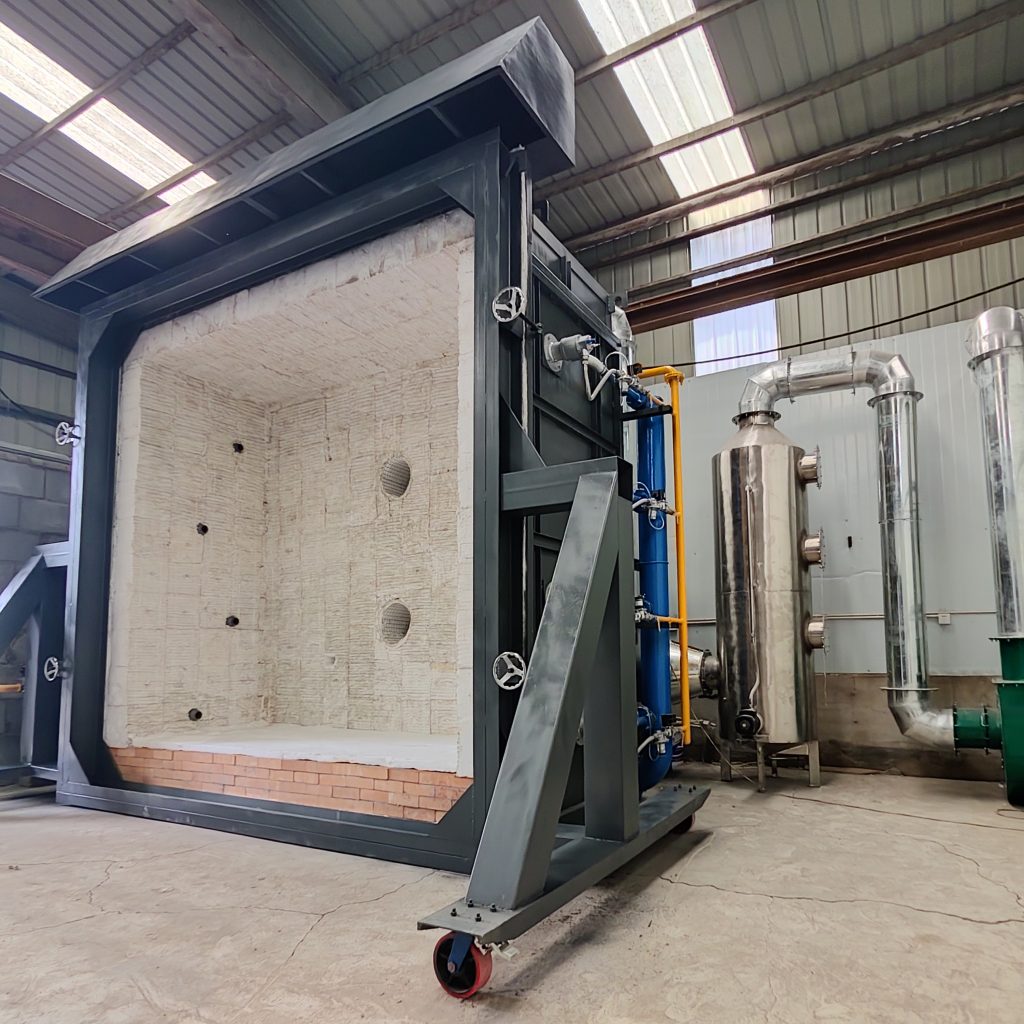
The BRT NH-XL Vertical Fire Resistance Test Furnace was designed from the ground up to meet exactly this demanding standard.
High-temperature furnace construction
- Metal frame with a baked-enamel steel-plate outer shell
- Furnace body and roof built on a lightweight high-alumina fiber suspended structure lined with zirconium-fiber wool block modules
- Floor constructed with the same zirconium-fiber wool block-module configuration — a design that both withstands sustained high heat and keeps the temperature curve under tighter control
Precise, automated combustion control
- Runs on natural gas or LPG with 8 burners operating on proportional combustion
- Automatic furnace-pressure control and automatic temperature regulation
- The entire temperature curve is managed through a programmed sequence with computer-aided operation — barely requiring anyone to sit there manually adjusting parameters
- Maximum operating temperature of 1300 °C
Large test space with external specimen mounting
- Effective internal test space of 3.0 m × 3.0 m × 1.2 m — large enough for standard-sized fire partition walls, doors, windows and valves
- Specimens mount externally, keeping loading and unloading relatively straightforward and reducing downtime between tests
Complete failure-mode judgment
The furnace covers both core failure modes of fire resistance testing — integrity and thermal insulation:
- Insulation failure: mean temperature rise on the unexposed face exceeding 140 °C above the initial value, or any single point exceeding 180 °C
- Integrity failure: cracking or penetration of the specimen
Broad test coverage for a stronger ROI
The NH-XL maps onto a wide set of related standards — GB/T 9978, GB/T 7633, GB/T 38252, GB 16809, GB 12955 and GB/T 23449–23451 — covering fire partition walls, doors, windows, roller shutters, check valves and oil-fume exhaust dampers. For third-party testing laboratories, the broader a single unit’s testing coverage, the better the return on that investment.
Who Needs the NH-XL Fire Resistance Test Furnace?
- Manufacturers of fire-protection building components — for factory-gate quality control; falling short on fire-resistance data can mean a product never clears the factory gate
- Third-party fire testing laboratories — where the precision of the furnace’s temperature curve and pressure control determines directly whether a test report can withstand review and regulatory audit
- Research institutes and certification bodies working with fire doors, fire partitions, fire windows, roller shutters and fire dampers
FAQ
What is a fire resistance test furnace? A fire resistance test furnace is a piece of fire testing equipment that reproduces the standard time-temperature curve of a real fire — reaching over 800 °C within minutes and stabilizing around 1200 °C — to test whether building elements such as fire doors, fire partition walls, windows and fire dampers maintain their integrity and thermal insulation for the required fire-resistance period.
What is the ISO 834 / GB 9978 time-temperature curve? The standard fire curve follows the formula T − T₀ = 345 lg(8t + 1): temperature rises extremely fast in the first minutes, passes 800 °C, then gradually levels off toward a stable range around 1200 °C. The furnace must follow this curve closely or the test result is considered unreliable.
What does a 120-minute fire resistance rating mean? A 120-minute fire-resistance rating (or fire-resistance limit) means the tested component maintained both integrity and thermal insulation — no cracking or penetration, and unexposed-face temperature rise within limits — for the full 120 minutes of furnace testing.
What is the difference between integrity and insulation in fire testing? Integrity failure means the specimen cracked or was penetrated by fire; insulation failure means the unexposed face exceeded the allowable temperature rise (mean >140 °C or any single point >180 °C). Both are judged during fire resistance tests of doors, partitions and dampers.
Which products can the NH-XL furnace test? The NH-XL tests fire partition walls, fire doors, fire windows, roller shutters, check valves and oil-fume exhaust dampers, covering standards including GB/T 9978, GB/T 7633, GB/T 38252, GB 16809, GB 12955 and GB/T 23449–23451.
Get a Quote
Need a reliable fire resistance test furnace for fire door certification or building element fire testing? Contact Shenyang Baoruitong Automation Equipment Co., Ltd. today for the NH-XL datasheet, test procedure guidance and a customized quotation. Every BRT instrument is backed by a 1-year warranty, installation guidance, operation training and long-term after-sales support.
Email: info@brt-test.com | WhatsApp: +86 15604057553 | Web: www.brt-test.com