
Vicat Softening Temperature Tester: Why Plastic Softens in the Sun — BRT WK3
Why does plastic trim go soft after a day parked in the sun?
Leave a car parked under the summer sun for a full day, and when you get back in, the dashboard or door trim often feels noticeably softer to the touch — and with lower-grade plastic parts, you might even notice slight warping. What’s actually happening is a physical property built into every plastic material: under a given load and temperature, it gradually softens and deforms. Engineers call this heat deflection temperature and Vicat softening point — two parameters that are impossible to skip when selecting plastic, rubber or nylon materials. Get the material choice wrong, and best case the product warps out of shape over time; worst case, it fails outright in a hot environment — and anyone who’s dealt with that kind of rework knows exactly how expensive the headache gets.
As a professional manufacturer of testing instruments, Baoruitong Automation Equipment Co., Ltd. (BRT) presents this guide to thermal testing of plastics and introduces the WK3 Vicat Softening Temperature Tester — engineered to turn “can this plastic actually hold up in a hot environment” into a quantifiable, repeatable temperature figure.
What Is the Vicat Softening Test?
The Vicat softening test, in plain terms, presses a specific needle into the sample surface under a constant load, then raises the temperature at a set rate, recording the temperature at which the needle penetrates 1 mm into the specimen — that temperature is the material’s softening point.
The principle isn’t complicated, but what actually determines whether the data can be trusted is how precisely the heating rate is controlled, how stable the load stays, and how accurately deformation gets measured. Slip on any one of these, and the resulting softening point may no longer reflect the material’s real performance — and choosing a material based on bad reference data only means paying for it later, at a much higher cost.
WK3: Real Precision for Softening Point Testing
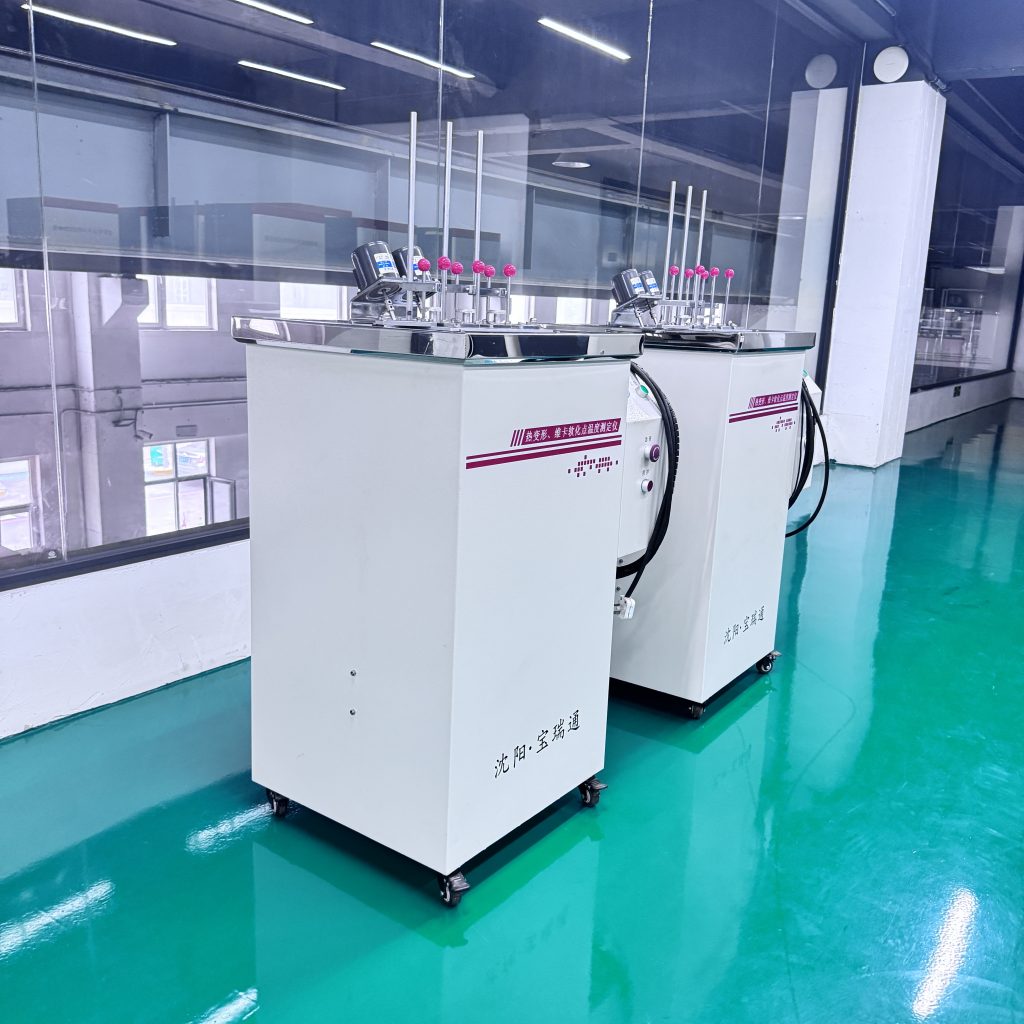
The BRT WK3 Vicat Softening Temperature Tester handles this workflow with genuine precision, covering both Vicat softening point and heat deflection temperature testing in one instrument.
Wide temperature range with dual heating rates
- Temperature control range from room temperature to 300 °C
- Two selectable heating rates — 120 °C/h and 50 °C/h — meeting the requirements of ISO 75, ISO 306, GB 1633 and GB 1634
- Deformation measurement error held within ±0.01 mm, leaving plenty of margin on precision
Safe, stable heating medium
- Heating medium is methyl silicone oil with a flash point above 300 °C, keeping safety well in hand even at the top of the temperature range
Three-station batch testing
- Holds three sample fixtures at once, giving batch testing efficiency a clear edge over single-sample equipment — a genuinely useful feature for labs that regularly need to compare multiple data sets in material selection and quality control
Hardware details that protect data integrity
- Maximum heating power of 4 kW, with both natural and water cooling available so operators can pick whichever fits their testing rhythm
- Combined weight of the load rod, tray and micrometer rod held to 64 g ± 1 g, matching the standard’s load requirements precisely — no risk of load deviation throwing off the final softening point reading
- The whole unit runs real-time display, temperature control and measurement automatically — no need to hover over it manually logging results throughout the test
Who Needs the WK3?
- Material selection engineers evaluating plastic, rubber and nylon materials for hot-environment applications
- Quality control laboratories verifying thermal performance of incoming and outgoing materials
- Manufacturers of electrical insulation materials, automotive interior trim and everyday plastic products
For engineers and labs alike, what this equipment really solves is turning a vague question — can this plastic actually hold up in a hot environment — into a quantifiable, repeatable temperature figure. Whether it’s electrical insulation material, automotive interior trim or everyday plastic products, spending a bit more time on softening point testing during material selection is almost always cheaper than reworking a product after it’s already failed in the field.
FAQ
What is the Vicat softening point? The Vicat softening point is the temperature at which a flat-ended needle penetrates 1 mm into a plastic specimen under a specified load and heating rate. It is a key indicator of a plastic material’s resistance to heat — critical for material selection in hot environments.
What is the difference between Vicat softening point and heat deflection temperature (HDT)? Both measure thermal resistance of plastics, but differently: the Vicat test uses a needle under a constant load and measures penetration temperature, while the HDT test measures the temperature at which a specimen deflects a set amount under a three-point bending load. The WK3 covers both test modes per ISO 306 and ISO 75.
Which standards does the WK3 comply with? The WK3 meets the requirements of ISO 306 (Vicat softening temperature) and ISO 75 (heat deflection temperature), as well as GB 1633 and GB 1634, with heating rates of 120 °C/h and 50 °C/h and a temperature range up to 300 °C.
Why is accurate softening point testing important? Inaccurate softening point data can lead to material failures in hot environments — warping, deformation or outright failure of parts such as automotive interior trim and electrical insulation. Precise, repeatable testing during material selection is far cheaper than field rework.
Which materials can be tested? Plastic, rubber and nylon materials, including electrical insulation materials, automotive interior parts and general plastic products. The three-station design allows batch testing of multiple specimens for efficient data comparison.
Get a Quote
Need a reliable Vicat softening temperature tester for plastic material selection or quality control? Contact Shenyang Baoruitong Automation Equipment Co., Ltd. today for the WK3 datasheet, test procedure guidance and a customized quotation. Every BRT instrument is backed by a 1-year warranty, installation guidance, operation training and long-term after-sales support.
Email: info@brt-test.com | WhatsApp: +86 15604057553 | Web: www.brt-test.com