
Limiting Oxygen Index (LOI): Standards, Test Procedure and Tester Configurations Explained
Baoruitong Automation Equipment Co., Ltd., a professional manufacturer of combustion testing instruments and laboratory equipment, today published an industry insight report on the Limiting Oxygen Index (LOI) — one of the most trusted small-scale methods for assessing material flammability worldwide. LOI measures the minimum oxygen concentration required to sustain combustion of a material, and it is the ultimate way to prove to clients that product quality standards are ahead of the curve (source: Qualitest). Every Baoruitong LOI tester is backed by a one-year warranty service period.
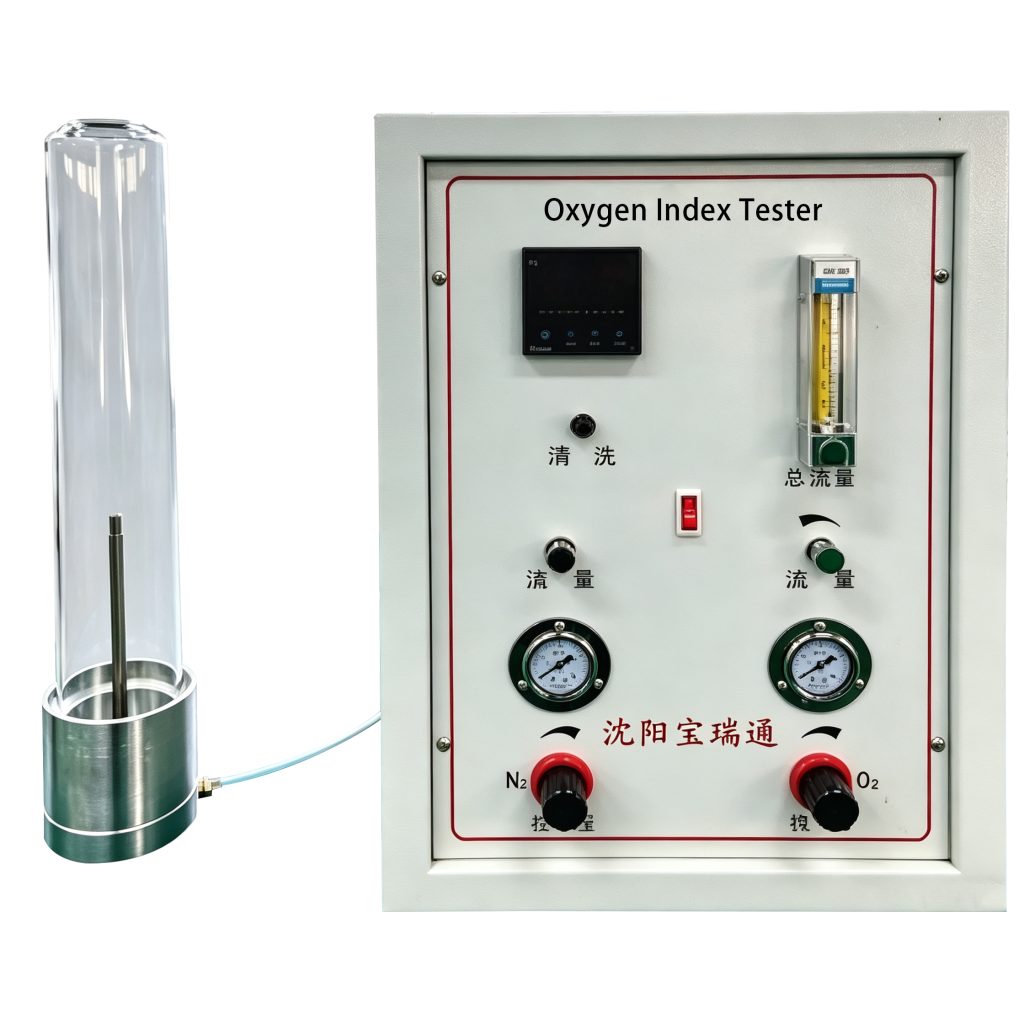
What Is the Limiting Oxygen Index?
The Limiting Oxygen Index is a measure of the minimum oxygen concentration required to sustain combustion of a material, typically determined by testing the vertical burning of a specimen in an oxygen/nitrogen mixture.
The safety benchmark is simple: since the air we breathe contains about 21% oxygen, any material with an LOI higher than 21% is effectively self-extinguishing under normal conditions. Higher LOI values indicate better fire resistance — a critical requirement across the transportation, construction, plastics and petrochemical sectors.
The LOI Formula
The limiting oxygen index calculation is straightforward:
LOI = O₂ / (O₂ + N₂) × 100%
Where O₂ is the oxygen flow and N₂ is the nitrogen flow at the point where combustion is just sustained. The accuracy of the final LOI calculation depends entirely on the precision of the gas flow meters — which is why modern laboratories rely on digital, automated instrumentation.
Global Compliance: The Limiting Oxygen Index Standard
LOI testing is governed by two internationally recognized standard families:
- ASTM D2863 — the primary North American standard, specifying the exact gas-mix mathematics and sample dimensions for highly repeatable limiting oxygen index calculations
- ISO 4589 — the international standard widely used across Europe and the Middle East; Part 2 covers testing at normal room temperature, while Part 3 addresses material behaviour in high-temperature environments
Following these standards is the fastest way to prove product safety for global export and clear regional compliance requirements such as SASO in Saudi Arabia and SABS in South Africa.
Step-by-Step: The LOI Test Procedure
Achieving repeatable results requires a tightly controlled environment — the gap between a “winner” and a “liability” usually comes down to the strictness of the test setup:
1. Specimen Preparation
The material — whether a hard plastic, a foam or a thin film — is cut into a specimen of defined dimensions according to the standard. Precision here is essential: ragged edges or incorrect thickness will skew the burn rate.
2. Mounting and Alignment
The specimen is mounted vertically inside a transparent, heat-resistant glass chimney. This vertical orientation allows the gas mixture to surround the material evenly from the bottom up, so the sample must be clamped perfectly straight.
3. Atmospheric Composition Control
A carefully measured blend of oxygen and nitrogen is pumped through the base of the chimney. The concentration must be precisely balanced to hit the critical threshold, and the gases must flush through the chimney for at least 30 seconds to clear out normal room air before testing begins.
4. Controlled Ignition Phase
A small candle-like flame is applied quickly and cleanly to the top of the vertically mounted specimen — avoiding pre-heating of the rest of the sample. The burner is withdrawn immediately after the top surface catches fire.
5. Data Observation and Endpoint Determination
The operator adjusts the oxygen concentration until the flame just sustains downward burning — hunting for the lowest oxygen concentration where the fire either lasts for exactly 3 minutes or burns exactly 50 mm down the specimen before extinguishing naturally.
Classification and Interpretation of Test Results
Once the LOI is calculated, materials typically fall into three categories:
| LOI Range | Classification | Behaviour |
|---|---|---|
| Below 21% | Highly flammable | Catches fire easily in normal air — requires extreme caution near heat sources |
| 21% – 28% | Slow burning | Burns, but not aggressively — provides a limited safety cushion |
| Above 28% | High resistance / self-extinguishing | Will generally not continue burning in normal air once the ignition source is removed — the target for serious industrial applications |
Automatic vs. Paramagnetic: Two LOI Tester Configurations Compared
Modern LOI testing laboratories choose between two instrument configurations, each serving a different precision and automation need:
| Aspect | Automatic LOI Chamber | Paramagnetic-Type LOI Tester |
|---|---|---|
| Gas measurement | Automated gas flow control and digital readout | Paramagnetic oxygen sensor for direct, highly precise O₂ measurement |
| Operation | Automated procedure with minimal operator input | High-sensitivity readings for demanding applications |
| Human error | Eliminated through digital automation | Minimized through precision instrumentation |
| Best suited for | High-throughput quality control laboratories | Research and compliance labs requiring maximum measurement accuracy |
| Standards | ASTM D2863 / ISO 4589 compliant | ASTM D2863 / ISO 4589 compliant |
Manual-dial instrumentation is a significant risk in LOI testing: upgrading to automatic or paramagnetic-type equipment gives incredibly precise oxygen readings and makes the whole testing process considerably less stressful.
LOI vs. UL 94: Complementary Fire Tests
LOI is often discussed alongside the UL 94 standard — both evaluate how a product reacts to fire, but they measure completely different things:
- UL 94 is an orientation-based test focused on physical reaction: does the plastic drip flaming pieces? Does it stop burning fast? It classifies materials into ratings such as V-0 or V-2
- LOI provides an exact, quantitative percentage — the precise chemical threshold of the product
While UL 94 mimics a real-world fire scenario, LOI gives the exact chemical threshold. Quality professionals should run both tests to get the complete picture of how a material handles a flame.
Variables Affecting LOI Accuracy
Since there is zero room for error in safety testing, several factors can compromise the limiting oxygen index calculation:
- Geometric specifications — thick blocks usually need more oxygen to keep burning than thin films
- Laboratory environmental conditions — temperature and humidity changes affect fire behaviour; climate-stable testing equipment is essential in hot regions
- Gas supply integrity — impure oxygen or nitrogen invalidates the entire gas mix
- Instrumentation precision — manual dials are a major risk; sensitive digital or paramagnetic equipment ensures accurate readings
Why Choose Shenyang Baoruitong for LOI Testing
- Standards-first engineering — LOI testers designed for ASTM D2863 and ISO 4589 workflows
- Precision gas measurement — accurate oxygen concentration control for reliable LOI calculations
- Configurations for every laboratory — automatic chambers and high-sensitivity paramagnetic-type models
- One-year warranty service period — professional after-sales support, calibration guidance and technical consultation included
FAQ
Q1: What is the limiting oxygen index (LOI)? LOI is the minimum oxygen concentration, expressed as a percentage, required to sustain combustion of a material in an oxygen/nitrogen mixture. Materials with an LOI above 21% (the oxygen level of normal air) are self-extinguishing under ambient conditions.
Q2: Which standards govern LOI testing? LOI testing is governed by ASTM D2863 (North America) and ISO 4589 (international; Part 2 at room temperature, Part 3 at high temperature).
Q3: What is the LOI test procedure? The procedure involves specimen preparation, vertical mounting in a glass chimney, controlled oxygen/nitrogen mixture flow, ignition, and adjusting oxygen concentration until the flame just sustains burning for 3 minutes or 50 mm down the specimen.
Q4: How is LOI calculated? LOI = O₂/(O₂+N₂) × 100%, where O₂ and N₂ are the gas flow rates at the point where combustion is just sustained.
Q5: What is the difference between LOI and UL 94 testing? UL 94 is an orientation-based test classifying physical burning behaviour (e.g., V-0, V-2), while LOI provides a quantitative percentage representing the exact chemical oxygen threshold. Running both gives a complete picture of fire performance.
Source: “Limiting Oxygen Index (LOI): Standards and Test Procedure,” Qualitest, March 2026 (original article).
Keywords: limiting oxygen index, LOI test, LOI tester, oxygen index testing, limiting oxygen index standard, ASTM D2863, ISO 4589, oxygen index chamber, LOI formula, flammability testing, fire resistance testing, self-extinguishing materials, LOI vs UL 94, paramagnetic oxygen sensor, automatic LOI chamber, material flammability classification, fire testing equipment, Shenyang Baoruitong