
Cone Calorimeter in Fire Testing and Research: How It Works, Operation and Applications
Baoruitong Automation Equipment Co., Ltd., a professional manufacturer of combustion testing instruments and laboratory equipment, today published an industry insight report on the cone calorimeter — one of the most important instruments in fire testing and research. In fire science, accurate measurements of heat release and smoke production are crucial: the cone calorimeter enables researchers to gather consistent, repeatable data on how materials behave when exposed to fire, supporting safety standards across industries (source: World of Test). Every Baoruitong cone calorimeter is backed by a one-year warranty service period.
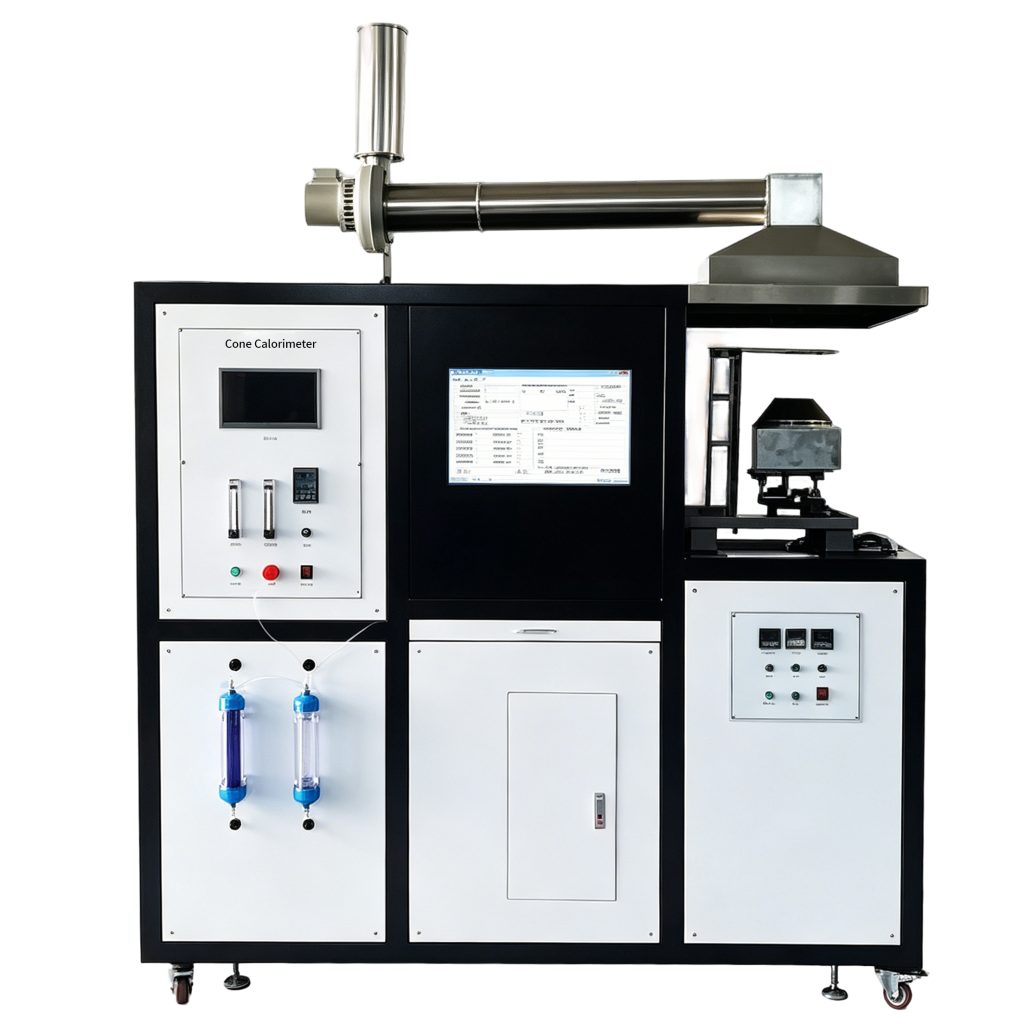
What Is a Cone Calorimeter?
The cone calorimeter is a key instrument in fire testing, designed to measure both the heat release rate and smoke production of materials under controlled heat exposure. It uses a cone-shaped heater to apply uniform heat to small specimens, making it possible to conduct precise, repeatable fire tests.
The device was first developed in November 1982 by Vytenis Babrauskas, a NIST fire research engineer, with support from technicians Dave Swanson, Randy Shields and Bill Twilley. This innovation brought standardization to fire testing, allowing consistent, reliable comparisons of data across various materials — a practice still trusted in fire safety laboratories today.
Detection Principle: Oxygen Depletion Calorimetry
The cone calorimeter operates on the principle of oxygen depletion calorimetry: as a material sample burns, the instrument measures the reduction in oxygen concentration in the combustion gases. For organic materials, this measurement is highly reliable — each kilogram of oxygen consumed releases approximately 13.1 MJ of energy — allowing the heat release rate to be calculated directly from oxygen consumption.
Materials containing halogens, phosphorus or aluminum hydroxide fire retardants may require adjustments or corrections, since these affect oxygen consumption and heat release measurements.
How the Cone Calorimeter Works: Key Components
1. Cone Heater and Spark Ignition
A conical radiant heater provides a controlled heat flux, typically set between 10 and 100 kW/m², to simulate fire conditions. Combustion is initiated with a spark igniter located above the sample, enabling consistent testing suited to material development and comparative fire performance studies.
2. Specimen and Load Cell
The sample is mounted on a load cell that continuously measures mass loss as it burns. The rate of mass loss contributes directly to the total heat release calculation and provides insight into the material’s thermal inertia and ignition properties.
3. Exhaust Hood and Gas Sampling System
Combustion gases pass through an exhaust hood connected to a duct system with a centrifugal fan, maintaining a controlled gas flow rate — crucial for accurate oxygen depletion and heat release rate measurements. A paramagnetic analyzer measures oxygen levels, while non-dispersive infrared (NDIR) analyzers measure carbon monoxide (CO) and carbon dioxide (CO₂) concentrations.
4. Smoke Measurement and Soot Collection
A laser photometer beam in the exhaust duct measures smoke density by detecting light attenuation, providing the dynamic smoke production rate. A soot sample tube and collection filter capture particulate matter, helping quantify smoke obscuration for visibility and toxicity assessment in fire scenarios.
5. Data Collection and Analysis
The instrument continuously records key parameters — heat release rate (HRR), time to ignition, mass loss rate, smoke generation and gas yields (CO and CO₂). The resulting heat release rate curves are used to evaluate fire performance, develop pyrolysis and burning models, and feed fire simulations or full-scale fire behavior predictions.
How to Operate a Cone Calorimeter
1. Sample Preparation
A standardized material sample — typically 100 × 100 × 4 mm — is placed on the load cell inside the testing chamber to monitor mass loss throughout the test.
2. Setting the Heat Flux
Adjust the cone-shaped heater to the required heat flux, typically between 10 and 75 kW/m², and allow the cone to reach the set temperature for accurate, controlled heating.
3. Initiating the Test
Remove cover plates to expose the sample to heat; an igniter above the sample sparks combustion, causing pyrolysis gases to ignite.
4. Monitoring and Data Collection
Track heat release rate, time to ignition, mass loss rate, smoke production rate and CO/CO₂ production throughout the test.
5. Analyzing Results
Calculate total smoke release, effective heat of combustion and ignition time, and generate heat release rate curves for fire modeling applications.
Standards for Reliable Results
Cone calorimeter testing follows strict international standards:
- ASTM E1354 — specifies methods for measuring heat release rate and smoke production under controlled conditions
- ISO 5660 — provides guidelines for conducting cone calorimeter tests, supporting consistency across international laboratories
Additional compliance standards include ASTM E1474, ASTM F1550, ASTM E1740, ASTM D6113, IMO MSC 40(64), BS 476-15, NFPA 264, NFPA 271, CSN EN 45545-2 and CSN EN 13501-1 — covering aerospace, marine, railway and building applications.
Applications in Fire Testing Laboratories
Unlike older pass/fail tests, the cone calorimeter delivers engineering-based, quantitative data for advanced applications:
- Fire model support — detailed data for modern fire modeling and predictions
- Real-scale fire behavior prediction — estimating full-scale fire performance using correlations
- Material ranking — rank-ordering products by fire performance for comparison testing
- Pass/fail evaluation — meeting regulatory fire safety requirements
Key industries include polymers (reliable HRR data replacing outdated UL 94 and LOI tests in material development), building materials (non-combustibility evaluation), upholstered furniture, electric wires and cables (predicting large-scale vertical cable test results) and specialized applications such as wood, textiles, PVC products and ornamental plants.
Bomb Calorimeter vs. DSC: Two Types of Calorimeters Compared
Cone calorimeters are sometimes confused with other calorimeter types. Two common alternatives serve different measurement purposes:
| Aspect | Bomb Calorimeter | Differential Scanning Calorimeter (DSC) |
|---|---|---|
| Measurement | Heat of combustion by burning samples in a high-pressure oxygen environment | Heat flow differences between sample and reference as temperature changes |
| Typical use | Fuel testing, calorific value determination | Identifying melting points and glass transitions in polymers |
| Sample state | Complete combustion in sealed bomb | Thermal analysis during controlled heating |
| Fire testing relevance | Measures total energy content | Measures thermal transitions, not fire behaviour |
For fire testing and research, the cone calorimeter remains the instrument of choice — providing well-defined, reproducible fire scenarios that support material comparison, fire-retardant assessment and standardized regulatory data.
Why Choose Shenyang Baoruitong for Cone Calorimetry
- Standards-first engineering — cone calorimeters designed for ASTM E1354 and ISO 5660 testing workflows
- Precision measurement — accurate heat release rate, smoke and mass loss data for confident fire performance evaluation
- One-year warranty service period — professional after-sales support, calibration guidance and technical consultation included
- Combustion testing expertise — a dedicated manufacturer of fire testing instruments for the building materials, plastics, textile and flooring industries
FAQ
Q1: How does a cone calorimeter work? A cone calorimeter applies controlled radiant heat to a sample via a cone-shaped heater, measures oxygen depletion in the combustion gases (oxygen depletion calorimetry), and calculates the heat release rate — approximately 13.1 MJ of energy per kilogram of oxygen consumed.
Q2: What standards apply to cone calorimeter testing? The primary standards are ASTM E1354 and ISO 5660, with additional compliance standards including ASTM E1474, ASTM F1550, ASTM E1740, ASTM D6113, IMO MSC 40(64), BS 476-15, NFPA 264, NFPA 271 and CSN EN 45545-2.
Q3: What data does a cone calorimeter measure? It measures heat release rate (HRR), time to ignition, mass loss rate, smoke production rate, and CO and CO₂ yields — data used for fire modeling and full-scale fire behavior prediction.
Q4: What is the typical heat flux for cone calorimeter testing? The conical heater generates radiant heat fluxes between 10 and 100 kW/m², with operators typically selecting 35 kW/m² or 50 kW/m² to simulate different stages of fire development.
Q5: What is the difference between a bomb calorimeter and a DSC? A bomb calorimeter measures the heat of combustion by burning samples in a high-pressure oxygen environment, while a DSC measures heat flow differences to identify thermal transitions such as melting points and glass transitions. Neither replaces the cone calorimeter for fire testing.