
DIN 53436 Smoke Toxicity Test Apparatus (Mouse Tester)
CYD Smoke Toxicity Test Apparatus by Shenyang Baoruitong
————————————————————————————————————
Meta Title: DIN 53436 Smoke Toxicity Test Apparatus | Shenyang Baoruitong Mouse Tester
Meta Description: Shenyang Baoruitong CYD Smoke Toxicity Test Apparatus is designed for testing the toxicity hazard of smoke and thermal decomposition products. The system uses a moving tube furnace, smoke exposure chamber and mouse activity monitoring system, with reference to DIN 53436 and JIS A 1321.
Keywords: DIN 53436 Smoke Toxicity Test Apparatus, Smoke Toxicity Tester, Mouse Tester, Shenyang Baoruitong Smoke Toxicity Tester, Fire Effluent Toxicity Tester, Smoke Toxicity Test Chamber, Material Smoke Toxicity Testing, Thermal Decomposition Toxicity Tester
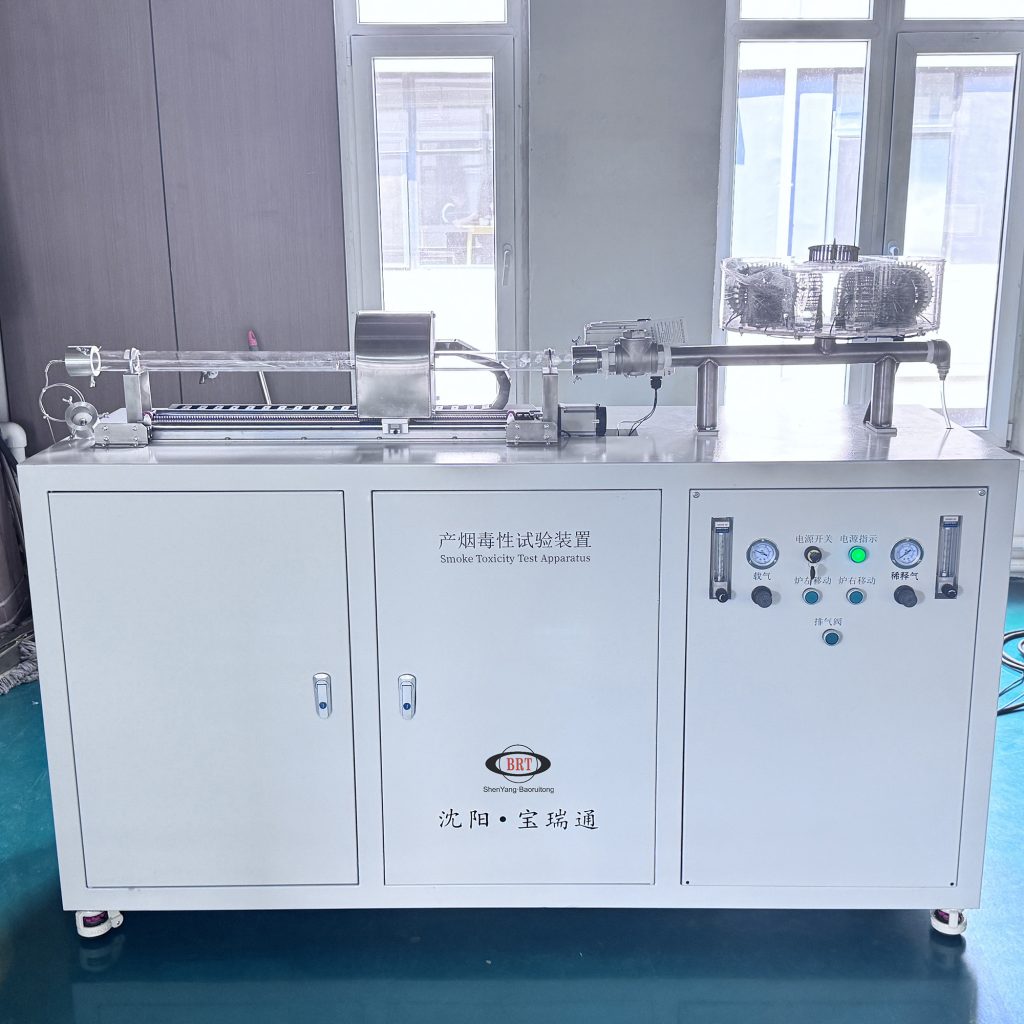
What Is a DIN 53436 Smoke Toxicity Test Apparatus?
A Smoke Toxicity Test Apparatus, also commonly referred to as a Mouse Tester or Fire Effluent Toxicity Test Apparatus, is used to evaluate the toxic effects of smoke and thermal decomposition products generated from materials under controlled heating conditions.
Shenyang Baoruitong Automation Equipment Co., Ltd. provides the CYD Smoke Toxicity Test Apparatus, which combines controlled smoke generation, animal exposure, automatic activity monitoring and computer data acquisition in one laboratory testing system.
Unlike a conventional smoke density tester, which mainly determines how much light is blocked by smoke, the CYD smoke toxicity tester focuses on the toxicity hazard of gases and smoke released during thermal decomposition or combustion.
The equipment adopts a controlled tube-furnace system to generate decomposition products from the test specimen. The generated smoke is transported by a controlled air stream into the exposure chamber, where the response of test animals can be monitored and recorded.
The Shenyang Baoruitong CYD Smoke Toxicity Tester is designed according to GB/T 20285-2006 – Toxic Classification of Fire Effluents Hazard for Materials, with reference to DIN 53436 and JIS A 1321.
How Does the Shenyang Baoruitong Smoke Toxicity Tester Work?
The CYD system manufactured by Shenyang Baoruitong generates smoke and thermal decomposition products under controlled laboratory conditions and introduces the generated fire effluent into an animal exposure chamber. The complete testing process can be divided into four main stages.
1. Controlled Thermal Decomposition
A prepared specimen is placed inside a quartz tube. A precisely controlled ring furnace moves along the quartz tube at a predetermined speed. As the furnace passes over the specimen, the sample is exposed to controlled thermal conditions and gradually decomposes.
The CYD ring furnace consists of a furnace shell, furnace body, furnace tube and electric heating element. The furnace tube has an internal diameter of approximately 47 ± 1 mm and a length of 95-110 mm. This moving furnace design allows controlled and repeatable thermal exposure of the test specimen.
2. Smoke and Fire Effluent Generation
During heating, the test material produces smoke, gases and thermal decomposition products. These products are transported through the system by a controlled carrier-air supply.
The quartz tube used by the Shenyang Baoruitong CYD Smoke Toxicity Test Apparatus has a nominal diameter of 36 ± 1 mm, a wall thickness of 2 ± 0.5 mm, and a total length of approximately 1000-1300 mm.
The smoke collection and distribution section includes valves, dilution-air tubing and gas-distribution components, allowing the generated fire effluent to be transported from the decomposition area to the exposure chamber.
3. Mouse Exposure Test
After generation, the smoke and thermal decomposition products are introduced into a transparent exposure chamber. The CYD system can accommodate up to 10 mice simultaneously for an exposure test.
Each mouse is placed inside an individual rotating cage. Changes in the animal’s movement during exposure can then be observed and recorded to assist in evaluating the toxic effects of the generated smoke according to the applicable test method.
For this reason, this type of equipment is also frequently searched internationally as a Smoke Toxicity Mouse Tester or Mouse Exposure Smoke Toxicity Test Apparatus.
4. Automatic Mouse Activity Monitoring
A major feature of the Shenyang Baoruitong CYD Smoke Toxicity Test Apparatus is its computer-based animal activity monitoring system. Hall sensors are used to detect the rotation of individual mouse cages.
The computer can simultaneously monitor signals from 10 mouse cages, allowing the operator to observe dynamic mouse activity curves during the experiment. After the test is completed, the computer system can process the recorded information and generate test graphs and reports.
This computerized monitoring system provides more consistent and traceable experimental records compared with purely manual observation.
Main Components of the CYD Smoke Toxicity Test Apparatus
The Shenyang Baoruitong CYD system integrates smoke generation, smoke transportation, animal exposure and computer monitoring into one complete laboratory platform.
Moving Ring Furnace
The ring furnace provides controlled heating of the test specimen. A stepper motor drives the furnace movement, providing stable motion and precise positioning.
- Standard furnace movement speed: 10 ± 0.1 mm/min
- Selectable movement speed: approximately 5-50 mm/min
- Available furnace travel distance: greater than 600 mm
- Fast return mode after a test to reduce waiting time between experiments
Quartz Tube and Quartz Sample Boat
The test specimen is placed inside a quartz sample boat positioned within the quartz decomposition tube. Quartz material is suitable for the controlled high-temperature environment required during thermal decomposition testing. The support structure of the quartz tube can be adjusted both horizontally and vertically, allowing proper alignment of the furnace, sample and gas-transfer system.
Smoke Collection and Distribution System
The generated smoke passes through a dedicated smoke collection and distribution assembly. The system connects the thermal decomposition section to the exposure chamber and provides a controlled pathway for fire effluent. Proper gas distribution is important for maintaining repeatable exposure conditions during testing.
Carrier Air and Dilution Air Supply System
The CYD equipment includes a dedicated carrier-air and dilution-air supply system consisting of:
- Air compressor
- Regulating valve
- Flow meter
- Connecting pipelines
Controlled airflow helps ensure that thermal decomposition products are generated and transported under defined laboratory conditions.
Mouse Exposure Chamber
The exposure chamber is manufactured from transparent material, allowing operators to visually observe the experiment. The chamber can accommodate 10 mice simultaneously, each positioned within an individual rotating cage.
Computer Control System
The Shenyang Baoruitong CYD Smoke Toxicity Tester is operated and monitored through computer software. The software includes functions for:
- Administrator login
- Experimental parameter setting
- Temperature display
- Mouse activity observation
- Database management
- Test result management
- User management
- User manual access
- System information
- Test control
The equipment therefore provides a relatively high degree of automated operation and data management.
DIN 53436 and Smoke Toxicity Testing
DIN 53436 is associated with the generation of thermal decomposition products from materials under controlled conditions in an air stream for toxicological evaluation.
The method is relevant when laboratories need to reproduce controlled thermal decomposition conditions and study the resulting smoke and fire effluent. Rather than simply exposing a specimen to an uncontrolled flame, a tube-furnace arrangement allows parameters such as heating conditions and airflow to be controlled.
The Shenyang Baoruitong CYD Smoke Toxicity Test Apparatus uses this type of controlled thermal decomposition principle. Its primary specified test standard is GB/T 20285-2006 – Toxic Classification of Fire Effluents Hazard for Materials, with reference to DIN 53436 and JIS A 1321.
For international projects, the applicable standard and required test method should always be confirmed before ordering. The CYD model should be described as designed to GB/T 20285-2006 with reference to DIN 53436 and JIS A 1321, rather than as fully compliant with every edition or part of DIN 53436.
Smoke Toxicity Tester vs. Smoke Density Tester
A Smoke Toxicity Tester and a Smoke Density Tester are two different types of fire-testing equipment.
Smoke Density Tester
A smoke density tester mainly measures how strongly smoke reduces the transmission of light. Typical measured parameters are related to light transmission, optical density and smoke density. The purpose is primarily to determine how dense or opaque the generated smoke is.
Smoke Toxicity Tester
A smoke toxicity tester focuses on the toxicological hazard associated with combustion or thermal decomposition products. The Shenyang Baoruitong CYD system generates the thermal decomposition products under controlled conditions and evaluates their effects using the specified exposure and monitoring method.
Test Type | Primary Purpose |
Smoke Density Test | Determines how much smoke is produced or how opaque the smoke is. |
Smoke Toxicity Test | Evaluates how hazardous the generated smoke or fire effluent is. |
For comprehensive fire-performance evaluation, laboratories may therefore require both smoke density testing and smoke toxicity testing equipment.
Typical Test Materials
The CYD Smoke Toxicity Test Apparatus can be used for fire-safety research and toxicity evaluation involving a wide variety of materials, depending on the applicable test standard. Typical materials may include:
- Plastics
- Polymer materials
- Rubber
- Electrical cable materials
- Insulation materials
- Building materials
- Composite materials
- Interior materials
- Flame-retardant materials
- Railway materials
- Transportation materials
The specimen dimensions, preparation procedure, heating conditions and evaluation method should be selected according to the applicable test standard.
Main Features of the Shenyang Baoruitong CYD Smoke Toxicity Tester
Controlled Thermal Decomposition: A moving ring furnace provides controlled heating of the specimen inside a quartz tube.
Adjustable Furnace Speed: The furnace movement can be adjusted according to the required testing procedure.
Precision Stepper Motor Control: The furnace movement system uses stepper-motor drive technology to provide stable and accurate movement.
Controlled Carrier and Dilution Air: Dedicated airflow components regulate carrier air and dilution air during smoke generation and transportation.
10-Position Mouse Exposure System: The transparent exposure chamber can accommodate up to ten mouse cages simultaneously.
Automatic Activity Detection: Hall sensors detect mouse cage rotation and transmit movement signals to the computer.
Real-Time Computer Monitoring: Mouse activity information from multiple channels can be displayed dynamically during the experiment.
Test Data Recording: Experimental data can be stored and processed through the computer software.
Test Report Generation: After completion of the experiment, recorded data can be used to generate graphs and test reports.
Sealed Smoke Transfer System: Connection points are designed to minimize smoke leakage during the experiment. Waste gases can be connected directly to the laboratory ventilation system.
Applications of the Smoke Toxicity Test Apparatus
The Shenyang Baoruitong Smoke Toxicity Test Apparatus is suitable for laboratories and research organizations studying the toxic hazard of smoke and thermal decomposition products. Typical users include:
Fire Testing Laboratories
For laboratory evaluation of smoke toxicity and material fire hazards.
Material Testing Laboratories
For comparing smoke toxicity characteristics among different material formulations.
Plastic and Polymer Manufacturers
For research and development of materials with improved fire-safety performance.
Building Material Laboratories
For evaluating construction and interior materials under controlled thermal decomposition conditions.
Cable and Electrical Material Manufacturers
For researching low-smoke and flame-retardant cable and insulation materials.
Railway and Transportation Laboratories
For studying smoke toxicity characteristics of materials used in transportation environments.
Universities and Research Institutions
For experimental studies involving fire effluent, material decomposition and toxicological evaluation.
Why Is Smoke Toxicity Testing Important?
During a fire, hazardous conditions are not caused only by flame and high temperature. When plastics, polymers, rubber, cables, insulation and other materials are exposed to high temperatures, they can release complex mixtures of smoke, gases, vapours and thermal decomposition products.
The composition and hazard of these fire effluents depend strongly on material composition, temperature, oxygen availability, heating conditions and fire development conditions.
For this reason, controlled smoke toxicity testing can provide important information for research into the overall fire hazard of materials. The Shenyang Baoruitong CYD Smoke Toxicity Test Apparatus provides a controlled laboratory platform for generating thermal decomposition products and monitoring their toxicological effects according to the specified test method.
Why Choose Shenyang Baoruitong for Smoke Toxicity Testing Equipment?
Shenyang Baoruitong Automation Equipment Co., Ltd. supplies the CYD Smoke Toxicity Test Apparatus for laboratory material fire-testing applications. The CYD system integrates several important testing functions into one platform:
- Controlled thermal decomposition
- Smoke generation
- Gas transportation
- Mouse exposure
- Multi-channel activity monitoring
- Computer control
- Data recording
- Test report generation
The integrated design allows laboratories to control the complete testing process from sample heating and smoke generation through exposure monitoring and final data recording.
For international customers, Shenyang Baoruitong can provide technical specifications for the CYD Smoke Toxicity Test Apparatus according to the required application and test method.
Conclusion
The Shenyang Baoruitong CYD Smoke Toxicity Test Apparatus (Mouse Tester) is designed for laboratory evaluation of the toxic hazards associated with smoke and thermal decomposition products.
The complete system integrates a moving ring furnace, quartz decomposition tube, smoke distribution system, carrier/dilution air supply, mouse exposure chamber, activity monitoring sensors and computer control software.
The equipment is designed according to GB/T 20285-2006 – Toxic Classification of Fire Effluents Hazard for Materials, with reference to DIN 53436 and JIS A 1321.
For laboratories studying material fire behaviour, thermal decomposition products and smoke toxicity, the CYD system provides an integrated solution for controlled smoke generation and toxicity evaluation.
Product Information
Manufacturer: Shenyang Baoruitong Automation Equipment Co., Ltd.
Product Name: CYD Smoke Toxicity Test Apparatus
Alternative Names: Smoke Toxicity Mouse Tester / Fire Effluent Toxicity Test Apparatus / Mouse Exposure Smoke Toxicity Tester
Applicable Standard: GB/T 20285-2006
Reference Standards: DIN 53436, JIS A 1321
Test Principle: Controlled thermal decomposition and mouse exposure method
Website:
Shenyang baoruitong automation equipment co., ltd.
Email: info@brt-test.com
WhatsApp: 0086-15604057553
Website: https://brt-test.com
Alibaba Store: https://sybrt.en.alibaba.com/
Add: Kaifa 22nd Rd., Tiexi Dist., Shenyang, Liaoning, China