
Understanding UV-Vis Spectrophotometers: A Practical Tool for Modern Laboratory Analysis
In modern laboratories, speed, accuracy, and ease of use are essential. Among the many analytical instruments available today, the UV-Vis spectrophotometer remains one of the most widely used tools for routine testing, research, and quality control. It plays an important role in helping laboratories measure how substances interact with ultraviolet and visible light, making it valuable across chemistry, life science, pharmaceuticals, environmental testing, education, and industrial analysis. DeNovix’s overview similarly frames UV-Vis spectrophotometry as a broadly used analytical technique for measuring absorbance across the ultraviolet and visible ranges.
What is a UV-Vis spectrophotometer?
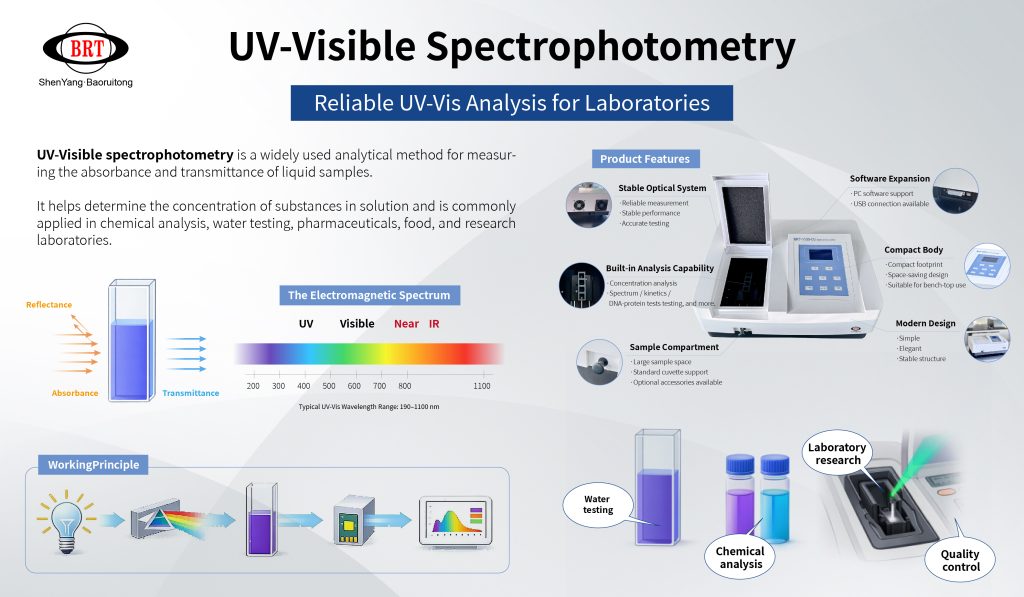
A UV-Vis spectrophotometer is an instrument used to measure the amount of ultraviolet and visible light absorbed by a sample. When light passes through a liquid sample, part of that light may be absorbed by the compounds in the solution, while the rest is transmitted. By comparing the light entering the sample with the light leaving it, the instrument can determine absorbance and help estimate the concentration of specific substances. This is the same core measurement principle described in the referenced DeNovix article. (DeNovix)
This measurement principle is based on the Beer-Lambert Law, which states that absorbance is proportional to concentration and path length. In practical terms, this means laboratories can use UV-Vis spectrophotometry to quantify unknown samples quickly and reliably when the appropriate method is established. DeNovix explicitly notes that Beer-Lambert Law underpins concentration determination in UV-Vis work.
How does it work?
The basic working process of a UV-Vis spectrophotometer is straightforward:
First, the instrument generates light in the ultraviolet and visible wavelength range.
Next, a monochromator selects a specific wavelength or narrow wavelength band.
Then, the selected light passes through the sample.
Finally, the detector measures how much light reaches it after transmission through the sample.
If the sample absorbs more light at a given wavelength, the detector receives less transmitted light, and the instrument records a higher absorbance value. According to the referenced article, UV-Vis instruments measure transmitted light against a reference and determine absorbance across the UV and visible ranges in essentially this way. (DeNovix)
Main components of a UV-Vis spectrophotometer
A UV-Vis spectrophotometer contains several important components that work together to ensure reliable analysis. DeNovix highlights the entrance slit, collimating mirror, monochromator, sample holder, and detector as the key elements of a typical system. (DeNovix)
Light source
Most UV-Vis spectrophotometers use deuterium lamps for the UV range and tungsten or halogen lamps for the visible range. Stable light output is critical for good measurement performance.
Monochromator
The monochromator separates light into individual wavelengths and allows the instrument to select the desired wavelength for analysis.
Sample holder
This is where the cuvette or sample container is placed. The quality and alignment of the sample path can affect measurement accuracy.
Detector
The detector receives transmitted light and converts it into an electrical signal that the system processes into absorbance or transmittance data.
Control system and software
Modern instruments often include digital displays, user-friendly interfaces, and software for photometric measurement, spectrum scanning, quantitative analysis, kinetics, and data storage.
Where is UV-Vis spectrophotometry used?
One of the biggest strengths of UV-Vis spectrophotometry is its versatility. The DeNovix article specifically names chemical analysis, microvolume analysis, nucleic acid and protein analysis, pharmaceutical research, purity testing, and broader quality control uses. (DeNovix)
1. Chemical analysis
UV-Vis spectrophotometers are widely used to analyze organic compounds, inorganic ions, colored solutions, and reaction systems. In teaching labs and industrial laboratories, they provide a simple and efficient way to perform concentration measurements.
2. Nucleic acid and protein analysis
In molecular biology and biochemistry, UV-Vis analysis is commonly used to determine DNA, RNA, and protein concentration. The DeNovix article emphasizes this as one of the major application areas for the technique. (DeNovix)
3. Pharmaceutical research and quality control
In pharmaceutical laboratories, UV-Vis spectrophotometers support compound identification, quantitative analysis, raw material verification, and finished product quality checks. DeNovix likewise notes an important role in identifying and quantifying pharmaceutical compounds and ensuring product quality. (DeNovix)
4. Purity evaluation
UV-Vis testing can help assess sample purity and suitability for downstream applications. The referenced article specifically mentions DNA purity testing for workflows such as PCR and sequencing. (DeNovix)
5. Industrial and routine laboratory testing
From food and beverage production to cosmetics, materials testing, and environmental analysis, UV-Vis spectrophotometers are commonly used as a practical routine analytical tool because they are efficient, repeatable, and relatively easy to operate. DeNovix also notes use in pharmaceuticals, food, and cosmetics for quality and consistency checks. (DeNovix)
Why do so many laboratories choose UV-Vis?
There are several reasons UV-Vis spectrophotometers remain so popular.
Fast analysis
Results can often be obtained within seconds, which is one of the major advantages highlighted in the DeNovix article. (DeNovix)
Easy operation
Many UV-Vis systems are designed with intuitive interfaces and simple workflows, making them suitable not only for researchers but also for students, QC staff, and routine laboratory users. This ease of use is also specifically emphasized in the source article. (DeNovix)
Non-destructive measurement
UV-Vis spectrophotometry is generally considered a non-destructive technique, allowing valuable samples to be measured without being consumed or significantly damaged. DeNovix highlights this as a key benefit for repeated analysis and quality assurance work. (DeNovix)
Broad application range
A single instrument can support multiple testing tasks, from absorbance measurement to concentration analysis and spectrum scanning, which helps improve laboratory efficiency.
Limitations to understand
Like any analytical technique, UV-Vis spectrophotometry also has limitations. The DeNovix article notes that compared with fluorescence quantification, UV-Vis can have lower sensitivity and selectivity in some applications, and measurement accuracy may be affected by stray light. (DeNovix)
This does not reduce its value. Instead, it means users should choose the right instrument and testing method according to the application. For routine analysis, educational use, many industrial tests, and standard laboratory workflows, UV-Vis remains an excellent solution.
Choosing the right UV-Vis spectrophotometer
When selecting a UV-Vis spectrophotometer, laboratories usually consider:
Wavelength range
Spectral bandwidth
Photometric accuracy and repeatability
Stray light performance
Software functions
Sample volume requirements
Ease of maintenance and after-sales support
The right instrument should match the real needs of the lab, whether that means routine absorbance testing, quantitative analysis, teaching applications, or more demanding research tasks.
Final thoughts
UV-Vis spectrophotometers continue to be one of the most practical and reliable analytical instruments in laboratories worldwide. Their ability to deliver fast, straightforward, and non-destructive measurements makes them highly valuable in research, education, pharmaceutical analysis, industrial QC, and many other fields. The DeNovix article reaches a similar conclusion, describing UV-Vis as an essential analytical technique with broad utility across chemistry, biology, pharmaceuticals, food and beverage, and materials science. (DeNovix)
As laboratory requirements continue to evolve, UV-Vis technology remains a trusted foundation for everyday analysis. For laboratories seeking a balance of performance, usability, and versatility, a well-designed UV-Vis spectrophotometer is still a smart investment.
Shenyang Baoruitong Automation Equipment Co., Ltd. is committed to providing practical UV-Vis spectrophotometer solutions for educational, industrial, and laboratory applications worldwide. With reliable instruments and professional support, we help customers improve daily testing efficiency and analytical confidence.