
Ultraviolet-visible (UV-Vis) spectrophotometer is a common laboratory analytical instrument that detects the absorbance and transmittance of liquid samples within ultraviolet and visible spectral ranges. During detection, incident light penetrates liquid samples, wherein solute substances absorb part of the light while the rest transmits through the sample. The instrument calculates sample absorbance by comparing the intensity of incident light and transmitted light, so as to quantify the target compound concentration in samples. Its detection principle complies with the Beer-Lambert Law, which defines the quantitative correlation between sample absorbance, analyte concentration and optical path length. With standardized testing procedures, the instrument enables rapid, accurate and reliable quantitative analysis of samples in routine laboratory experiments.

What is a UV-Vis spectrophotometer?
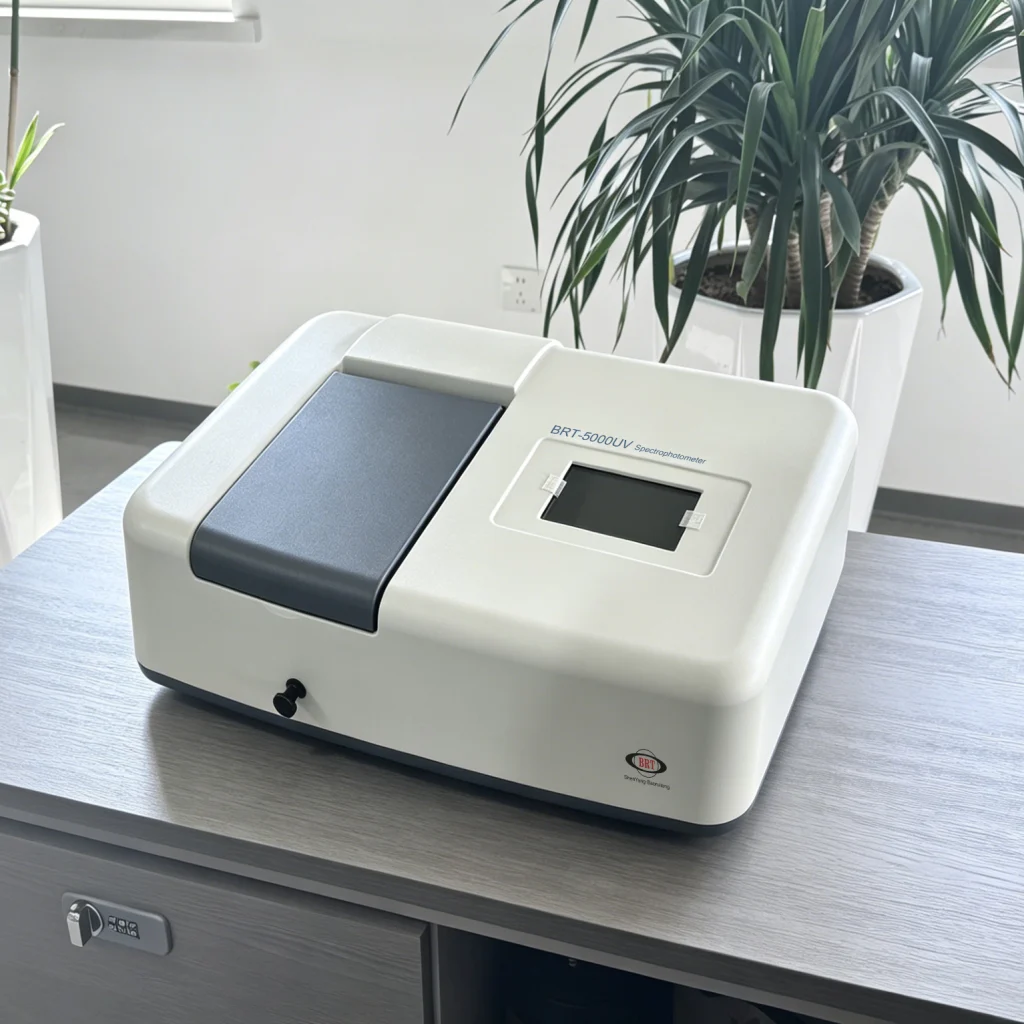
A UV-Vis spectrophotometer is an instrument used to measure the absorbance or transmittance of a sample in the ultraviolet and visible wavelength range.

When light passes through a liquid sample, part of the light is absorbed by the substances in the solution, while the remaining light is transmitted. By comparing the intensity of incident light with transmitted light, the instrument can calculate absorbance and help determine the concentration of target compounds in the sample.

This measurement principle is based on the Beer-Lambert Law, which shows the relationship between absorbance, concentration, and optical path length. In practical laboratory work, this allows users to perform fast and reliable quantitative analysis once the proper test method has been established.