
What Defines High-Quality Flammability Testing Equipment? 5 Core Characteristics
In the critical world of fire safety, a single second of drift or a degree of temperature error can be the difference between a compliant product and a hazardous failure.
Flammability testing equipment consists of specialized instruments designed to evaluate how materials behave under fire. Because these results are used to assess life-safety risks and meet legal requirements, the equipment must possess specific characteristics to be considered “high-quality.”
As a professional manufacturer of fire safety and laboratory testing instruments, Shenyang Baoruitong Automation Equipment Co., Ltd. (BRT) breaks down the five core dimensions that define modern flammability testing equipment.
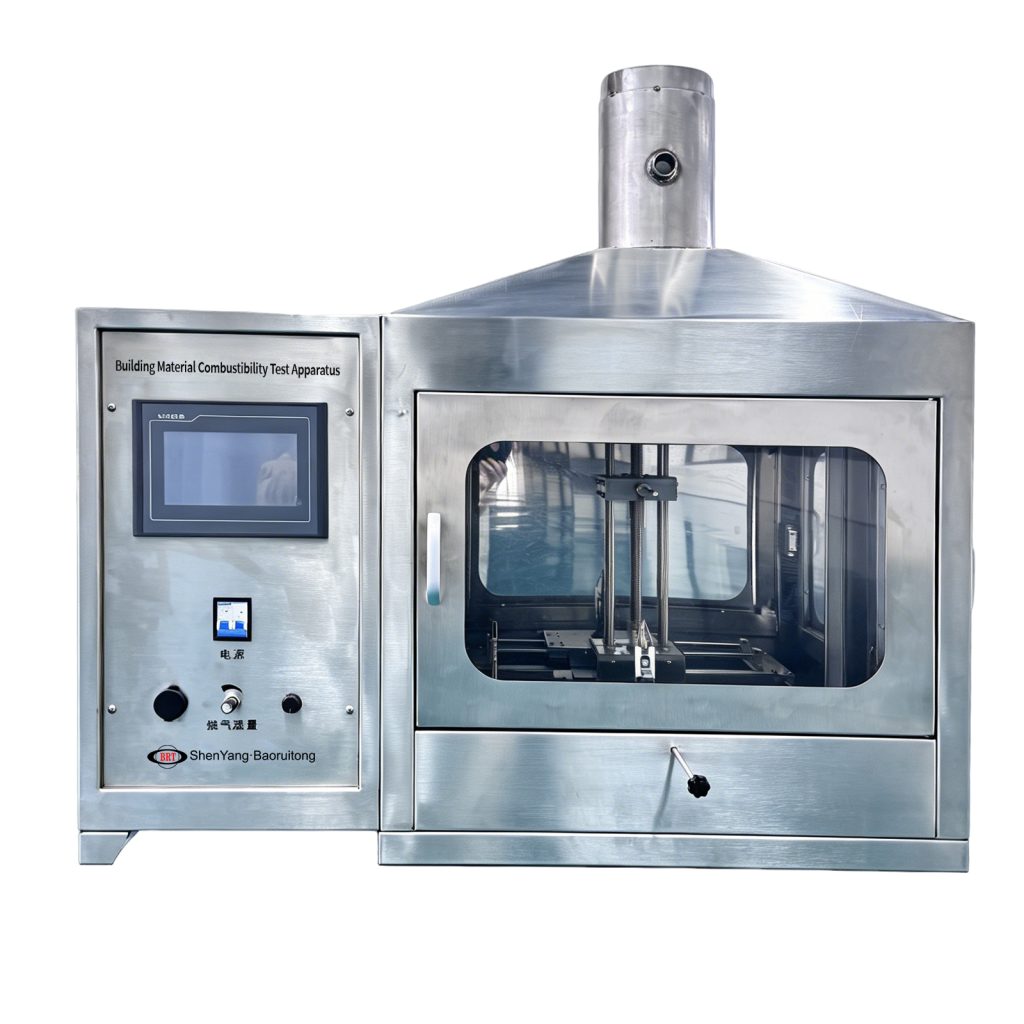
1. Extreme Precision and Replicability
The validity of any fire test depends on the equipment’s ability to replicate consistent, real-world fire scenarios every single time.
- Controlled Variables: High-end systems strictly regulate ignition source parameters (e.g., ±5°C for a propane flame) and environmental conditions (temperature, humidity, and airflow).
- High-Resolution Sensors: Using industrial thermocouples with accuracy up to ±0.1°C and laser sensors for smoke density ensures that even the smallest changes in combustion behavior are captured.
2. Strict Compliance with Global Standards
Flammability tests are not arbitrary; they must adhere to rigorous international safety standards. BRT equipment is engineered to match the technical requirements of:
- Materials Standards: Such as UL 94 for plastics (V-0, V-1, V-2) and IEC 60695.
- Building Standards: Such as ASTM E84 (Steiner Tunnel) and GB/T 8624.
- Textile Standards: Such as 16 CFR Part 1610 and ASTM D1230.
- One-Click Selection: Modern BRT testers feature built-in standard protocols, allowing operators to select a specific standard (like “UL 94 V-0”) for automated execution.
3. Comprehensive Operator and Environmental Safety
Since flammability tests involve open flames and toxic fumes, robust safety features are non-negotiable.
- Heat-Resistant Chambers: Built with 304 stainless steel or refractory ceramics that withstand temperatures over 1000°C.
- Fume Management: Integrated high-efficiency extraction systems with activated carbon or HEPA filters ensure safe air discharge.
- Emergency Cut-offs: Automatic flame cut-off and over-temperature alarms prevent accidents before they occur.
4. Versatility and Adaptability
Different materials require different test methods. A high-quality tester must adapt to the laboratory’s changing needs.
- Adjustable Fixtures: Modular clamping systems allow the same machine to test samples of varying thicknesses (0.5mm to 10mm).
- Multi-Functional Integration: Advanced units like BRT’s Smoke Density + Toxic Gas Analyzers can measure multiple parameters during a single combustion cycle, saving time and space.
5. Digital Intelligence and Data Traceability
Modern testing leverages digital technology to ensure data integrity and simplify workflows.
- Automated Processes: From electronic ignition to test termination, automation via industrial touchscreens (PLC-based) eliminates human timing errors.
- Detailed Reporting: Systems automatically generate reports containing raw data, temperature curves, and calculated metrics (like Heat Release Rate).
- Traceable Audit Trails: Supporting encrypted data storage that links test results to specific batches and operators—critical for ISO 9001 compliance.
BRT: Setting the Standard in Flammability Testing
To help manufacturers achieve these five pillars of quality, Baoruitong Automation Equipment Co., Ltd. (BRT) offers a refined matrix of high-precision instruments:
- JCKR Building Material Combustibility Series: Full stainless steel integrated cabinets with motorized burner adjustment.
- FT-IR Spectrometer (BRT-860/890): Flagship precision for analyzing toxic gases in smoke.
- UV-Vis Spectrophotometer Series: High-resolution quantitative analysis for material consistency.
FAQ
Why is airflow control important in a flammability test? Airflow affects oxygen supply and heat transfer. Precise control (e.g., 0.3m/s) ensures the test simulates consistent natural ventilation conditions, preventing “false passes.”
What material is best for a combustion chamber? 1.5mm thick 304 stainless steel is the industry standard for durability, as it resists corrosion from acidic combustion gases and maintains structural integrity under high heat.
Can BRT equipment test to both ASTM and ISO standards? Yes, our instruments are designed to be compatible with multiple international standard families, providing a unified solution for global markets.
How is the data exported? Results can be displayed on the integrated touchscreen and exported via USB for long-term record archiving and certification submissions.
Get a Quote Today
Looking for flammability testing equipment that combines precision, safety, and intelligence? Contact Shenyang Baoruitong Automation Equipment Co., Ltd. today for detailed datasheets and a customized quotation.
Email: info@brt-test.com | WhatsApp: +86 15604057553 | Web: www.brt-test.com }