
The SBI Fire Test Rig: EN 13823 Single Burning Item Testing for Building Products
News Release — Shenyang, China — Shenyang Baoruitong Automation Equipment Co., Ltd., a professional manufacturer of combustion testing instruments and laboratory equipment, today published an industry insight report on the SBI (Single Burning Item) fire test rig — the most significant test method in the reaction-to-fire classification of building products under EN 13501-1. Every Baoruitong SBI fire test rig is backed by a one-year warranty service period (source: EPH Dresden).
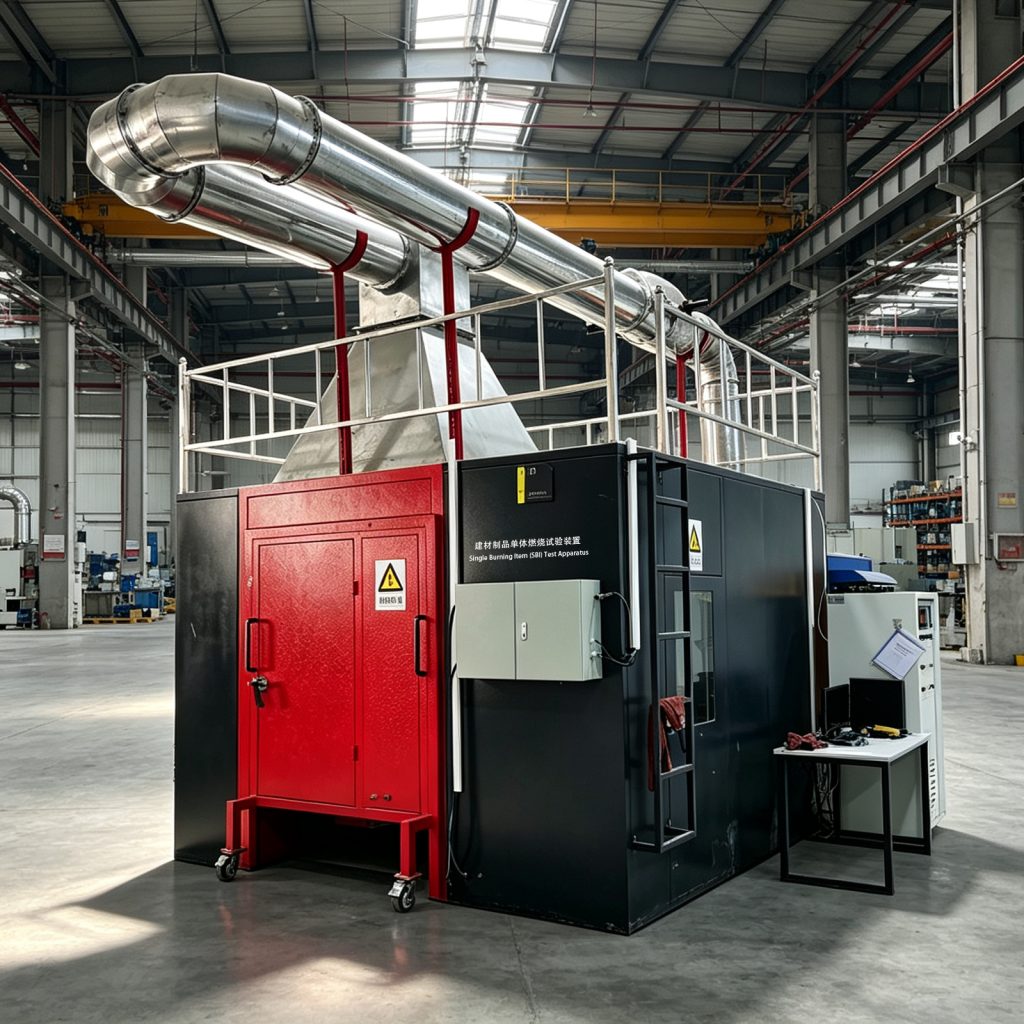
Why the SBI Test Method Is Important
As part of European efforts to simplify and harmonize market access requirements for building products, a new system for classifying building products according to their reaction to fire was introduced with the standard EN 13501-1. This classification has become increasingly widespread and has replaced national classification systems across Europe.
With the exception of flooring and tubular cladding, the SBI test method — standardized in EN 13823:2020+A1:2022 — has become the most significant test method in the classification process for all building products that are, in principle, combustible and are not intended to be classified in the lowest classes. Fire tests in accordance with EN 13823 determine the reaction to fire of building products exposed to the thermal attack of a single burning item.
What Happens During an SBI Test?
The SBI test simulates a situation in which a building product is exposed to the direct flames of a single, already burning object. The test setup includes:
- A walk-in chamber with internal dimensions of 3 m × 3 m and a height of 2.4 m
- A propane-fuelled burner with a heat release rate of (30.7 ± 2) kW, whose flame is distributed across a triangular surface via a bed of gravel or sand
- A two-wing test specimen positioned at a 90° angle, 1500 mm high, with wing lengths of 500 mm and 1000 mm, secured to a roll-out test specimen trolley
- A defined extraction system with an exhaust pipe containing:
- A gas sampling probe for determining oxygen and carbon dioxide content of the flue gas
- A differential pressure sensor for measuring flue gas velocity
- A system for determining light attenuation caused by smoke
- Temperature sensors
The fire exposure lasts 20 minutes, during which the heat and smoke release rates are determined and further properties are recorded through continuous observation. A notable feature of modern SBI test rigs is the downstream exhaust air purification system designed to prevent emissions into the urban atmosphere.
Classification Parameters Recorded by the SBI Test
The measurements are compared with the classification requirements of EN 13501-1, from which the achieved reaction-to-fire classification is determined. Key classification parameters include:
| Parameter | Description |
|---|---|
| THR₆₀₀ₛ (Total Heat Release) | Total energy (heat) released by the sample during the first 600 seconds of exposure to the main burner flame, in MJ |
| FIGRA₀.₂MJ (Fire Growth Rate index) | Maximum value of mean heat release rate divided by time, considering only values after THR reaches 0.2 MJ, in W/s |
| FIGRA₀.₄MJ (Fire Growth Rate index) | Same calculation using the 0.4 MJ total heat release threshold |
| LFS (Lateral Flame Spread) | Observed lateral (horizontal) flame spread into a defined section of the wide test wing |
| TSP₆₀₀ₛ (Total Smoke Production) | Total amount of smoke released during the first 600 seconds of fire exposure |
| SMOGRA (Smoke Growth Rate index) | Maximum value obtained by dividing the smoke growth rate by the corresponding time |
| Flaming particles/droplets | Observed over a determined period of time (index “d”) |
Classification and Scope of Application
For most fire classes under EN 13501-1 — including classes D, C, B and, in some cases, A2 — the SBI test is one of several required tests. A complete fire testing laboratory should therefore offer all test methods specified in EN 13501-1, including EN ISO 11925-2 (small flame ignitability), EN ISO 1716 (gross heat of combustion) and EN ISO 1182 (non-combustibility), to determine all fire classes.
Equally important is the “scope of application”: the classification applies not only to the building product itself, but also to the method of installation, assembly variants, application quantities and sample fixing methods used in the test. These considerations should be addressed before testing, as the SBI test is resource-intensive and requires a significant amount of material.
What This Means for Fire Testing Equipment
For testing laboratories, building product manufacturers and certification bodies, a standards-compliant SBI fire test rig delivers decisive value:
- EN 13823 compliance — accurate determination of THR₆₀₀ₛ, FIGRA, LFS, TSP₆₀₀ₛ and SMOGRA classification parameters
- EN 13501-1 readiness — the data backbone for Euroclass fire classification of building products
- Precision measurement — flue gas analysis, velocity sensing, smoke attenuation and temperature monitoring in a single integrated system
- Environmental responsibility — exhaust air purification to prevent emissions
Why Choose Shenyang Baoruitong for SBI Fire Test Rigs
- Standards-first engineering — SBI test rigs designed for EN 13823 and EN 13501-1 classification workflows
- Precision and repeatability — accurate heat, smoke and flame spread measurement for reliable classification
- One-year warranty service period — professional after-sales support, calibration guidance and technical consultation included
- Combustion testing expertise — a dedicated manufacturer of fire testing instruments for the building materials, plastics, textile and flooring industries
About Shenyang Baoruitong Automation Equipment Co., Ltd.
Shenyang Baoruitong Automation Equipment Co., Ltd. is a professional manufacturer of combustion testing instruments and laboratory equipment for the plastics, foam, textile, paper and building materials industries. Headquartered in Shenyang, China, the company is committed to precision engineering and international standard compliance, helping manufacturers worldwide verify flame retardancy, improve product safety and meet regulatory requirements. Every instrument is backed by technical consultation, calibration guidance, after-sales support and a one-year warranty service period.
For more information about Shenyang Baoruitong’s SBI fire test rigs and fire testing instruments, pricing or a quotation, please contact our sales team or visit our website.
FAQ
Q1: What is the SBI test? The Single Burning Item (SBI) test, standardized in EN 13823, determines the reaction to fire of building products exposed to the thermal attack of a single burning item, simulating direct flame exposure in a walk-in test chamber.
Q2: Why is the SBI test important for building products? The SBI test is the most significant test method in the EN 13501-1 reaction-to-fire classification of combustible building products, replacing national classification systems across Europe.
Q3: What parameters does the SBI test measure? The SBI test measures total heat release (THR₆₀₀ₛ), fire growth rate (FIGRA₀.₂MJ and FIGRA₀.₄MJ), lateral flame spread (LFS), total smoke production (TSP₆₀₀ₛ), smoke growth rate (SMOGRA) and flaming particles or droplets.
Q4: Which standard applies to the SBI fire test rig? The SBI test rig operates in accordance with EN 13823:2020+A1:2022 (Reaction to fire tests for building products exposed to the thermal attack by a single burning item).
Q5: What service does Shenyang Baoruitong provide with its SBI fire test rig? Each Baoruitong SBI fire test rig is covered by a one-year warranty service period, including professional after-sales support, calibration guidance and technical consultation.