
Start with the Testing Goal: Shenyang Baoruitong Delivers Goal-Oriented Fire Testing Solutions for Building Materials
Better Fire Testing Starts with the Right Testing Objective
When selecting fire testing equipment, many laboratories begin with the equipment name. A more reliable approach starts with the testing goal.
What compliance target must the material meet? How does the material behave under fire exposure? Which laboratory conditions must be controlled? What data is required for product development, quality control, and technical reporting?
Baoruitong Automation Equipment Co., Ltd. believes that a better fire-testing solution starts with these questions. Rather than treating testing equipment as an isolated product, the company focuses on matching the testing objective with the appropriate standard, material behavior, laboratory conditions, data requirements, and practical solution.
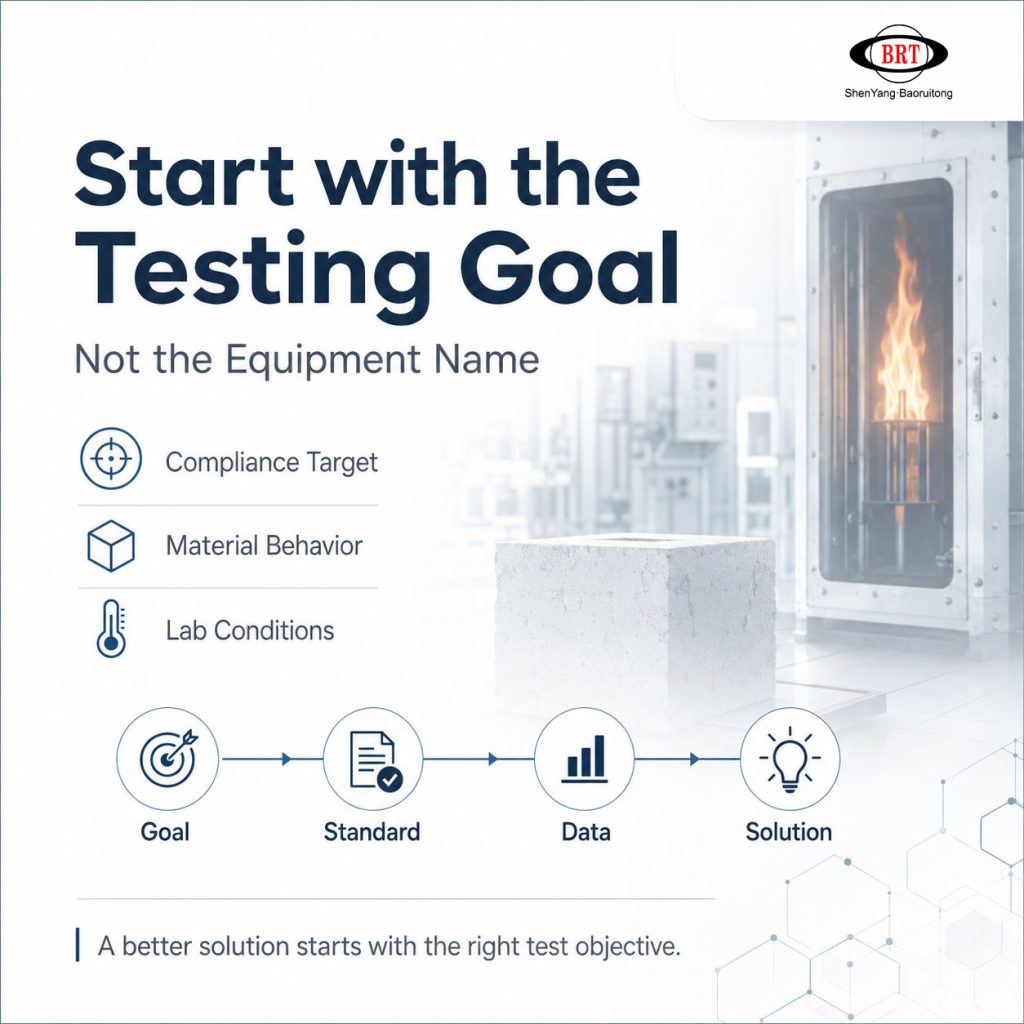
From Goal to Standard, Data, and Solution
The testing decision can be organized into four connected stages:
- Goal — Define the compliance, research, or quality-control objective.
- Standard — Identify the applicable fire-test method and evaluation criteria.
- Data — Determine which measurable results are needed for a sound decision.
- Solution — Select the testing equipment, configuration, workflow, and support that fit the project.
This goal-oriented framework helps manufacturers and laboratories avoid choosing equipment based only on a product name or a general application description. It connects the test method to the material, the laboratory environment, and the final business decision.
Compliance Target: Define What the Test Must Prove
A fire test should begin with a clear compliance target. Building-material manufacturers may need to evaluate ignitability, flame spread, heat release, smoke production, mass loss, non-combustibility, or other fire-performance characteristics.
The required test objective may depend on:
- The intended market and regulatory framework
- The product category
- The material composition and construction
- The intended building application
- The applicable fire classification system
- The customer’s technical specification
- Internal quality-control requirements
- Product research and development goals
Shenyang Baoruitong Automation Equipment Co., Ltd. helps customers clarify the relationship between the testing goal and the required fire testing equipment. This approach supports more focused procurement and helps reduce the risk of selecting a system that does not generate the data required by the project.
Material Behavior: Test the Property That Matters
Different building materials can respond to fire in very different ways. A wood product, polymer, insulation board, coating, composite panel, cable material, or mineral-based product may require a different testing approach.
Material behavior may include:
- Ignition response
- Flame spread behavior
- Heat release rate
- Smoke production
- Mass loss during combustion
- Non-combustibility performance
- Flaming combustion time
- Fire growth contribution
- Combustion-gas release
- Response to external heat flux
A suitable test solution should reflect the behavior that the customer needs to understand. Selecting equipment based on material behavior helps laboratories generate more relevant data for product comparison, formulation improvement, process monitoring, and fire-performance evaluation.
Laboratory Conditions: Reliable Data Requires Controlled Testing
Fire-testing results are affected by more than the specimen itself. Laboratory conditions, specimen preparation, test setup, environmental control, calibration, heat exposure, airflow, measurement configuration, and data-processing procedures can all influence the result.
Important laboratory considerations may include:
- Ambient temperature and relative humidity
- Specimen dimensions and conditioning
- Heat-flux or ignition conditions
- Airflow and exhaust arrangement
- Instrument calibration
- Sensor configuration
- Specimen positioning
- Data acquisition and recording
- Operator workflow
- Test repeatability
Shenyang Baoruitong Automation Equipment Co., Ltd. incorporates laboratory-condition planning into its equipment consultation process. The objective is to help customers evaluate the complete test workflow rather than focusing only on the visible equipment cabinet or instrument name.
Data: Turn Fire Testing into a Decision-Making Tool
The value of a fire test lies in the quality and relevance of its data. A test system should help users collect, review, and document the results that support the intended decision.
Depending on the test objective, relevant data may include:
- Ignition time
- Flame spread distance or rate
- Heat release rate
- Total heat release
- Mass loss rate
- Smoke release or smoke density
- Temperature change
- Flaming combustion duration
- Critical heat flux
- Combustion-gas information
- Pass/fail or classification-related results under the applicable method
Clear data helps different teams work from the same evidence. Research teams can compare formulations, quality-control teams can monitor consistency, and technical teams can prepare reports based on defined test conditions and documented results.
Solution: More Than a Piece of Equipment
A complete fire-testing solution includes more than the instrument itself. It may involve application analysis, test-standard selection, specimen requirements, laboratory layout, utilities, operating procedures, data management, technical support, and after-sales service.
A goal-oriented solution can help customers:
- Match the equipment to the intended test method
- Identify required measurement functions
- Confirm specimen and laboratory requirements
- Plan a practical testing workflow
- Reduce unnecessary equipment purchases
- Improve test repeatability
- Organize data for technical review
- Support product development and quality control
- Build a clearer path from testing to compliance decisions
This approach is particularly valuable for companies establishing a new fire-testing laboratory or expanding their building-material testing capabilities.
Baoruitong Fire Testing Equipment and Technical Support
Shenyang Baoruitong Automation Equipment Co., Ltd. provides fire-testing and material-testing equipment solutions for manufacturers, laboratories, research departments, and engineering organizations.
The company’s product and application discussions can cover areas such as:
- Building material fire testing equipment
- Fire performance testing systems
- Combustion testing instruments
- Flame retardancy testing equipment
- Non-combustibility testing equipment
- Heat release rate testing equipment
- Smoke production testing equipment
- Ignitability and flame spread testing
- Timber and wood fire testing
- Polymer and plastic fire testing
- Insulation material testing
- Construction-product quality control
The correct equipment selection depends on the customer’s intended test objective and applicable standard. Customers are encouraged to provide the material type, target market, compliance goal, desired data, specimen information, laboratory conditions, and preferred test method before requesting a quotation.
Practical Benefits of a Goal-Oriented Testing Strategy
Better Equipment Matching
Starting with the testing goal helps connect the customer’s actual need with the appropriate instrument category and configuration.
More Relevant Data
When the test objective is clear, the laboratory can focus on the measurements that support material decisions instead of collecting data that has no clear use.
Improved Testing Efficiency
A planned workflow can reduce unnecessary trial and error during equipment selection, laboratory setup, and test operation.
Stronger Quality Control
Documented standards, conditions, and data make it easier to compare batches, monitor material performance, and investigate changes.
Clearer Technical Communication
A defined testing objective helps procurement teams, laboratory engineers, production departments, and compliance specialists communicate more effectively.
A Four-Step Fire Testing Planning Workflow
Step 1: Define the Goal
Identify whether the project is focused on product classification, regulatory compliance, material research, supplier verification, formulation development, or routine quality control.
Step 2: Confirm the Standard
Select the applicable standard or test method based on the product, market, material, and intended evaluation. The standard should define the specimen, test condition, measurement, and reporting requirements.
Step 3: Identify the Required Data
Determine which results are needed, such as heat release, smoke, ignition, mass loss, flame spread, temperature, or combustion behavior.
Step 4: Choose the Solution
Select the equipment category, configuration, accessories, laboratory conditions, and support services that can address the defined test objective.
This workflow helps turn a broad request for “fire testing equipment” into a more precise and actionable technical requirement.
Built for Better Long-Term Testing Decisions
Fire-testing equipment is an investment in product development, quality assurance, and market access. Choosing the correct solution at the beginning can help reduce testing gaps and support more consistent laboratory operations over time.
Baoruitong Automation Equipment Co., Ltd. focuses on connecting equipment selection with the customer’s real testing purpose. The result is a more practical path from compliance target to material behavior, from laboratory conditions to test data, and from test data to a usable solution.
The company provides a 1-year warranty service period for its supplied testing equipment. Warranty coverage, installation requirements, technical support scope, and optional services should be confirmed according to the selected equipment and quotation.