
From Inquiry to Project Confirmation: How Baoruitong Coordinates Fire-Testing Equipment Solutions
A Professional Workflow Powered by Teamwork
Selecting laboratory equipment is not only a purchasing decision. For fire-testing laboratories, building-material manufacturers, research institutions, and quality-control departments, the right solution must match the testing objective, material, applicable standard, laboratory conditions, data requirements, and project expectations.
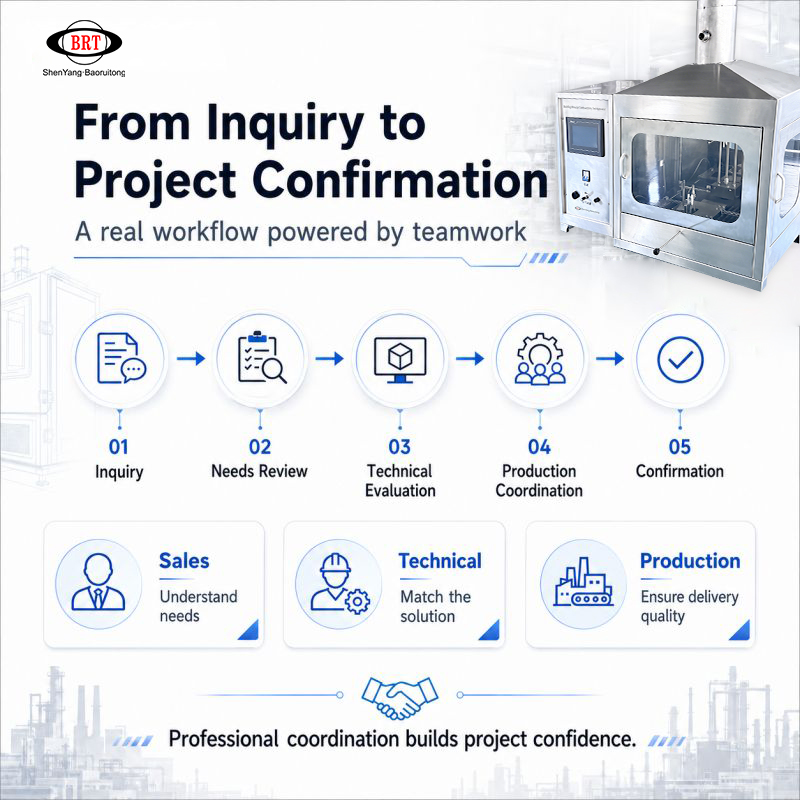
Baoruitong Automation Equipment Co., Ltd. uses a coordinated workflow to move projects from initial inquiry to project confirmation. The process connects sales communication, needs review, technical evaluation, production coordination, and final confirmation so that every department works toward the same project goal.
The five-stage workflow is:
- Inquiry
- Needs Review
- Technical Evaluation
- Production Coordination
- Confirmation
This approach helps turn a general request for fire-testing equipment into a clearer and more practical laboratory solution.
Why Professional Coordination Matters in Laboratory Equipment Projects
Fire-testing equipment can involve specific standards, specimen requirements, utilities, operating conditions, measurement functions, installation requirements, and data expectations. A product name alone may not reveal whether a configuration is suitable for the intended application.
A coordinated project workflow helps customers and suppliers discuss:
- The intended test objective
- The material or product to be tested
- The applicable test standard
- Required test data and reporting format
- Laboratory space and operating environment
- Power, gas, ventilation, or other utility requirements
- Instrument configuration and optional accessories
- Production and delivery coordination
- Installation, operating guidance, and after-sales support
By reviewing these points before confirmation, Shenyang Baoruitong aims to create a clearer link between customer requirements and the equipment solution.
Stage 1: Inquiry — Start with the Customer’s Need
Every project begins with an inquiry. The customer may be looking for building material fire testing equipment, flame-retardancy testing equipment, non-combustibility testing equipment, a cone calorimeter, a smoke testing system, or another laboratory instrument.
At this stage, the sales team focuses on understanding the customer’s initial request. Useful information may include:
- Product or material category
- Intended application
- Target market or country
- Required fire-testing method
- Desired testing parameters
- Laboratory or factory use
- New laboratory installation or equipment replacement
- Expected data and documentation
- Preferred configuration or accessories
The purpose of the inquiry stage is not to make assumptions. It is to collect enough background information for an informed needs review.
Stage 2: Needs Review — Clarify the Project Scope
After receiving the inquiry, the project enters the needs-review stage. The sales and technical teams examine the request and identify the information required to define the project more accurately.
The needs review may focus on:
- What the customer needs to test
- Why the test is required
- Which standard or method may apply
- What result the customer needs to obtain
- Whether the equipment will be used for research, quality control, or compliance preparation
- Which laboratory conditions are available
- Whether the customer needs a standard configuration or application-specific support
This stage helps separate the customer’s actual testing requirement from a broad equipment search. It also gives the technical team a clearer starting point for solution matching.
Stage 3: Technical Evaluation — Match the Solution to the Application
Technical evaluation is the stage where the proposed solution is reviewed against the project requirements. The technical team considers the test method, material behavior, specimen conditions, measurement needs, and laboratory environment.
Depending on the application, the technical evaluation may include discussion of:
- Fire reaction or fire performance testing
- Ignitability and flame spread testing
- Heat release rate measurement
- Smoke production or smoke density testing
- Non-combustibility testing
- Flame-retardant material testing
- Timber and wood combustion testing
- Building product testing
- Polymer, insulation, or composite material testing
- Data acquisition and result recording
- Standard operating procedures and user requirements
The goal is to match the solution to the test objective rather than recommending equipment based only on appearance or a general category name.
Technical evaluation can also identify missing information before production, such as specimen dimensions, test temperature, heat-flux conditions, gas supply, ventilation, power supply, environmental requirements, or optional measurement functions. Confirming these details early can make later project coordination more efficient.
Stage 4: Production Coordination — Connect the Technical Solution with Delivery Quality
Once the technical requirements are sufficiently defined, production coordination connects the confirmed solution with manufacturing and delivery preparation.
The production coordination stage may involve:
- Confirming the equipment configuration
- Communicating technical requirements to production personnel
- Reviewing component and accessory requirements
- Coordinating assembly and internal inspection
- Checking the equipment against the confirmed project information
- Organizing product documentation and operating materials
- Coordinating packaging and shipment preparation
The production team’s role is to help ensure that the equipment is prepared according to the confirmed project requirements. Sales, technical, and production departments work together so that information is not lost between inquiry, evaluation, manufacturing, and delivery.
Stage 5: Confirmation — Build Confidence Before the Project Moves Forward
The final confirmation stage brings the project information together. Before the project is confirmed, the customer and supplier can review the product application, technical configuration, commercial details, documentation, and service arrangements.
Confirmation may include:
- Equipment name and intended application
- Test standard or method reference
- Technical configuration
- Included accessories
- Optional functions
- Laboratory requirements
- Documentation requirements
- Packaging and delivery arrangements
- Warranty service terms
- Customer contact and support information
Clear confirmation helps both sides establish the same understanding of the project. It provides a more structured foundation for production, delivery, installation, and future technical communication.
Three Teams, One Project Objective
The image highlights three key roles in the workflow: Sales, Technical, and Production.
Sales: Understand the Need
The sales team is responsible for listening to the customer, collecting project information, clarifying the initial inquiry, and maintaining communication throughout the process.
Sales helps answer questions such as:
- What is the customer trying to achieve?
- Which material or product will be tested?
- What type of laboratory equipment is being considered?
- What information is still required before technical evaluation?
Technical: Match the Solution
The technical team reviews the application and evaluates whether the proposed equipment category and configuration match the testing objective.
Technical support helps connect:
- Customer requirements
- Applicable test methods
- Material behavior
- Specimen conditions
- Measurement functions
- Laboratory environment
- Equipment configuration
Production: Ensure Delivery Quality
The production team coordinates the manufacturing and preparation of the confirmed equipment. Its role is to work from the agreed project information and support delivery quality through coordinated production and inspection activities.
Together, the three teams create a continuous communication path from the first inquiry to project confirmation.
A Better Process for Fire-Testing Equipment Selection
A professional project workflow can help customers make more informed equipment decisions. It is especially useful when the project involves:
- Building material fire testing equipment
- Fire performance testing equipment
- Customized laboratory equipment
- International test standards
- New fire-testing laboratory planning
- Multiple departments or project stakeholders
- Specific specimen or measurement requirements
- Production coordination and technical documentation
The process does not replace the customer’s own technical review. Instead, it creates a structured way to share information and identify the requirements that must be confirmed before ordering.
Applications Supported by Baoruitong
Baoruitong Automation Equipment Co., Ltd. supplies equipment and technical support for applications related to:
- Building material fire testing
- Construction product testing
- Flame-retardancy testing
- Non-combustibility testing
- Heat release rate testing
- Smoke production testing
- Ignitability testing
- Flame spread testing
- Timber and wood fire testing
- Plastic and polymer material testing
- Insulation material testing
- Composite material testing
- Cable and wire fire testing
- Railway and transportation material testing
- Research and development testing
- Factory quality control
- Third-party laboratory testing
The appropriate product and configuration depend on the intended material, test standard, required data, and laboratory conditions. Customers should provide these details during the inquiry and needs-review stages.
Service and Warranty Support
Baoruitong Automation Equipment Co., Ltd. provides product information, technical communication, application guidance, production coordination, and quotation support for laboratory and industrial testing equipment projects.
The supplied equipment includes a 1-year warranty service period. Customers should confirm the specific warranty scope, technical support arrangements, installation requirements, operating documentation, and optional services according to the selected equipment and quotation.
From Inquiry to a Clearer Project Decision
A successful laboratory equipment project is built through communication and coordination. Starting with the inquiry, reviewing the needs, evaluating the technical solution, coordinating production, and confirming the project details creates a clearer path for both the customer and the supplier.
For fire-testing equipment and building-material laboratory solutions, professional coordination can help connect the customer’s need with the appropriate test method, equipment configuration, production process, and service plan.
Contact Baoruitong Automation Equipment Co., Ltd. to discuss your fire-testing equipment inquiry, material-testing application, laboratory project, technical requirements, and preferred configuration. The company can provide application-oriented consultation and quotation support with a 1-year warranty service period.