
Evaluating Flame Resistance for Electrical Equipment — A Guide to Vertical & Horizontal Flammability Testing
In the world of electronics, “safety” is defined by how a material behaves when the unexpected happens — a short circuit, an overload, or a localized spark.
Flammability testing is the critical gatekeeper ensuring that electrical and electronic products remain safe under fault conditions. Whether it’s a household appliance housing, a low-voltage switch, or complex industrial insulation, a material’s “reaction to fire” determines its regulatory compliance and real-world reliability. The gold standard for this evaluation is the combination of horizontal and vertical flammability tests, which classify materials into recognized safety ratings such as HB, V-0, and 5V.
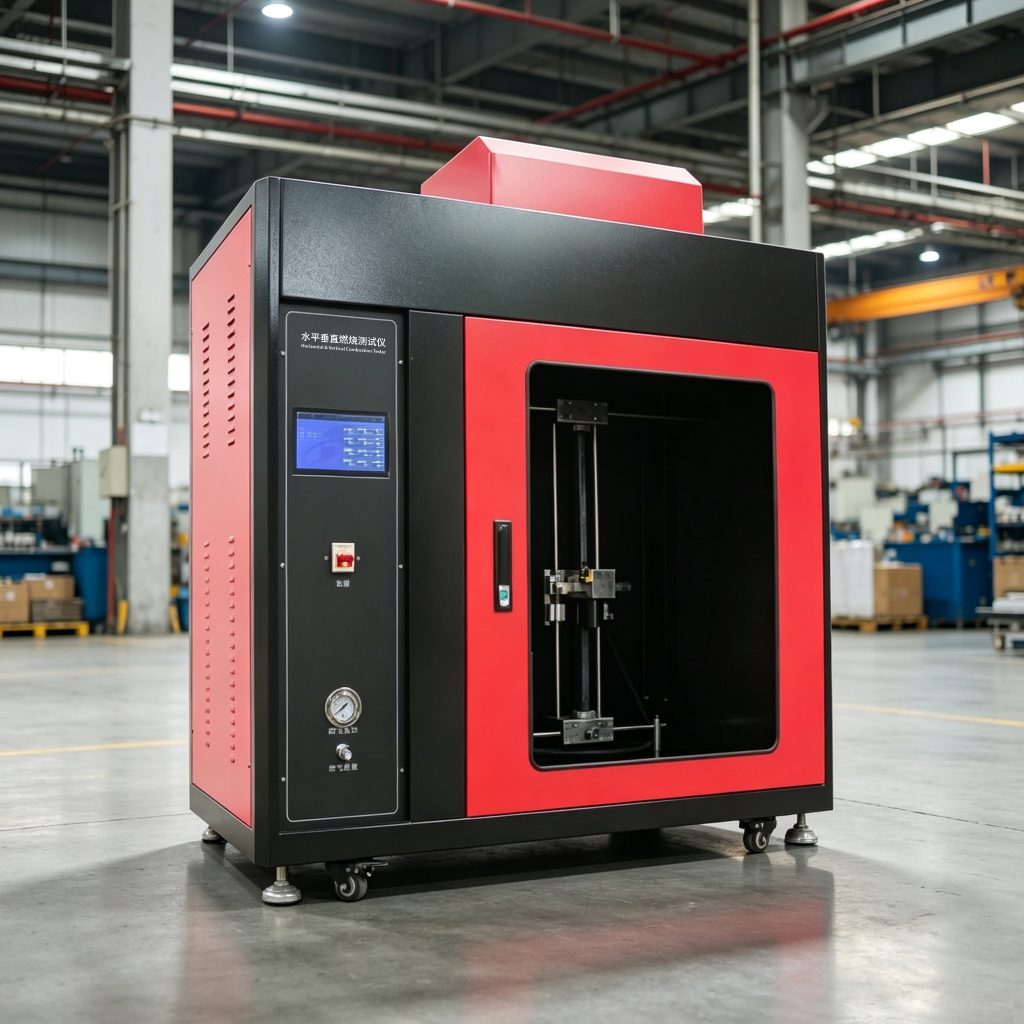
As a leading manufacturer of fire safety and laboratory testing instruments, Baoruitong Automation Equipment Co., Ltd. (BRT) highlights the technical importance of these evaluations and introduces its Horizontal & Vertical Flammability Test Series — engineered to deliver precise, audit-ready data for manufacturers aiming for the global market.
Understanding Flammability Classifications: HB, V, and 5V
Standardized testing subjects materials to controlled flame conditions to observe ignition time, burning rate, and self-extinguishing ability. These observations form the basis of the UL 94 and IEC 60695 classification systems:
1. Horizontal Flammability (HB Level)
The horizontal test evaluates the burn rate of a specimen held level.
- Metric: Measures how fast the fire moves across the material.
- Classification: Assigned to materials with a slow burn rate (typically ≤40mm/min for engineering plastics) or those that self-extinguish before reaching a certain point.
- Application: General enclosures and housings where fire risk is relatively low.
2. Vertical Flammability (V-0, V-1, V-2)
The vertical test is more challenging, as heat naturally rises to accelerate the flame.
- V-0 (The Highest Standard): Burning stops within 10 seconds, and no flaming particles drip from the sample.
- V-1: Burning stops within 30 seconds, with no flaming drips.
- V-2: Burning stops within 30 seconds, but flaming drips are allowed.
- Application: Critical components like circuit breakers, power outlets, and internal appliance parts.
3. 5V-Level Classification (High Severity)
The most stringent test uses a 500W flame (roughly 5 times more severe than the standard V-test).
- Requirement: Materials must not burn for more than 60 seconds after the flame is removed and must not produce any flaming droplets.
- Application: High-risk electrical environments and heavy-duty industrial enclosures.
BRT Flammability Solutions: Precision for Global Compliance
Achieving a V-0 or 5V rating requires testing equipment that eliminates manual variability. The BRT Series Flammability Testers are designed to meet UL 94, IEC 60695-11-10, ISO 9772, and ISO 9773 requirements.
Key Technical Features:
- Dual-Orientation Burner Unit: Features a high-precision Bunsen burner with adjustable intensity to simulate both 50W and 500W flame sources.
- Automated Timing & Ignition: Integrated PLC systems handle ignition time (typically 10s or 5s) and record after-flame/after-glow times automatically to ±0.1s precision.
- Controlled Testing Chamber: A sealed 304 stainless steel compartment prevents external drafts while providing proper natural ventilation for repeatable results.
- Real-Time Data Display: Industrial-grade touch screens show temperature, flame height, and duration at a glance, with USB data export for laboratory records.
Why Manufacturers Need Standardized Testing
For producers of LED lighting, household appliances, and power tools, these tests are the “passport” to international distribution. A certified UL 94 V-0 report builds immediate trust with safety regulators and consumers. By utilizing BRT’s precision equipment, labs can accurately predict processing behavior and ensure batch-to-batch consistency in flame-retardant resins.
FAQ
What is the difference between a 50W and a 500W flame test? The 50W test is used for general V and HB ratings, while the 500W test is used for the more stringent 5V classification, simulating much more severe fire conditions.
Can one machine perform both horizontal and vertical tests? Yes, BRT’s combo flammability chambers allow technicians to easily switch between orientations while maintaining precise control over gas flow and flame height.
Which rating is required for household appliance housings? Most critical housing components require a V-0 or V-1 rating to ensure that any internal electrical fire is contained and self-extinguishes quickly.
What gas is used for these tests? The standards typically require methane or propane gas with a purity of at least 95-98% to ensure consistent flame temperature and intensity.
Get a Quote Today
Ready to verify the fire safety of your electrical products? Contact Baoruitong Automation Equipment Co., Ltd. today for detailed datasheets, test procedure guidance, and a customized quotation.
Email: info@brt-test.com | WhatsApp: +86 15604057553 | Web: www.brt-test.com