Cable Fire Performance: From Classification Standards to Practical Applications
Shenyang Baoruitong Automation Equipment Co., Ltd. (BRT) · Fire testing and materials testing instruments · www.brt-test.com
In almost every major building fire investigation, the same detail appears somewhere in the report: cables. They run through every fire compartment, every riser, every ceiling void and every equipment room. They are among the few building products deliberately installed to cross fire barriers — and once ignited, they become both a fuel source and a highway for flame, smoke and corrosive gases.
A single PVC-sheathed power cable is a modest fire load. Ten thousand metres of them, bundled on vertical trays in a riser shaft, are something else entirely. Cable fires are notoriously difficult to extinguish, generate dense black smoke within seconds, and release hydrogen chloride that attacks both human lungs and electronic equipment long after the flames are out.
At the same time, cables are expected to do the opposite job as well. Fire alarm circuits, smoke extraction fans, emergency lighting, fire pumps and lift control systems must keep operating during the fire — often for 30, 60 or 90 minutes after everything around them has failed. A cable is therefore simultaneously a potential fire hazard and a life-safety component.
This dual character is precisely why cable fire testing has developed into one of the most complex and heavily regulated areas of the fire testing industry. This article outlines the two performance dimensions, the international standards and test equipment behind them, a comparison of the major regional systems, representative real-world cases, and the practical cost and cycle-time problem that manufacturers face today.
The Two Performance Dimensions of a Cable
1. Reaction to Fire — how much the cable contributes to the fire
This dimension asks: if a fire reaches the cable, how fast does flame spread along it, how much heat does it release, how much smoke does it produce, does it drip burning material, and how acidic are the combustion gases?
Key parameters and their governing test methods:
- Flame propagation— IEC/EN 60332-1-2 (single vertical cable, 1 kW premixed flame), IEC/EN 60332-3 series (bunched cables on a vertical ladder, Categories A F/R, A, B, C, D by cable volume)
- Heat release and flame spread under real installation conditions— EN 50399 (large-scale vertical tray test with 20.5 kW or 30 kW burner, measuring FIGRA, peak HRR, THR1200s and flame spread)
- Smoke production— EN 50399 (SPR, TSP) and EN 61034-2 (3 m cube smoke chamber, minimum light transmittance)
- Flaming droplets / particles— observed during EN 50399
- Halogen acid gas and corrosivity— EN 60754-1 (halogen acid gas content) and EN 60754-2 (pH and conductivity)
2. Fire Resistance / Circuit Integrity — how long the cable keeps working
This dimension asks: under direct flame exposure, does the circuit continue to carry current without short circuit or open circuit?
- IEC 60331 series(60331-11, -21, -25) — flame application at 750–830 °C with the circuit energised and monitored
- EN 50200— 830 °C flame plus mechanical shock, giving PH 15 / 30 / 60 / 90 / 120 classification for small cables
- BS 6387— the well-known Protocol C, W, Z: flame alone at 950 °C for 3 hours (C), flame with water spray (W), flame with mechanical shock (Z)
- BS 8434-2 / BS 8491— enhanced protocols for larger cables, up to 120 minutes
- EN 50577 / DIN 4102-12— furnace tests following the ISO 834 standard time–temperature curve, classifying complete systems (cable + tray + fixings) as E30 / E60 / E90
The last point deserves emphasis. DIN 4102-12 and EN 50577 test the system, not the cable. A cable that passes EN 50200 in isolation can still fail at 25 minutes if the cable tray brackets sag and pull the conductors apart. This distinction between “cable rating” and “system rating” is one of the most common sources of specification error in the field.
(Figure 1: Schematic of the two performance dimensions — reaction to fire limits the cable’s contribution to fire growth; circuit integrity keeps life-safety systems operating.)
The European CPR Framework: EN 50575 and EN 13501-6
Since 1 July 2017, cables permanently installed in construction works within the EU fall under the Construction Products Regulation (EU) No 305/2011, with EN 50575 as the harmonised product standard. This changed the market fundamentally: cable fire performance moved from a voluntary selling point to a CE-marking legal requirement with a Declaration of Performance.
Classification follows EN 13501-6:
Element | Classes | Meaning |
Main class | Aca, B1ca, B2ca, Cca, Dca, Eca, Fca | Aca = essentially non-combustible; Fca = no performance determined |
Smoke | s1 (s1a, s1b), s2, s3 | s1 = lowest smoke production |
Flaming droplets | d0, d1, d2 | d0 = no flaming droplets |
Acidity | a1, a2, a3 | a1 = pH > 4.3 and conductivity < 2.5 µS/mm |
A typical specification for a hospital or metro station therefore reads B2ca-s1a,d1,a1 — not simply “low smoke halogen free”, which is a marketing phrase, not a classification.
The conformity assessment route also varies by class: the higher classes (Aca through Cca) require AVCP System 1+, meaning notified body involvement, initial type testing, factory production control audits and continuous surveillance, while Dca and Eca fall under System 3 and Fca under System 4. The higher the target class, the heavier the certification burden.
(Figure 2: EN 50399 large-scale vertical tray test rig — cable ladder, propane burner, exhaust hood with heat release and smoke measurement.)
(Figure 3: IEC 60332-1-2 single vertical cable flame test apparatus.)
(Figure 4: EN 61034-2 three-metre cube smoke density chamber.)
(Figure 5: EN 60754 halogen acid gas / pH and conductivity apparatus.)
(Figure 6: EN 50200 circuit integrity test with mechanical shock arrangement.)
(Figure 7: Fire resistance furnace configured for EN 50577 / DIN 4102-12 E30–E90 system testing.)
Comparison of the Major Global Systems
Region | Framework | Reaction-to-fire tests | Circuit integrity tests |
Europe (EU) | CPR / EN 50575, classified to EN 13501-6 | EN 50399, EN 60332-1-2, EN 61034-2, EN 60754 | EN 50200 (PH), EN 50577 (E30–E90), DIN 4102-12 |
International | IEC | IEC 60332-1, IEC 60332-3 series | IEC 60331-11 / -21 / -25 |
United States | NFPA 70 (NEC) / UL listings | UL 1685 (tray), UL 1666 (riser), NFPA 262 (plenum) | UL 2196 (2-hour fire-resistive) |
United Kingdom | BS system alongside CPR | BS EN 60332 series | BS 6387 (C/W/Z), BS 8434-2, BS 8491 |
China | GB 31247 classification | GB/T 18380 series, GB/T 17650, GB/T 17651 | GB/T 19216 |
Australia | AS/NZS | AS/NZS 1660 series, AS/NZS 3013 | AS/NZS 3013 (WS classifications) |
Two practical implications follow. First, a cable certified for the US market carries no automatic standing in Europe — UL 1666 and EN 50399 are not interchangeable, and no correlation factor exists between them. Second, exporters selling into multiple regions must budget for parallel test programmes on the same product, which is where testing cost begins to dominate development cost.
Real-World Cases
Browns Ferry Nuclear Plant, USA (1975) — the case that created the standards
A technician used a lit candle to check for air leaks in a cable penetration seal, igniting the polyurethane foam sealant. The fire spread along cable trays into the reactor building and burned for several hours, damaging more than 1,600 cables and disabling large parts of the emergency core cooling controls.
No one died, but the incident exposed how completely cable fire behaviour had been overlooked. It directly produced IEEE 383 cable flame propagation testing and, later, 10 CFR 50 Appendix R fire protection requirements for US nuclear plants. Nearly every modern cable flame test can trace its lineage to this event.
Düsseldorf Airport, Germany (1996) — smoke, not flame, as the killer
Welding sparks ignited polystyrene insulation in a ceiling void above the arrivals area. Flame damage was localised; smoke was not. Dense toxic smoke travelled through voids, ducts and service penetrations into the terminal above, and 17 people died, most from smoke inhalation rather than burns.
The investigation drove a decisive shift in German and later European practice toward halogen-free, low-smoke cable compounds in public buildings, and toward assessing smoke production as a classification criterion in its own right — the reasoning that later became the s1/s2/s3 additional classification in EN 13501-6.
Channel Tunnel fire (1996) — infrastructure and circuit integrity
A fire on a heavy goods vehicle shuttle burned for hours, causing severe concrete spalling and destroying signalling and power cabling along a substantial section of the tunnel. No lives were lost, but the loss of cabling complicated both the emergency response and the subsequent repair, which took months.
The case reinforced why tunnel and metro projects now specify circuit integrity at the system level (E60/E90 with tested mounting hardware) rather than relying on cable-only certificates.
European CPR implementation (2017 onwards) — a regulatory success case
Before CPR, a European specifier comparing two “flame retardant” cables from different countries had no common basis for comparison. After CPR, both must carry a Declaration of Performance stating a class from the same scale, tested by the same method.
The effect has been visible in market behaviour: specifications for hospitals, schools, airports, metro systems and high-rise residential buildings now routinely name a class such as B2ca-s1a,d1,a1, and manufacturers have reformulated compounds to reach it. This is the clearest available demonstration that harmonised classification — not just testing — changes what actually gets installed.
Data centres and battery energy storage — the emerging frontier
High-density cabling in data halls, and DC cabling in battery energy storage systems, present conditions that existing standards were not designed around: very high cable density, forced airflow, and in the BESS case, the possibility of thermal runaway producing flammable gas alongside the cable fire.
Several operators now specify Cca or better with a1 acidity for equipment protection reasons alone — corrosive gas can destroy far more server hardware than the fire itself reaches. Standards development in this area is still catching up with installed practice.
The Practical Problem: Testing Cost and Cycle Time
Here is the constraint that shapes the entire industry.
A full CPR test programme for a single cable construction is not one test. It is EN 50399 plus EN 60332-1-2 plus EN 61034-2 plus EN 60754-2, and if the cable is also fire resistant, EN 50200 and possibly EN 50577 on top. Outsourced to a notified body, a complete programme can run into tens of thousands of euros or dollars, and the calendar time — sample preparation, shipping, laboratory queue, testing, reporting — is typically measured in months rather than weeks.
Now consider what compound development actually looks like. A materials engineer adjusting the ATH loading, the polymer base, or the char-forming additive package in an LSZH sheath compound may need to iterate ten or twenty times before the formulation reliably meets B2ca-s1a. Doing that through an external laboratory is economically impossible. The result is that most manufacturers under-iterate: they stop at the first formulation that passes, rather than the best one, and they carry the cost of over-engineered compounds for the life of the product.
This is why leading cable manufacturers increasingly build in-house fire testing capability. A functional internal cable fire laboratory typically comprises:
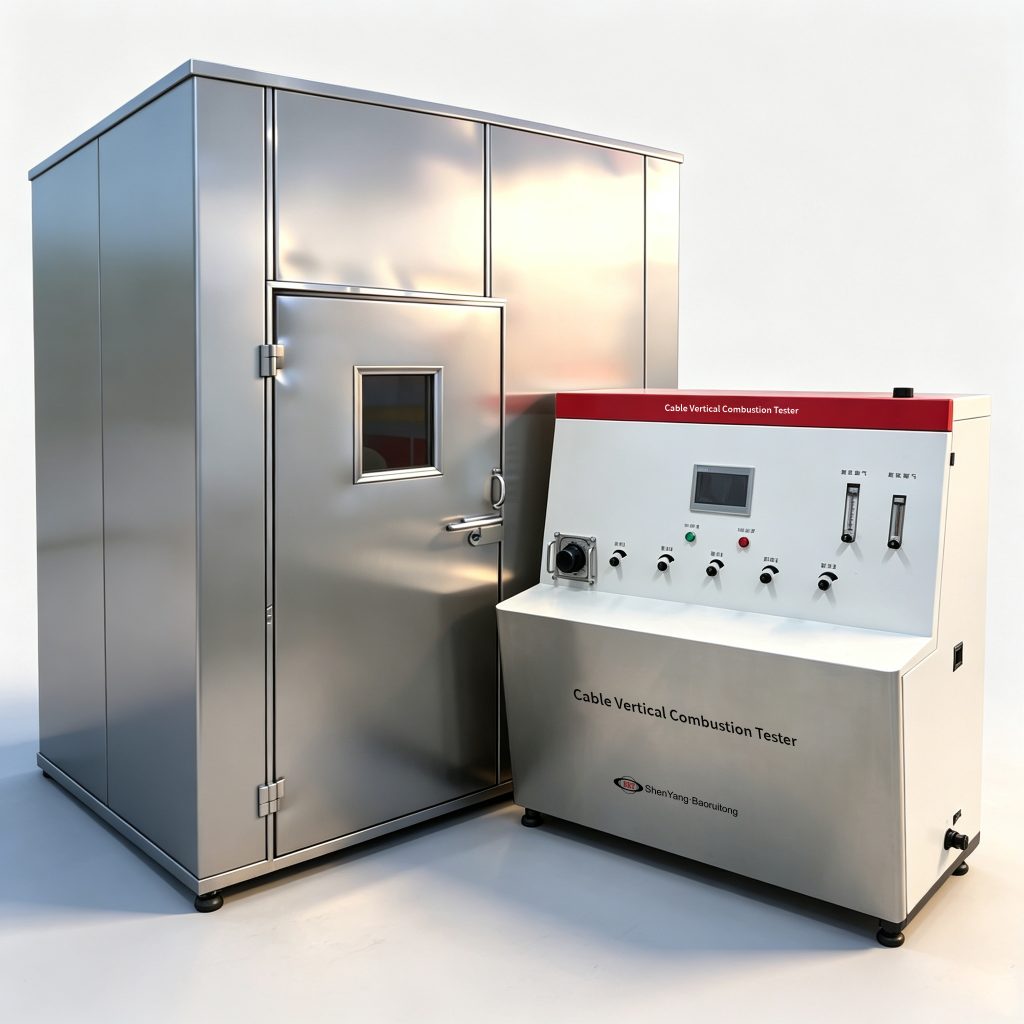
- EN 50399 / IEC 60332-3 vertical tray chamberwith heat release and smoke measurement — the central instrument for CPR class development
- IEC/EN 60332-1-2 single cable apparatusfor routine QC and Eca verification
- EN 61034-2 three-metre cubefor smoke density
- EN 60754-1/-2 apparatusfor halogen content, pH and conductivity
- EN 50200 / IEC 60331 circuit integrity rigfor fire-resistant cable development
- Fire resistance furnaceconfigurable to ISO 834 and hydrocarbon curves for EN 50577 / DIN 4102-12 system testing
- ISO 5660 cone calorimeterfor rapid small-sample screening of compounds before committing to full-scale runs
- Integrated data acquisition and control systemfor repeatable, traceable results
This is the configuration Shenyang Baoruitong Automation Equipment Co., Ltd. (BRT) supplies as an integrated cable fire testing laboratory — the individual instruments built to EN, IEC, BS, GB and UL test geometries, sharing one data acquisition and control platform, with commissioning, correlation trials against accredited laboratory data, and operator training included. Where a customer already owns part of the chain, the remaining instruments are matched to the existing system rather than sold as a separate island.
The economics change substantially. Per-test cost drops by an order of magnitude, cycle time falls from months to days, and — most importantly — the engineering team can run failure experiments. Knowing precisely where a compound fails is worth more than a certificate saying it passed.
The cone calorimeter deserves particular mention as the screening layer: a small sample, a short test, and heat release data that correlates well enough with full-scale behaviour to eliminate most unpromising formulations before they ever reach the vertical tray rig.
None of this replaces third-party certification. CE marking under System 1+ still requires a notified body, and it should. What in-house capability provides is the confidence that when the sample is shipped to that notified body, it will pass — and that the product being certified is the optimised version rather than the first one that happened to work.
Closing
Cables are the one building product that deliberately penetrates every fire barrier in the structure, and the one expected to keep functioning when everything else has failed. That combination makes their fire performance uniquely consequential and uniquely difficult to verify.
Whether the framework is EN 13501-6 classification, IEC 60332 propagation testing, or BS 6387 circuit integrity protocols, they all resolve to the same question: in the minutes between ignition and evacuation, does this cable make the situation better or worse?
Testing is how that question gets answered before the fire, rather than after it.
About Shenyang Baoruitong
Shenyang Baoruitong Automation Equipment Co., Ltd. (BRT) is a Chinese manufacturer of testing instruments serving laboratories and manufacturers worldwide. Its fire testing range covers reaction-to-fire and fire-resistance instrumentation built to EN, IEC, ISO, BS, ASTM/UL and GB test geometries, alongside a broader materials testing portfolio including universal testing machines, impact testers, hydrostatic pressure and burst testers, ring stiffness testers and Vicat softening point apparatus.
Typical cable fire laboratory scope: EN 50399 / IEC 60332-3 vertical tray chamber · IEC 60332-1-2 single cable apparatus · EN 61034-2 3 m cube smoke chamber · EN 60754 halogen acid gas and pH/conductivity apparatus · EN 50200 / IEC 60331 circuit integrity rigs · fire resistance furnaces to ISO 834 and hydrocarbon curves · ISO 5660 cone calorimeter · integrated data acquisition and control.
Shenyang baoruitong automation equipment co., ltd.
Email: info@brt-test.com
WhatsApp: 0086-15604057553
Website: https://brt-test.com
Alibaba Store: https://sybrt.en.alibaba.com/
Add: Kaifa 22nd Rd., Tiexi Dist., Shenyang, Liaoning, China