
Flow Resistance Test Bench Supports AI Server and Data Center Liquid Cooling Validation
Baoruitong Develops a Flow Resistance Testing Solution for High-Density Computing Cooling Systems
AI servers, GPU computing platforms, and high-density data centers generate substantial heat during continuous operation. As rack power density increases, liquid cooling is becoming an important approach for removing heat from processors, accelerator cards, memory modules, and other high-performance computing components.
A liquid cooling system must deliver the required coolant flow while keeping pressure drop, pump demand, and temperature variation under control. For this reason, flow resistance testing is an essential part of liquid cooling component development, cooling-loop validation, supplier quality control, and data center thermal-management engineering.
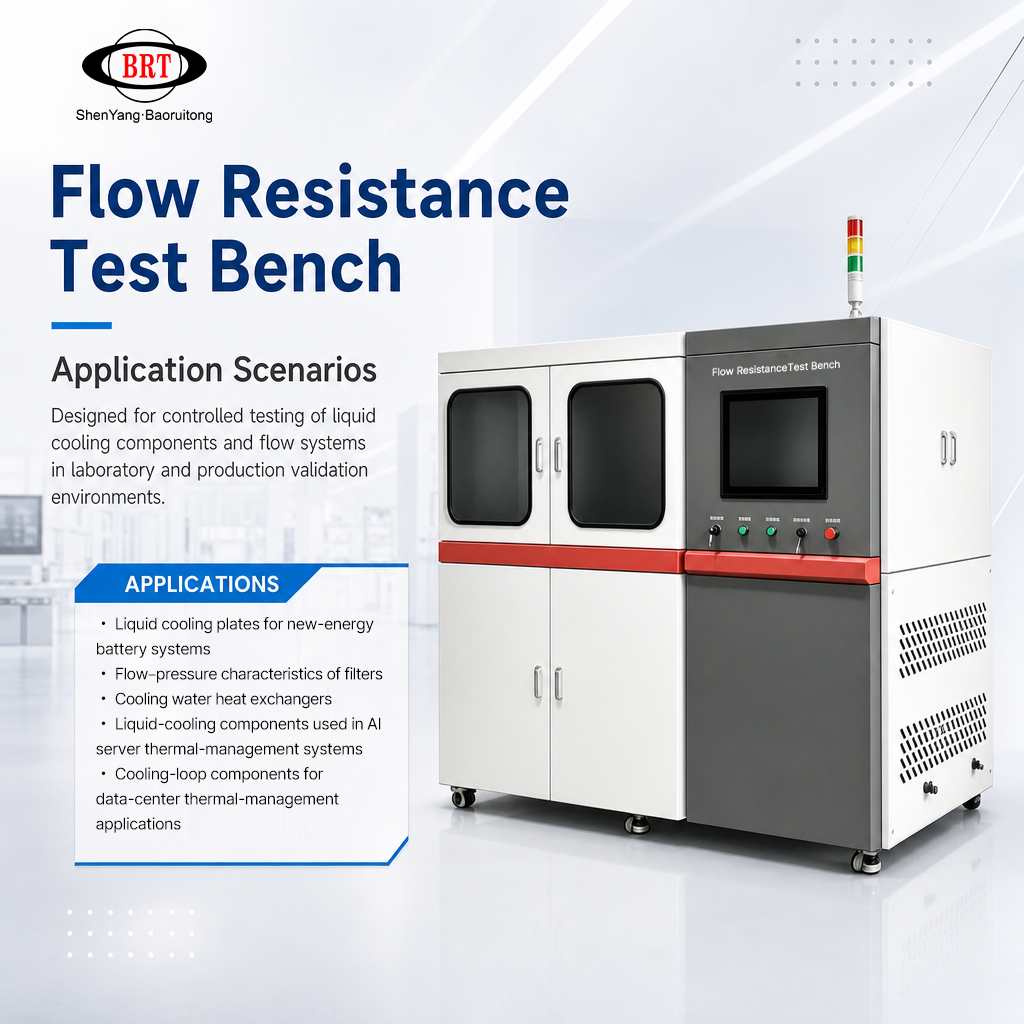
Shenyang Baoruitong Automation Equipment Co., Ltd. presents the BRT-LZ Flow Resistance Test Bench, an integrated hydraulic testing system that can be configured for liquid cooling plate, cold plate, water-cooled component, filter, and related fluid-component testing.
The BRT-LZ system measures flow and pressure characteristics under controlled temperature conditions. Its functions are relevant to the development and evaluation of liquid cooling components used in AI servers, GPU servers, high-performance computing systems, data center cooling infrastructure, and industrial liquid cooling equipment. Final fixture design, coolant compatibility, and application suitability should be confirmed according to the customer’s component and test procedure.
Why Flow Resistance Testing Matters for AI Server Cooling
AI servers and GPU servers can operate at high computational loads for extended periods. Their liquid cooling systems must move coolant through cold plates, manifolds, hoses, filters, heat exchangers, and other hydraulic components with predictable performance.
If a cold plate or flow path creates excessive pressure drop, the system may require greater pump output. This can influence pump power consumption, system efficiency, operating noise, and cooling-loop design. If the flow distribution is unstable, different processors or accelerator modules may receive different coolant flow, which can affect temperature uniformity and thermal-management performance.
Flow resistance testing helps engineers evaluate:
- AI server cold plate pressure drop
- GPU server liquid cooling plate flow resistance
- Data center liquid cooling loop pressure loss
- Direct-to-chip cooling component performance
- Coolant flow distribution through cold plates
- Manifold and distribution-channel resistance
- Filter pressure drop in liquid cooling circuits
- Water-cooled plate hydraulic performance
- Cooling-loop pump selection requirements
- Coolant flow stability at different operating points
- Temperature-dependent hydraulic behavior
- Pressure differential across cooling components
- Flow-rate and pressure-drop curves
- Liquid cooling system quality consistency
- Prototype and production-batch performance
- Data center cooling infrastructure validation
The BRT-LZ is a component and fluid-performance test bench. It does not replace complete data center commissioning or thermal validation of an entire server rack. The final test objective, specimen, fixture, coolant, and acceptance criteria should be defined before testing.
BRT-LZ Flow Resistance Test Bench: Key Features for Liquid Cooling Development
0.2–20 L/min Flow Testing Range
The BRT-LZ provides a documented flow testing range of 0.2–20 L/min. This range can support flow-resistance evaluation of liquid cooling plates, AI server cold plates, water-cooled components, filters, and other fluid-flow specimens when the selected test point falls within the equipment range.
The hydraulic circuit uses a variable-frequency magnetic-drive pump, flow meter, electrically adjustable valve, and bypass-flow adjustment. Variable-frequency regulation allows the operator to set and adjust coolant flow without relying only on manual valve adjustment.
For AI server and data center cooling projects, customers should provide the expected coolant flow rate, number of cooling channels, component connection size, target pressure drop, and required test points so Baoruitong can review the fixture and system configuration.
-50°C to 150°C Temperature Testing Range
The documented temperature testing range is -50°C to 150°C, with a stated temperature accuracy of ±0.5°C. This allows liquid cooling components to be evaluated under different coolant temperatures and thermal-management conditions.
The product document identifies water-glycol mixture and coolant as working media. For data center liquid cooling, the actual coolant may depend on the system design, water quality, corrosion-control requirements, material compatibility, and customer specification. Coolant concentration, viscosity, additives, and operating temperature should be confirmed before testing.
Temperature-controlled testing is useful for studying how coolant temperature and fluid properties affect cold-plate pressure drop, flow stability, and hydraulic resistance.
0–100 kPa and 0–300 kPa Differential-Pressure Ranges
The BRT-LZ provides differential-pressure measurement ranges of 0–100 kPa and 0–300 kPa, with a stated accuracy of ±0.5% FS.
Differential-pressure measurement is a core requirement for AI server cold plate testing and data center liquid cooling component validation. By measuring the pressure difference between the inlet and outlet of a specimen at different flow rates, engineers can generate a pressure-drop curve and compare the hydraulic performance of different designs.
Typical test outputs may include:
- Inlet pressure
- Outlet pressure
- Differential pressure
- Flow rate
- Coolant temperature
- Pressure-drop curve
- Flow-resistance comparison
- Flow stability at selected operating points
The final pressure-transducer range should be selected according to the expected pressure drop of the cold plate, filter, manifold, or other component.
Variable-Frequency Magnetic-Drive Pump
The hydraulic system uses a variable-frequency magnetic-drive pump. The product document states that the pump output pressure can reach 0.6 MPa.
Variable-frequency pump control supports adjustment of the circulating flow and can help reduce the uncertainty associated with manual operating-point changes. This is useful when testing a cold plate across multiple flow rates or building a flow-pressure-drop performance map.
The final pump capacity and pressure capability must be matched to the component, coolant, tubing, connection design, and test conditions. Customers should confirm whether the target AI server cooling component requires a special coolant, higher flow, higher pressure, or customized connector.
PID Temperature Control
The BRT-LZ uses PID temperature control for the test medium. The temperature-control system can help the operator reach and maintain the selected coolant temperature while the hydraulic circuit is running.
Stable temperature control is important because coolant viscosity and flow behavior can change with temperature. In AI server and data center liquid cooling research, controlled temperature conditions help engineers compare cold-plate designs and evaluate hydraulic performance at defined operating points.
Industrial Computer and Full Digital Closed-Loop Control
The control system combines an industrial computer with a full digital closed-loop controller. The system architecture includes temperature sensors, pressure sensors, differential-pressure sensors, an industrial computer, and PLC-related control components.
This integrated control arrangement supports:
- Centralized parameter setting
- Flow and temperature management
- Pressure and differential-pressure monitoring
- Automatic test execution
- Real-time process observation
- Alarm management
- Test-record storage
- Data review and report preparation
For data center cooling component suppliers, closed-loop test control can support a more consistent laboratory process when comparing cold plates, filters, manifolds, or other liquid cooling hardware.
Automatic and Manual Operating Modes
The BRT-LZ supports manual and automatic start/stop functions.
Manual mode allows operators to start the medium pump, control valve, and temperature-control system separately. This can be useful during commissioning, component checks, maintenance, and troubleshooting.
Automatic mode can complete the programmed test process. Automatic operation helps laboratories repeat defined flow, temperature, and pressure conditions while reducing unnecessary manual intervention.
Test Pause, Alarm, and Emergency Shutdown Functions
The equipment includes a test pause function for mid-test inspection or abnormal conditions. The product document also identifies the following safety and protection functions:
- High-oil-temperature alarm
- High-pressure alarm
- Emergency shutdown
- Low-level liquid alarm
- Lower-limit liquid-level protection
- Upper and lower temperature protection limits
- Automatic stop under configured protection conditions
When the liquid level reaches the lower limit, the equipment cannot start. These functions support safer operation during coolant circulation and component testing.
The final safety interlocks, alarm thresholds, emergency procedures, and data-center laboratory requirements should be confirmed during technical review.
Real-Time Recording and Power-Interruption Data Preservation
The BRT-LZ records the test process in real time and supports full-process monitoring. The document also states that test records can be preserved after a power interruption and that the program can continue to run after restoration, subject to system conditions and configuration.
This can help cooling-component manufacturers and laboratory teams maintain test traceability for:
- AI server cold plate comparison
- GPU liquid cooling component validation
- Data center coolant-loop development
- Filter pressure-drop analysis
- Temperature and flow stability review
- Prototype verification
- Production quality control
- Customer technical documentation
Visual Basic Software and Microsoft Word Reports
The product document identifies Visual Basic as the operating software and Microsoft Word as the report format. Word-based report output can support internal review, supplier documentation, engineering comparison, and customer-facing test records.
The final report template, chart format, database functions, export fields, and communication interfaces should be confirmed with Baoruitong according to the project requirements.
Applications in AI Server and Data Center Liquid Cooling
AI Server Cold Plate Testing
The BRT-LZ can be configured for flow-resistance and pressure-drop testing of cold plates used in AI servers, GPU servers, CPU cooling systems, and other high-performance computing hardware, subject to the final fixture and connection design.
Potential evaluation items include:
- Cold plate inlet-to-outlet pressure drop
- Flow resistance at multiple flow rates
- Coolant distribution through internal channels
- Temperature-dependent hydraulic behavior
- Comparison of channel and manifold designs
- Flow stability near the target operating point
- Prototype and production consistency
GPU and High-Performance Computing Cooling
GPU servers and accelerated computing systems often use liquid cooling components to manage high thermal loads. The BRT-LZ can support component-level hydraulic testing for GPU cold plates, server cooling modules, distribution blocks, and related fluid circuits when the test requirements match the equipment range.
The test bench can help engineers compare pressure loss and flow behavior before integrating a component into a server cooling loop.
Data Center Direct-to-Chip Cooling Components
Direct-to-chip cooling systems rely on controlled coolant circulation through cold plates and distribution components. Flow resistance testing can help verify whether a component meets its target hydraulic behavior before deployment in a rack or data center cooling system.
The test scope may include cold plates, manifolds, filters, hoses, connectors, and other liquid cooling components. Complete rack-level thermal performance, facility water-system performance, and commissioning requirements require separate evaluation.
Data Center CDU and Liquid Cooling Loop Components
A cooling distribution unit and associated liquid cooling loop may contain pumps, valves, filters, heat exchangers, manifolds, and secondary-side components. The BRT-LZ can be considered for component-level flow-pressure testing of selected parts, provided the required flow, pressure, temperature, fluid, and connection conditions are within the final configuration.
Baoruitong can review the component type and test objective to determine whether a standard or customized fixture is required.
Coolant Filter and Water-Cooled Component Testing
The system is also designed to test the flow rate–pressure differential characteristics of filters and water-cooled components. This is relevant to liquid cooling systems where filter blockage, pressure loss, and flow availability can affect maintenance and operating performance.
Potential tests include:
- Data center coolant filter pressure drop
- Liquid cooling loop filter flow testing
- Water-cooled plate hydraulic testing
- Heat exchanger flow resistance testing
- Manifold pressure-drop testing
- Coolant circuit component comparison
Main BRT-LZ System Modules
Hydraulic Control Module
The hydraulic control module manages coolant circulation, pump operation, valves, flow adjustment, and the test specimen loop.
Circulation Temperature-Control Module
The circulation temperature-control module includes heating equipment and temperature sensors for managing the coolant temperature during the test.
Differential-Pressure Measurement Module
The differential-pressure module measures the pressure difference between the inlet and outlet of the test specimen under controlled flow conditions.
Test Filtration Module
The test filtration system includes a motor-pump group and pipeline filter for circulating and managing the test medium.
Cabinet and Frame
The cabinet and frame support the internal components and provide the test area. The document describes a sheet-metal cabinet with a powder-coated surface.
Test Fixture and Connection Adapters
The fixture system provides the installation position for the specimen. Conversion connectors can adapt the test bench to different component connections, subject to final fixture design.
For AI server cold plates and data center liquid cooling components, the fixture review should consider port location, connector type, sealing method, flow direction, pressure rating, component dimensions, and coolant compatibility.
AI Server Liquid Cooling Test Workflow
A typical component-level test workflow may include:
- Define the AI server or data center cooling component to be tested.
- Confirm the required flow rate, temperature, pressure, and pressure-drop range.
- Provide the cold-plate drawing, port information, connector specification, and sealing requirements.
- Select the working coolant and confirm material compatibility.
- Install the cold plate, filter, manifold, water-cooled component, or other specimen.
- Check the fixture, seals, pipeline connections, sensors, valves, and liquid level.
- Set the coolant temperature and target flow rate.
- Start the variable-frequency magnetic-drive pump.
- Establish stable circulation through the specimen.
- Measure inlet pressure, outlet pressure, differential pressure, flow rate, and coolant temperature.
- Repeat the test at the required operating points.
- Record the data and generate the test report.
The exact stabilization time, measurement points, acceptance limits, calculations, and test sequence must be determined by the customer’s engineering test procedure.
Installation and Safety Considerations
The product document specifies the following normal operating conditions and installation requirements:
- Ambient temperature: 0°C to 40°C
- Stable foundation and level installation
- No corrosive medium in the surrounding environment
- AC380 V power supply with a stated range of -10% to +15%
- 50 Hz power frequency
- Three-phase power supply
- Dry laboratory area
- Good laboratory ventilation
The equipment dimensions are documented as 4600 mm × 2580 mm × 2050 mm, excluding the dimensions of the integrated heating and cooling machine. Data center and AI server cooling laboratories should confirm the complete footprint, access route, service clearance, coolant storage, drainage, ventilation, electrical capacity, and facility layout before purchase.
The PDF lists total power as 70 kW in one technical-parameter section and 80 kW in the normal-working-condition section. The final power requirement must be confirmed by Baoruitong according to the delivered configuration.
The equipment should be installed on a stable foundation and leveled before electrical connection. Only trained personnel should operate the system. Personnel must not approach or touch the equipment while it is running automatically unless the relevant safety procedure permits it.
Baoruitong Technical Support for Liquid Cooling Projects
Shenyang Baoruitong Automation Equipment Co., Ltd. provides fluid-performance testing equipment and laboratory solutions for AI server cooling, data center liquid cooling, battery thermal management, filtration, water cooling, and industrial component testing.
Baoruitong can support customers with:
- AI server cold plate flow-resistance testing
- GPU liquid cooling component pressure-drop testing
- Data center liquid cooling loop component testing
- Direct-to-chip cooling component evaluation
- Coolant filter flow-pressure testing
- Water-cooled plate and heat-exchanger testing
- Flow and pressure range review
- Coolant and water-glycol test-medium planning
- Temperature-control requirements
- Cold-plate fixture and adapter design discussion
- Port, seal, and connection review
- Industrial computer and control configuration
- Data-recording and report-output requirements
- Laboratory power and installation review
- Technical quotation and after-sales support
For a quotation, customers should provide the component type, drawing or dimensions, port size, coolant type, target flow rate, expected pressure drop, operating temperature, pressure limit, test points, reporting requirements, and laboratory power conditions.
FAQ
1. Can the BRT-LZ be used for AI server cold plate testing?
Yes. The BRT-LZ is designed for flow-resistance and pressure-drop testing of liquid cooling plates and related fluid components. It can be considered for AI server and GPU cold plate testing when the required flow, temperature, pressure, coolant, and fixture conditions match the final system configuration.
2. Can it test data center liquid cooling components?
Yes, for suitable component-level applications. Potential specimens include cold plates, filters, manifolds, water-cooled plates, heat-exchanger components, and other liquid cooling parts. Complete rack-level or facility-level commissioning requires separate evaluation.
3. What flow range is available?
The documented flow testing range is 0.2–20 L/min.
4. What temperature range does the BRT-LZ support?
The documented temperature testing range is -50°C to 150°C, with a stated temperature accuracy of ±0.5°C.
5. What differential-pressure ranges are available?
The system provides 0–100 kPa and 0–300 kPa differential-pressure ranges, with a stated accuracy of ±0.5% FS.
6. What coolant can be used?
The product document identifies water-glycol mixture and coolant as working media. The final coolant type, concentration, viscosity, additives, and material compatibility must be confirmed for the cold plate or data center component.
7. Can the system generate a pressure-drop curve?
The system records flow, temperature, pressure, and differential pressure during testing. These data can be used to analyze flow resistance and generate pressure-drop performance information according to the customer’s test procedure.
8. Does the BRT-LZ support automatic operation?
Yes. It supports manual and automatic start/stop, PID temperature control, full digital closed-loop control, automatic test execution, test pause, alarms, emergency shutdown, and real-time recording.
9. What is the maximum pump output pressure?
The product document states that the variable-frequency magnetic-drive pump output pressure can reach 0.6 MPa. The final pressure capability must be confirmed for the selected configuration and test medium.
10. Can the BRT-LZ test a complete AI server rack?
The BRT-LZ is primarily a component-level flow-resistance and pressure-drop test bench. It is not presented as a complete rack-level thermal validation or data center commissioning system. The test objective and specimen scope should be confirmed before purchase.
11. What report format is supported?
The product document lists Visual Basic as the operating software and Microsoft Word as the report format. The final report template and export functions should be confirmed with Baoruitong.
12. What information is needed for a quotation?
Customers should provide the component type, drawing or dimensions, ports and connectors, coolant, target flow, operating temperature, expected pressure drop, pressure limit, test points, report requirements, and laboratory power conditions.