
Vertical Fire Resistance Test Furnace Supports Building Element and Check Valve Fire-Resistance Testing
Fire resistance testing helps manufacturers and laboratories evaluate how building elements, fire-protection products, and related components perform when exposed to the temperature-rise conditions of a real fire. For building-material producers, inspection laboratories, fire-safety organizations, and construction-product manufacturers, a controlled fire-resistance test furnace is essential for studying fire-resistance limits and preparing reliable test data.
Baoruitong Automation Equipment Co., Ltd. presents the NH-XL Vertical Fire Resistance Test Furnace, a laboratory and industrial testing solution designed for fire-resistance-limit testing of building elements and check valves.
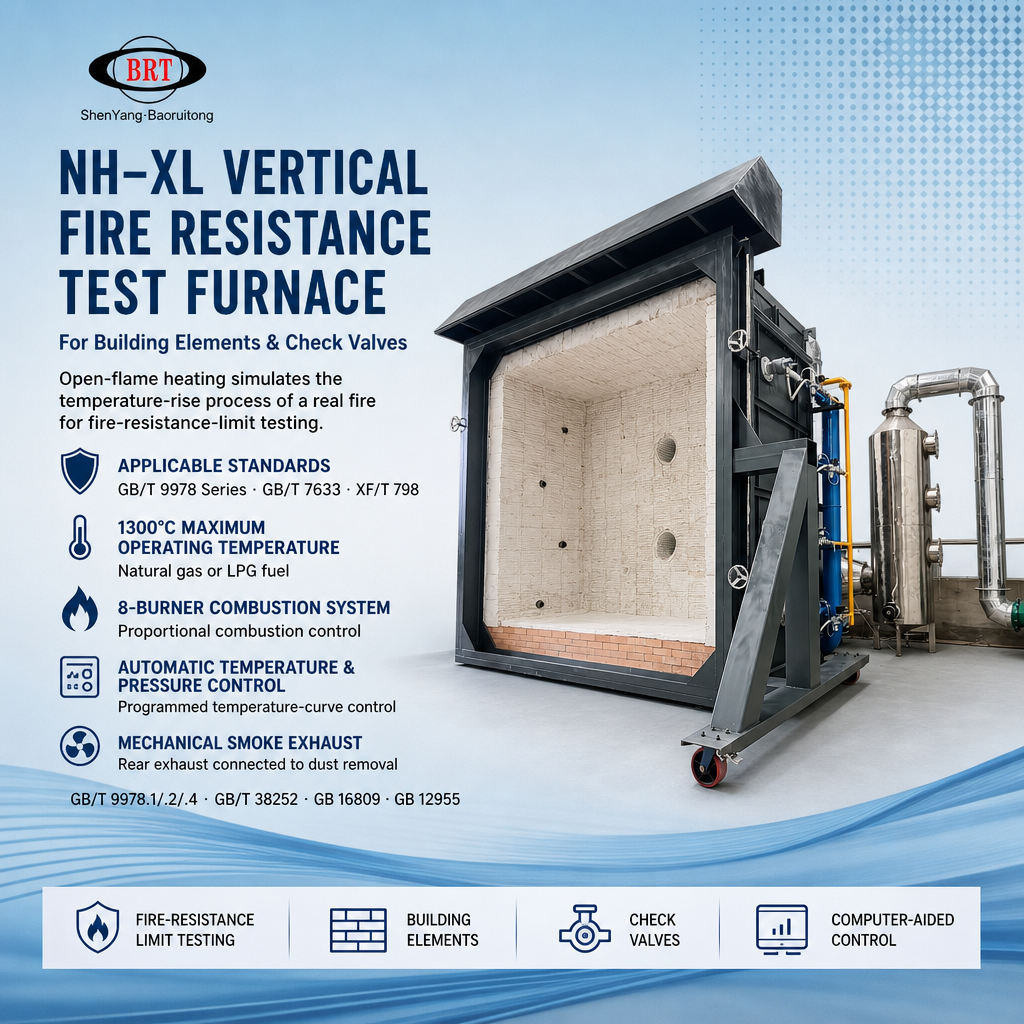
The NH-XL furnace uses open-flame heating to simulate the temperature-rise process of a real fire. The product image identifies applications for building elements and check valves, together with applicable references including the GB/T 9978 series, GB/T 7633, XF/T 798, GB/T 38252, GB 16809, and GB 12955.
Why Vertical Fire Resistance Testing Matters
A building element may need to maintain its required performance when exposed to fire for a specified period. Fire-resistance testing provides a controlled way to investigate the behavior of walls, doors, floors, roofs, structural components, valves, dampers, and other fire-related products.
Vertical fire-resistance testing can support:
- Fire-resistance limit testing
- Building element fire testing
- Fire door and fire wall evaluation
- Check valve and fire damper testing
- Building-material fire-performance research
- Structural fire-resistance assessment
- Fire-resistant product development
- Quality-control testing
- Product design verification
- Fire-safety compliance preparation
The final classification or compliance conclusion depends on the applicable standard, specimen construction, loading conditions, test procedure, furnace configuration, observations, and authorized evaluation process.
NH-XL Vertical Fire Resistance Test Furnace: Key Features
Open-Flame Heating for Real-Fire Temperature Simulation
The NH-XL furnace uses open-flame heating to simulate the temperature-rise process of a real fire. This provides a controlled thermal environment for evaluating the fire-resistance performance of building elements and related products.
Open-flame heating is particularly relevant when the test objective is to observe how a product responds to a programmed fire temperature curve. The furnace configuration and test procedure should be matched to the selected standard and specimen type before official testing.
Maximum Operating Temperature of 1300°C
The product image identifies a maximum operating temperature of 1300°C. This high-temperature capability supports demanding fire-resistance test conditions for building elements, fire-protection products, and related components.
The actual operating temperature, heating curve, holding period, and test limits should be selected according to the applicable test method and confirmed in the technical documentation.
Natural Gas or LPG Fuel Options
The NH-XL system is shown with natural gas or LPG fuel options. Flexible fuel selection can help laboratories and industrial test facilities adapt the furnace to available site conditions and project requirements.
Before installation, users should confirm the fuel supply, pressure, ventilation, exhaust, fire-protection arrangements, and local safety requirements. Fuel selection must also be consistent with the approved equipment configuration.
Eight-Burner Combustion System
The furnace uses an 8-burner combustion system with proportional combustion control. Multiple burners help distribute heat across the test area, while proportional control supports adjustment of the combustion output during the programmed heating process.
A controlled multi-burner system can help maintain the intended fire-temperature curve and support more stable testing conditions. The precise burner arrangement, control range, and furnace zoning should be confirmed according to the selected configuration.
Automatic Temperature and Pressure Control
The NH-XL features automatic temperature and pressure control. Automated control helps the system manage key operating variables during a fire-resistance test and reduces unnecessary manual adjustment.
Automatic control also supports a more organized laboratory workflow by coordinating furnace operation with the selected temperature curve and pressure conditions. The exact control accuracy, sensor configuration, pressure range, and safety interlocks should be reviewed in the final technical specification.
Programmed Temperature-Curve Control
The furnace is designed for programmed temperature-curve control. A programmed curve allows the laboratory to follow the required heating profile for the selected fire-resistance test procedure.
Accurate temperature-curve management is important when comparing test results or evaluating whether a specimen maintains its required performance during fire exposure. The applicable curve and test duration must be determined from the relevant standard and project requirements.
Mechanical Smoke Exhaust and Dust-Removal Connection
The product image highlights mechanical smoke exhaust with the rear exhaust connected to dust removal. This arrangement supports the removal of smoke and combustion products from the furnace area and helps laboratories plan a more controlled exhaust system.
The exhaust and dust-removal system should be connected according to the equipment design, facility ventilation capacity, local environmental requirements, and laboratory safety procedures.
Computer-Aided Control
The NH-XL furnace supports computer-aided control. Computer control can help operators manage the test sequence, monitor furnace operation, follow the programmed temperature curve, and organize test information.
The exact software functions, data-recording capability, report format, communication interface, and remote-monitoring options should be confirmed with Baoruitong for the selected system configuration.
Applications for Building Elements and Check Valves
The NH-XL Vertical Fire Resistance Test Furnace can support testing and research for:
- Fire walls
- Building walls
- Fire doors
- Fire shutters
- Floors and slabs
- Roof systems
- Structural building elements
- Load-bearing components
- Non-load-bearing building elements
- Fire dampers
- Check valves
- Non-return valves
- Smoke-exhaust valves
- Fire-protection assemblies
- Building-product fire-resistance systems
- Construction-material fire-performance research
For check valves and related components, customers should confirm the required fixture, installation orientation, pressure condition, airflow or smoke-control requirement, and applicable test standard before purchasing.
Applicable Standards and Test References
The product image lists the following standards and references for the NH-XL testing solution:
- GB/T 9978 series — fire-resistance testing of building elements
- GB/T 7633 — fire-resistance testing reference for relevant building components
- XF/T 798 — reference for related fire-protection or valve applications
- GB/T 38252 — applicable building or fire-performance testing reference shown in the product information
- GB 16809 — relevant fire-protection product testing reference
- GB 12955 — fire-door-related application reference
The broader international market may also use search terms such as ISO 834 fire resistance furnace, vertical fire resistance test furnace, building element fire test furnace, fire door test furnace, fire damper fire resistance furnace, and check valve fire test furnace. These international terms should be used as relevant method or application keywords unless conformity for the specific equipment configuration has been verified.
How a Vertical Fire-Resistance Test Is Organized
A typical fire-resistance testing workflow may include:
- Define the test objective and required fire-resistance limit.
- Identify the building element, valve, damper, or fire-protection product.
- Confirm the applicable standard, specimen construction, and test orientation.
- Prepare the test specimen, frame, seals, fixtures, and loading arrangement.
- Connect the natural-gas or LPG supply and verify the exhaust system.
- Install the specimen in the furnace test opening.
- Select or program the required temperature curve.
- Start the 8-burner combustion system and automatic control sequence.
- Monitor temperature, pressure, smoke exhaust, and specimen behavior.
- Record observations and determine the result according to the applicable test method.
The exact specimen dimensions, loading, pressure conditions, temperature curve, test duration, and performance criteria must be confirmed from the applicable standard and project specification.
Benefits for Fire-Testing Laboratories and Manufacturers
Controlled High-Temperature Testing
The 1300°C maximum operating temperature and open-flame heating system provide a high-temperature platform for demanding fire-resistance evaluations.
More Stable Combustion Management
The 8-burner system and proportional combustion control help support programmed heating and temperature-curve management.
Reduced Manual Intervention
Automatic temperature and pressure control, computer-aided operation, and programmed temperature curves help laboratories organize the test process more efficiently.
Broader Product Coverage
The vertical furnace can support building elements as well as check valves, fire dampers, and related fire-protection components when the appropriate configuration is selected.
Organized Smoke and Exhaust Handling
Mechanical smoke exhaust with rear dust-removal connection supports a planned laboratory exhaust and environmental-control arrangement.
Baoruitong Technical Support
Baoruitong Automation Equipment Co., Ltd. provides fire-testing furnaces, material-performance testing equipment, and laboratory solutions for manufacturers, inspection organizations, research institutes, universities, and quality-control departments.
Baoruitong can assist with:
- Fire-resistance test-furnace selection
- Building-element application review
- Check-valve and fire-damper test planning
- Standard and method communication
- Furnace configuration guidance
- Burner and fuel planning
- Temperature-curve setup discussion
- Exhaust and dust-removal planning
- Computer-control requirements
- Technical quotation and after-sales support
Customers requesting a quotation should provide the product type, specimen size, test orientation, target standard, required fire-resistance limit, available fuel, laboratory space, exhaust conditions, and data-recording requirements.
FAQ
1. What is the NH-XL Vertical Fire Resistance Test Furnace used for?
It is used for fire-resistance-limit testing of building elements and related fire-protection products, including applications involving check valves and fire dampers when the correct configuration is selected.
2. What is the maximum operating temperature?
The product image identifies a maximum operating temperature of 1300°C. The actual test temperature curve and operating limits must follow the applicable standard and equipment configuration.
3. What fuel can the furnace use?
The product information identifies natural gas or LPG as fuel options. Fuel supply, pressure, ventilation, exhaust, and local safety requirements should be confirmed before installation.
4. How many burners does the NH-XL furnace have?
The product image shows an 8-burner combustion system with proportional combustion control.
5. Does the furnace support automatic control?
Yes. The displayed features include automatic temperature and pressure control, programmed temperature-curve control, and computer-aided control.
6. Can the NH-XL be used for check valve testing?
Yes. The product is presented for building elements and check valves. Customers should confirm the required fixture, installation orientation, pressure condition, and applicable standard for their specific valve or damper.
7. Does the furnace include smoke exhaust?
The product image highlights mechanical smoke exhaust with a rear exhaust connected to dust removal. The facility exhaust capacity and connection requirements should be reviewed before purchase.
8. Does the equipment automatically provide a fire-resistance classification?
No. The furnace supports controlled testing and data collection. The final fire-resistance classification depends on the applicable standard, specimen, test conditions, results, and authorized evaluation process.