
Building Material Combustibility Test Apparatus Supports ISO 11925-2 Single-Flame Source Testing
Building products and finishing materials can respond differently when exposed to a small direct flame. For manufacturers, fire-testing laboratories, research institutions, and quality-control teams, a controlled small-flame test helps evaluate the burning behaviour and ignitability of essentially flat building products under defined laboratory conditions.
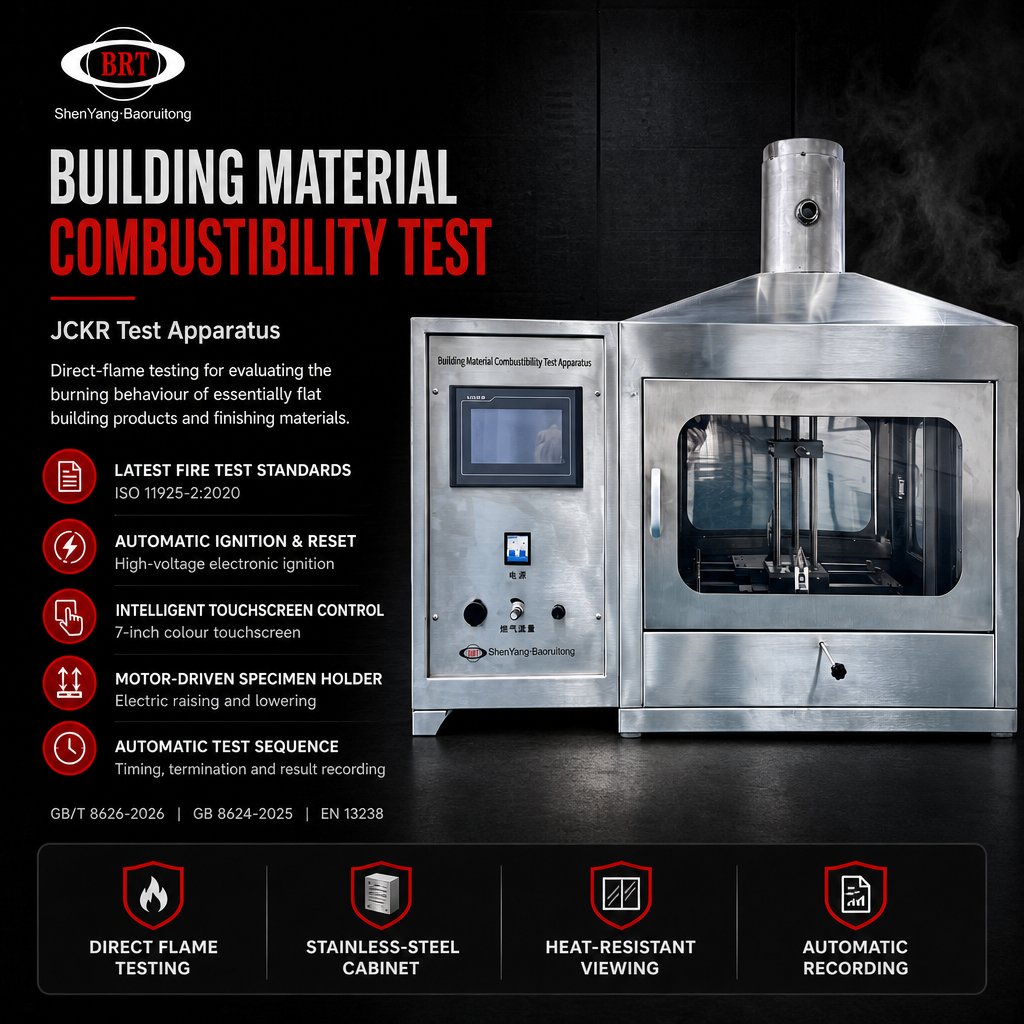
Baoruitong Automation Equipment Co., Ltd. presents the JCKR Building Material Combustibility Test Apparatus, an automated laboratory system designed for direct-flame testing of building materials and finishing products.
The JCKR apparatus is positioned for single-flame source testing and supports the testing direction associated with ISO 11925-2:2020. The product image also identifies GB/T 8626-2026, GB 8624-2025, and EN 13238 as relevant standards or testing references. The exact standard edition, specimen requirements, test procedure, and equipment configuration should be confirmed before making a formal conformity statement.
Why Building Material Ignitability Testing Matters
Fire performance assessment involves more than simply asking whether a material burns. Laboratories may also need to evaluate how a building product reacts to a small flame, whether ignition occurs under the specified conditions, and how the material behaves during and after direct flame exposure.
Single-flame source testing can support:
- Building material ignitability evaluation
- Building product reaction-to-fire research
- Direct-flame burning behaviour testing
- Small-flame exposure testing
- Building product material comparison
- Finishing material fire-performance evaluation
- Flame-retardant material development
- Quality-control testing
- Construction-material compliance preparation
- Research into surface burning behaviour
The test result must be interpreted according to the applicable test standard, specimen preparation method, conditioning requirements, flame exposure procedure, observation criteria, and classification rules.
JCKR Test Apparatus: Key Product Features
Direct-Flame Testing for Building Products
The JCKR apparatus is designed for direct-flame testing of essentially flat building products and finishing materials. A defined direct-flame source allows laboratories to assess the response of a specimen under a controlled small-flame test arrangement.
This makes the system relevant to manufacturers and laboratories working with building boards, surface finishes, panels, wall materials, flooring-related products, and other essentially flat building products. The specific specimen types and dimensions should be confirmed against the selected test method.
Support for ISO 11925-2 Testing Direction
The product image identifies ISO 11925-2:2020 as the latest fire-test standard reference for the displayed solution. ISO 11925-2 is commonly associated with single-flame source testing and the ignitability behaviour of building products.
The JCKR product naming and SEO structure therefore use precise terms such as:
- ISO 11925-2 test apparatus
- ISO 11925-2 single-flame source tester
- Single-flame source test apparatus
- Building material ignitability tester
- Small-flame test apparatus
- Building product flammability tester
- Reaction-to-fire test equipment
Listing a standard as a product reference does not by itself prove that every configuration is certified. Customers should confirm the applicable edition and the complete conformity requirements with Baoruitong before official testing.
Automatic Ignition and Reset
The JCKR apparatus features automatic ignition and reset. This helps organize the ignition sequence and prepare the equipment for the next test cycle with less manual intervention.
Automated ignition and reset can improve workflow consistency in laboratories that perform repeated building-material ignitability tests. The exact ignition source, operating sequence, safety interlocks, and reset conditions should be verified in the final technical specification.
Intelligent Touchscreen Control
The product is equipped with a 7-inch colour touchscreen. The touchscreen interface allows operators to interact with the test system through a centralized control panel.
A touchscreen control system can simplify access to operating functions, test settings, timing information, and result-recording operations. The actual software interface, data fields, storage functions, language options, and report format should be confirmed according to the selected configuration.
Motor-Driven Specimen Holder
The JCKR apparatus uses a motor-driven specimen holder with electric raising and lowering. Motorized specimen movement helps operators position the specimen in a more controlled and repeatable manner.
Electric specimen-holder movement can support a cleaner workflow when the laboratory needs to align the specimen, apply the test sequence, and return the holder after the test. The permitted travel range, positioning accuracy, specimen fixture, and operating limits should be checked in the equipment documentation.
Automatic Test Sequence
The image highlights an automatic test sequence covering timing, test termination, and result recording. Automated sequencing helps laboratories manage the key stages of a small-flame test in a structured way.
Automatic timing and result recording can reduce missed operations and help improve the consistency of laboratory records. However, the final test conclusion still depends on specimen preparation, operator setup, equipment condition, and correct interpretation of the applicable standard.
Stainless-Steel Cabinet and Heat-Resistant Viewing
The JCKR system features a stainless-steel cabinet and a heat-resistant viewing window. The stainless-steel enclosure provides a durable external structure for laboratory operation, while the viewing window allows operators to observe the specimen during direct-flame exposure without opening the test area unnecessarily.
The enclosed viewing arrangement supports clearer observation and helps maintain a more controlled test environment. Laboratories should still follow ventilation, fire-safety, operator-training, and emergency procedures during operation.
Applicable Building Material and Product Applications
The JCKR Building Material Combustibility Test Apparatus can support testing and research for:
- Building boards
- Wall and ceiling products
- Surface finishing materials
- Interior finishing products
- Flooring-related materials
- Construction panels
- Decorative building products
- Composite building materials
- Flame-retardant building products
- Insulation-facing materials
- Architectural finishing materials
- Polymer-based construction products
- Plastic building components
- Laminated building products
- Building product reaction-to-fire research
Before purchase, customers should confirm whether their material is essentially flat, whether the selected method is appropriate, and whether the required specimen fixture and test configuration are included.
How the JCKR Single-Flame Source Test Works
A typical workflow for a building-material ignitability test may include:
- Identify the building product, finishing material, or specimen to be evaluated.
- Confirm the applicable standard and classification objective.
- Prepare and condition the specimen according to the selected procedure.
- Install the specimen on the motor-driven holder.
- Use the touchscreen to check the test settings and operating status.
- Start the automatic ignition and direct-flame exposure sequence.
- Observe the specimen through the heat-resistant viewing window.
- Record timing, test termination, and other required observations.
- Review the recorded data against the applicable test criteria.
- Prepare the laboratory report and retain the relevant test records.
The exact flame application, specimen position, exposure duration, evaluation criteria, and classification method must be obtained from the applicable standard and confirmed before official testing.
Benefits for Fire-Testing Laboratories and Manufacturers
More Organized Test Operation
Automatic ignition, electric specimen-holder movement, touchscreen control, and automatic sequencing help laboratories organize the complete test workflow.
Improved Repeatability of Routine Testing
A defined test chamber, controlled specimen movement, and structured timing can help laboratories repeat the same operating sequence more consistently. Repeatability also depends on specimen preparation, conditioning, calibration, maintenance, and operator practice.
Easier Observation During Flame Exposure
The heat-resistant viewing window allows operators to observe the specimen during the test while keeping the test area enclosed.
Efficient Data Recording
Automatic timing, test termination, and result recording provide a structured basis for laboratory documentation and internal quality control.
Support for Reaction-to-Fire Research
The JCKR apparatus can support early-stage material screening, formulation comparison, product development, and preparation for building-product fire-performance evaluation.
Standard and Compliance Notes
The supplied product information references:
- ISO 11925-2:2020 — single-flame source testing direction
- GB/T 8626-2026 — building material ignitability testing reference
- GB 8624-2025 — building product reaction-to-fire classification context
- EN 13238 — building product fire-test specimen conditioning or application-related reference shown in the product information
These references should be treated as applicable-method or product-reference information until the exact equipment configuration and conformity documentation are confirmed. A test apparatus does not automatically certify a building product or guarantee a fire classification.
Baoruitong Technical Support
Baoruitong Automation Equipment Co., Ltd. provides laboratory fire-testing equipment and material-performance testing solutions for building-material manufacturers, inspection laboratories, universities, research organizations, and quality-control departments.
Baoruitong can assist customers with:
- Product selection
- Standard and method communication
- Specimen application review
- Equipment configuration guidance
- Laboratory installation planning
- Operation and safety documentation
- Test workflow discussion
- Technical quotation support
- After-sales service
To request a quotation, customers should provide the material type, target market, applicable standard, specimen information, intended test objective, laboratory conditions, and required data output.
FAQ
1. What is the JCKR Building Material Combustibility Test Apparatus used for?
It is used for controlled direct-flame and single-flame source testing of essentially flat building products and finishing materials, with a focus on ignitability and burning behaviour evaluation.
2. Which standard is associated with the JCKR apparatus?
The product image identifies ISO 11925-2:2020 and also references GB/T 8626-2026, GB 8624-2025, and EN 13238. The exact applicable standard and equipment conformity should be confirmed for the selected configuration.
3. Does the equipment automatically provide a fire classification?
No. The apparatus supports testing, timing, observation, and result recording. Final classification depends on the applicable standard, specimen, test procedure, results, and responsible evaluation process.
4. What are the main control features?
The main features shown in the product information include automatic ignition and reset, a 7-inch colour touchscreen, a motor-driven specimen holder, automatic test sequencing, timing, test termination, and result recording.
5. What materials can be tested?
The apparatus is intended for essentially flat building products and finishing materials. Suitable material types, specimen dimensions, and fixtures should be confirmed against the selected test method before purchase.
6. Is the test area enclosed?
Yes. The product features a stainless-steel cabinet and a heat-resistant viewing window for observation during direct-flame testing. Laboratory ventilation and fire-safety procedures remain necessary.
7. What information is needed for a quotation?
Please provide the material type, specimen information, target standard, target market, test objective, laboratory conditions, and required data-recording functions.
Lorem ipsum dolor sit amet, consectetur adipiscing elit. Ut elit tellus, luctus nec ullamcorper mattis, pulvinar dapibus leo.