
Simply Supported Beam Impact Tester: Measuring the Impact Strength of Plastics
A plastic part that shatters on impact can bring an entire production line to a halt — or worse, fail in service.
Impact resistance is one of the most important mechanical properties of non-metallic materials. From rigid plastics and nylon to hard rubber and electrical insulation materials, every component that may face a sudden blow in service needs its impact toughness verified under standardized conditions. That is exactly what the simply supported beam impact test is built to do — and the instrument at the center of it is the pendulum impact tester.
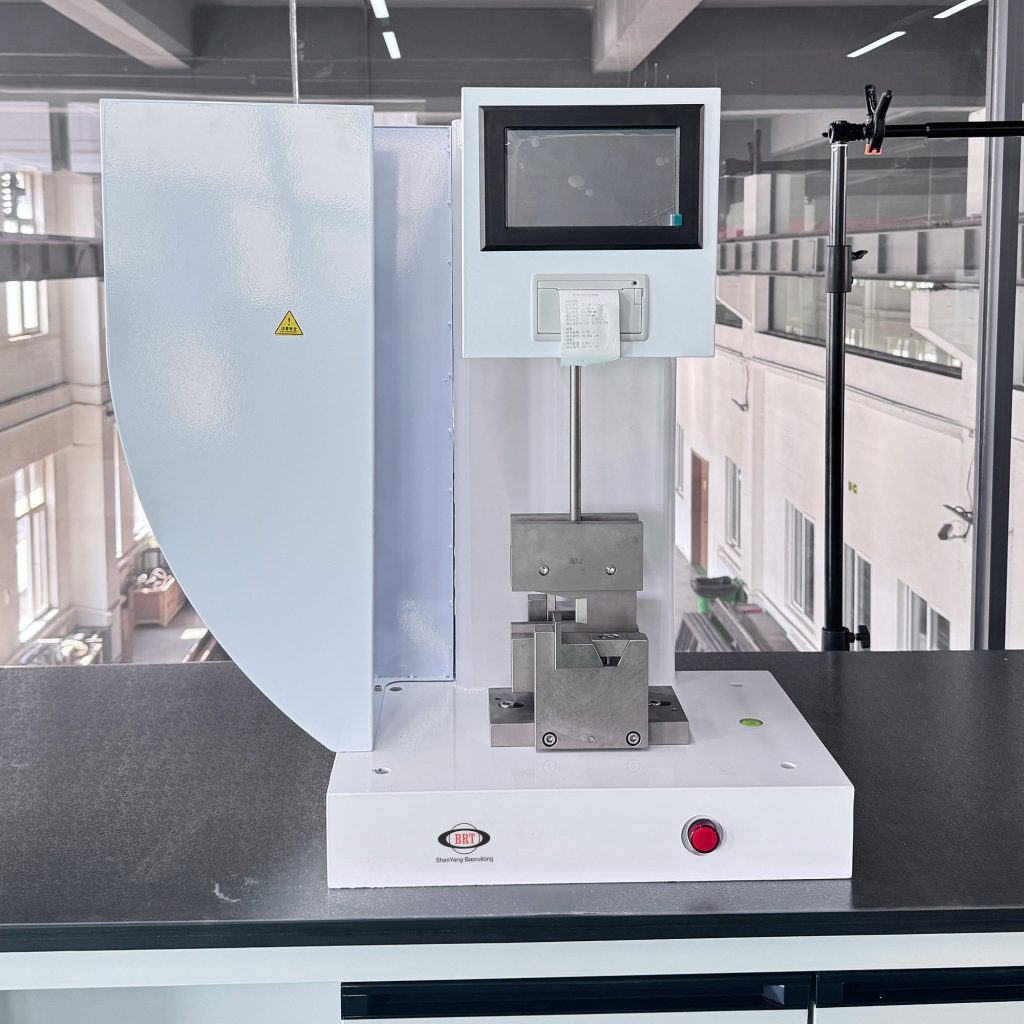
As a professional manufacturer of testing instruments, Baoruitong Automation Equipment Co., Ltd. (BRT) presents this guide to simply supported beam impact testing and its BRT-JZ50 Plastic Beam Impact Resistance Tester — a digital, touch-screen impact testing machine engineered for stable, repeatable impact energy measurement in factory laboratories, quality inspection departments and research institutions.
What Is a Simply Supported Beam (Charpy) Impact Test?
The simply supported beam impact test — known internationally as the Charpy impact test — evaluates the impact resistance of non-metallic materials under dynamic loads. A pendulum of defined energy is released from a pre-set angle and strikes a notched or un-notched specimen supported at both ends. The energy absorbed in breaking the specimen is measured and reported as impact strength, typically in KJ/m².
The test is an essential quality gate for non-metallic material manufacturers and quality inspection departments, and an indispensable tool for research institutions developing new materials. The measured impact toughness tells engineers whether a plastic part will survive real-world impacts — from a dropped power tool housing to a pipe fitting struck during installation.
Which Standards Apply?
A simply supported beam impact testing machine is typically designed to meet a family of national and international standards:
- ISO 179 — Determination of impact strength of rigid plastics by simply supported beam (Charpy) method
- GB/T 1043 — Impact test methods for rigid plastic simply supported beams
- JB/T 8762 — Plastic simply supported beam impact testing machine
- GB/T 18743 — Impact test method for thermoplastic pipes with simply supported beams (pipe parts)
- ISO 180 / GB/T 1843 — Cantilever beam (Izod) impact test methods
- ASTM D256 — Izod pendulum impact resistance of plastics
Standard specimen types per ISO 179 / GB/T 1043 include Type 1 (80 × 10 × 4 mm), Type 2 (63.5 × 12.7 × 6.4 mm) and Type 3 (63.5 × 12.7 × 3.2 mm), in both notched and un-notched configurations.
How the Test Works
- Zero and energy-loss check — the pendulum is allowed to swing freely, and the machine’s own friction loss is measured and recorded
- Specimen mounting — the sample is placed in the supports with the notch facing away from the direction of the impact hammer (or facing the blade for cantilever tests), centered precisely
- Impact — the pendulum is raised to the pre-lift angle (typically 150°) and released; the energy absorbed in breaking the specimen is measured via high-resolution angle detection
- Calculation — impact strength is calculated as σ = W / (h × b), where W is the absorbed work, h the specimen thickness and b the width (or remaining width below the notch); modern machines calculate and average multiple results automatically
- Reporting — results are displayed and printed for quality records
For reliable results, pendulum energy loss during free swing must stay within standard tolerances (for example, a maximum of 4.0% at 0.5 J, down to 0.5% at ≥ 4 J), and the machine should be mounted on a solid foundation with a mass at least 40 times that of the pendulum.
BRT-JZ50: Touch-Screen Precision for Impact Testing
The BRT-JZ50 Plastic Beam Impact Resistance Tester is a digital simply supported beam impact testing machine that conforms to ISO, GB and ASTM standards for both simply supported beam and cantilever beam tests.
Multi-standard compatibility
- Complies with ISO 179, ISO 180, GB/T 1043, GB 1834, JB/T 8761, JB/T 8762, ASTM D256, ISO 9854 and GB/T 21189
- Supports both simply supported beam (Charpy) and cantilever beam (Izod) impact tests in one instrument
Intuitive touch control
- 7-inch touch screen for easy parameter setting and real-time digital data display
- Simple sample installation and a smooth testing process — ideal for quality inspection labs, universities and R&D institutions
Precise and stable testing
- High-resolution angle detection system calculates impact energy accurately with excellent repeatability
- Impact velocity 3.8 m/s, pendulum energy 15 J
- Sturdy heavy steel frame provides stable operation and long service life without vibration interference
Wide testing coverage
- Tests PVC, PE and PP pipes, engineering plastics, ceramics and insulating materials
- Widely used to evaluate rigid plastics, reinforced nylon, glass fiber reinforced plastics, ceramics, cast stone and electrical insulation materials
- Operating environment 10–35 °C, relative humidity ≤ 80%
Who Needs the BRT-JZ50?
- Plastic and rubber manufacturers — verifying impact strength of production batches
- Quality inspection departments — incoming and outgoing material testing
- Pipe manufacturers — impact testing of PVC/PE/PP pipes and pipe fittings
- Universities and research institutions — material science teaching and new material development
- Third-party testing laboratories — impact testing services per ISO 179, GB/T 1043 and ASTM D256
FAQ
What is a simply supported beam impact test? The simply supported beam impact test (the Charpy method) measures the impact strength of plastics and non-metallic materials by releasing a pendulum of defined energy to strike a specimen supported at both ends, reporting the energy absorbed in breaking it as impact toughness in KJ/m².
Which standards apply to simply supported beam impact testing? Common standards include ISO 179 and GB/T 1043 (simply supported beam / Charpy), ISO 180 and GB/T 1843 (cantilever beam / Izod), ASTM D256 (Izod), plus machine standards JB/T 8762 and GB/T 21189, and GB/T 18743 for thermoplastic pipes.
What is the difference between Charpy and Izod impact tests? In the Charpy (simply supported beam) test, the specimen is supported at both ends and struck in the middle; in the Izod (cantilever beam) test, the specimen is clamped at one end and struck near the free end. The BRT-JZ50 supports both methods.
Which materials can be tested? Rigid plastics, nylon, hard rubber, reinforced nylon, glass fiber reinforced plastics, ceramics, cast stone and electrical insulation materials — as well as PVC, PE and PP pipes per GB/T 18743.
How is impact strength calculated? Impact strength is calculated as the absorbed work divided by the specimen cross-section: σ = W / (h × b), where h is thickness and b is width (or the remaining width below the notch for notched specimens). Modern touch-screen testers calculate and average results automatically.
Get a Quote
Need a reliable simply supported beam impact tester for plastic impact strength testing? Contact Baoruitong Automation Equipment Co., Ltd. today for the BRT-JZ50 datasheet, test procedure guidance and a customized quotation. Every BRT instrument is backed by a 1-year warranty, installation guidance, operation training and long-term after-sales support.
Email: info@brt-test.com | WhatsApp: +86 15604057553 | Web: www.brt-test.com