
Carbon Black Content Tester: The Invisible Shield in Black Plastic Pipes
Black plastic pipes survive decades in the sun — thanks to an invisible ingredient measured to the fraction of a percent.
Carbon black is a compound added to polyethylene, polypropylene and rubber compounds to provide UV protection and reinforce the polymer matrix. The concentration of this carbon black determines how well the matrix performs in outdoor environments: when the carbon black content is too low, the material can be degraded by UV; when it is in excess, mechanical properties can suffer. That is why measuring carbon black content precisely is a cornerstone of quality control for plastic pipes, cable insulation and geomembrane production.
As a professional manufacturer of testing instruments, Baoruitong Automation Equipment Co., Ltd. (BRT) presents this guide to carbon black content testing and its BRT-1000D Carbon Black Content Tester — a fully automatic, touch-screen instrument engineered for reliable, repeatable results per ISO, IEC, GB and ASTM testing requirements.
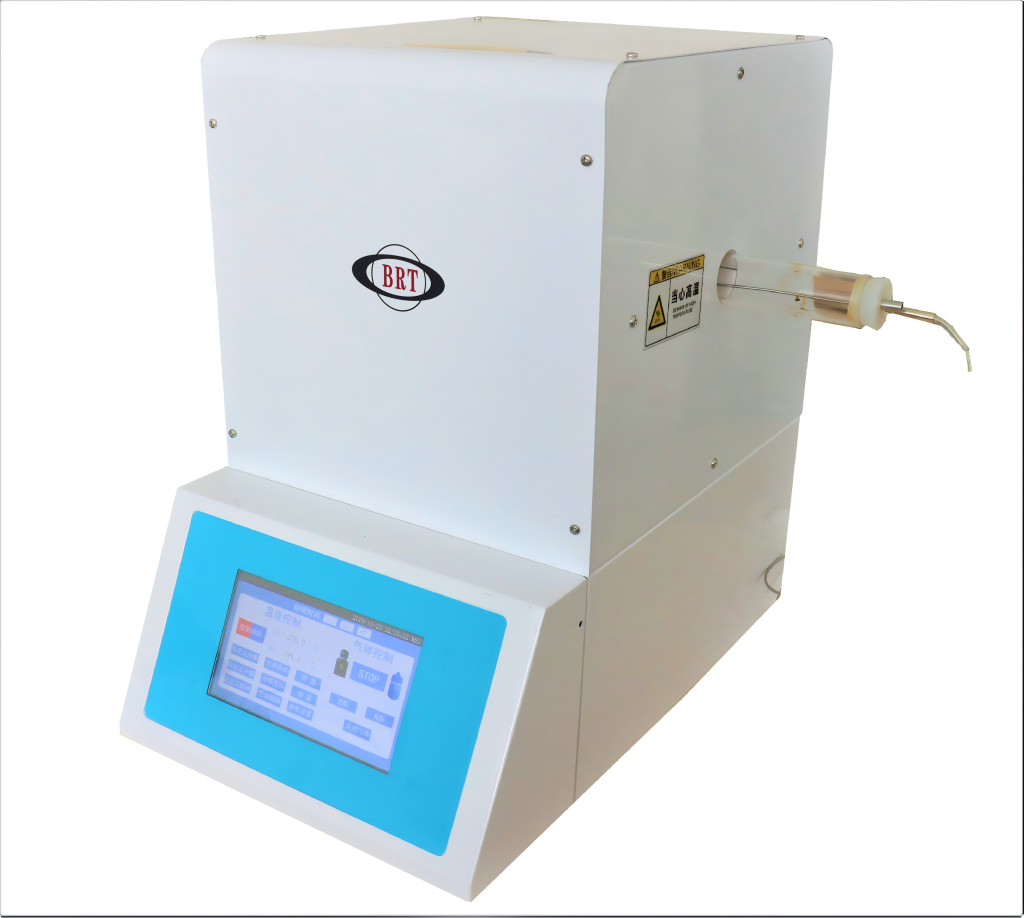
What Is a Carbon Black Content Tester?
A carbon black content tester is a laboratory instrument that measures the percentage of carbon black present in a plastic or rubber sample by weight, using a gravimetric combustion method. The sample is subjected to high-temperature combustion, and the mass difference before and after each stage of the process yields the carbon black percentage.
The tester is used for quality control and material research in plastic manufacturing, cable insulation and membrane production — wherever UV resistance and mechanical performance depend on getting the carbon black level right.
Carbon Black Content vs. Carbon Black Dispersion
Two different instruments test the same carbon black in a material but present two different parameters — and it is completely possible for a material to pass the content test and fail the dispersion test:
| Property | Carbon Black Content Tester | Carbon Black Dispersion Tester |
|---|---|---|
| What it measures | Quantity of carbon black present (% by weight) | Uniformity of carbon black distribution in the polymer matrix |
| Test principle | High-temperature combustion (gravimetric) | Optical microscopy / image analysis |
| Output | Percentage figure (e.g., 2.3%) | Dispersion rating or grade (e.g., Grade 1–5) |
| Primary standards | ASTM D1603, ASTM D4218, ISO 6964 | ISO 18553, ISO 11420 |
Agglomeration of carbon black particles creates weak points in the polymer structure and reduces UV protection — which is why dispersion testing complements content testing in comprehensive quality programs.
How the Carbon Black Content Test Works
The high-temperature combustion method is a two-stage process:
Pyrolysis — the sample is placed in a combustion boat inside a tube furnace at temperatures between 550 °C and 600 °C. Nitrogen constantly purges the furnace, creating an inert environment in which the polymer decomposes and volatilizes without the carbon black oxidizing. The remaining residue consists of carbon black plus any inorganic fillers.
Oxidation — the combustion boat is placed in a muffle furnace at 600 °C. In the presence of oxygen, the carbon black burns completely, leaving only inorganic ash. The mass difference between the two stages equals the carbon black mass.
Calculation formula (ASTM D1603):
% Carbon Black = ((mass of residue from tube furnace − mass of residue from muffle furnace) / original sample mass) × 100
Standards for Carbon Black Content Testing
- ASTM D1603 — carbon black content in olefin plastics (polyethylene, polypropylene, polybutylene) using a tube furnace under an inert atmosphere
- ASTM D4218 — an alternative for black polyethylene compounds, conducted entirely in a muffle furnace for high-throughput tests
- ISO 6964 / GB/T 13021 — polyolefin pipes and fittings: determination of carbon black content by calcination and pyrolysis (tubular electric furnace method)
- IEC 60811-4-1 / GB/T 2951.41 — direct burning method for carbon black and mineral filler content in cable and optical cable insulation and sheath materials
- JTG E50 — carbon black content test by thermal weight loss method for highway geosynthetic materials
BRT-1000D: Fully Automatic Carbon Black Content Testing
The BRT-1000D carbon black content tester is designed for polyolefin materials, complying with GB, ISO and IEC standards, with the intelligence and automation modern laboratories expect.
Full automatic intelligent control
- Automatic nitrogen/oxygen gas switching — no manual intervention between pyrolysis and oxidation stages
- PID programmable temperature control with automatic memory of temperature settings; experiment completion alarm
- Temperature program segments (pyrolysis, decomposition and calcination) are auto-stored — a single button press starts the whole process
Intuitive 7-inch touch screen
- Real-time display of temperature, gas status and test progress — current temperature, decomposition status, pyrolysis status, constant-temperature status and nitrogen/oxygen charging status at a glance
Ultra-wide temperature range
- Room temperature up to 999.9 °C with superior nano thermal insulation material ensuring uniform furnace temperature
- Heating zone length 300 mm; combustion tube Ф32 mm × 450 mm; resistance wire heating
Dual industry-specific configurations
- Separate combustion chambers and gas flow parameters for two industries:
- Wire & cable industry — flow rate 3 L/min (0.1 L/min scale); combustion vessel 70 × 16 × 11 mm
- Pipeline material industry — flow rate 250 mL/min (12.5 mL/min scale); combustion vessel 55 × 7 × 9 mm
Integrated data output
- After entering the weighing value, the system automatically calculates carbon black content, ash content and filler content
- Built-in mini thermal printer for direct result printing on site
- Power supply AC 220 V / 50 / 60 Hz, rated power 1.5 kW; compact host 49 × 30 × 50 cm
Who Needs the BRT-1000D?
- Polyethylene, polypropylene and polybutylene pipe manufacturers — verifying carbon black content of pipe materials and fittings
- Wire and cable manufacturers — carbon black and filler content testing of insulation and sheath materials
- Geomembrane and geosynthetic producers — highway engineering material testing per JTG E50
- Quality control laboratories, research institutes and third-party testing bodies
Maintaining Your Carbon Black Content Tester
To keep the tester in best performance: inspect combustion boats before each test for cracks, contamination and glaze deposits; clean the furnace tube by heating it to about 700 °C in air to oxidize deposits; calibrate temperature every 3 months or after every 100 tests, whichever comes first; and check gas fittings, tubing and connections for leaks monthly — gas leaks can compromise test quality by introducing oxygen during pyrolysis.
FAQ
What is a carbon black content tester? A carbon black content tester is a laboratory instrument that measures the percentage of carbon black in a plastic or rubber sample by weight using a gravimetric high-temperature combustion method — pyrolysis in a tube furnace under nitrogen, followed by oxidation in a muffle furnace, with the mass difference giving the carbon black content.
Which standards apply to carbon black content testing? Common standards include ASTM D1603 and ASTM D4218 for olefin plastics, ISO 6964 / GB/T 13021 for polyolefin pipes and fittings, IEC 60811-4-1 / GB/T 2951.41 for cable insulation and sheath materials, and JTG E50 for geosynthetic materials.
Why is carbon black content important in plastic pipes? Carbon black provides UV protection and reinforcement to polyolefin materials. Too little carbon black leads to UV degradation of the material; too much can affect mechanical properties — so precise content control is essential for outdoor pipe performance.
What is the difference between carbon black content and dispersion? Content measures how much carbon black is present (percentage by weight, via combustion), while dispersion measures how uniformly carbon black is distributed in the polymer matrix (via optical microscopy, graded per ISO 18553). A material can pass one and fail the other.
Which materials can the BRT-1000D test? Polyethylene, polypropylene and polybutylene plastics — including pipe materials and fittings, cable insulation and sheath materials, and highway geosynthetics — with dedicated combustion chamber configurations for the wire & cable and pipeline industries.
Get a Quote
Need a reliable carbon black content tester for pipe, cable or geosynthetic material QC? Contact Shenyang Baoruitong Automation Equipment Co., Ltd. today for the BRT-1000D datasheet, test procedure guidance and a customized quotation. Every BRT instrument is backed by a 1-year warranty, installation guidance, operation training and long-term after-sales support.
Email: info@brt-test.com | WhatsApp: +86 15604057553 | Web: www.brt-test.com