
Melt Flow Tester: Why This Instrument Is Crucial in the Plastic Industry
Have you ever wondered how plastic products achieve their precise dimensions and consistent quality, despite the complex nature of the manufacturing process?
The answer lies in a critical instrument known as the melt flow tester — also known as the melt flow indexer or MFI tester. It evaluates the melt flow rate (MFR) and melt volume-flow rate (MVR) of plastic materials under controlled conditions of temperature and pressure. By measuring the ease with which a molten plastic flows through a standardized die, the melt flow tester provides invaluable insights into the material’s viscosity, flow behavior and processability — information that is indispensable for every plastic industry player seeking to fine-tune production processes, troubleshoot material inconsistencies and deliver superior products to the market.
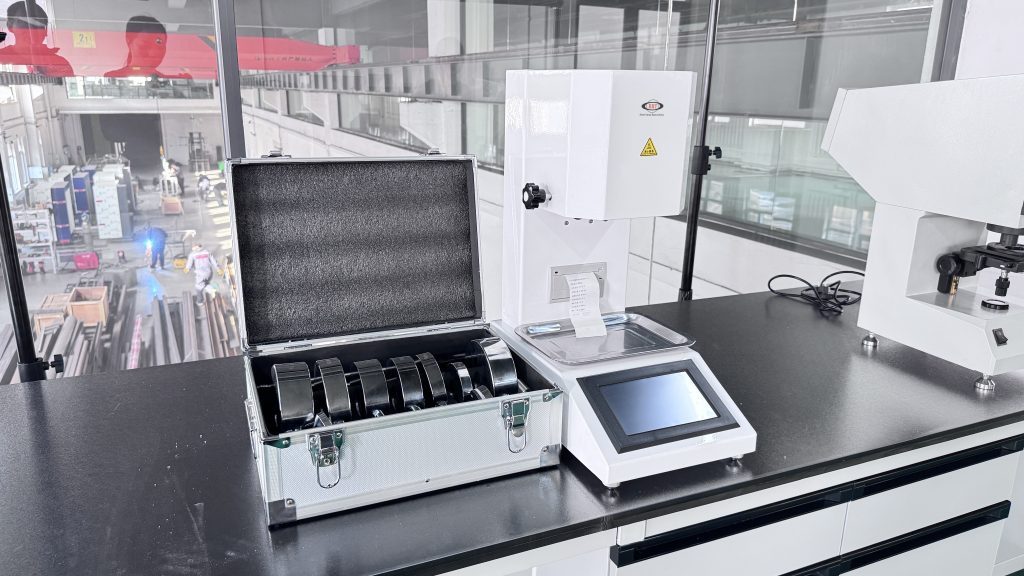
As a professional manufacturer of testing instruments, Baoruitong Automation Equipment Co., Ltd. (BRT) presents this guide to melt flow testing and its BNR-400B Melt Flow Rate Tester — engineered for accurate, repeatable MFI testing in quality control and material selection.
What Is Melt Flow Testing?
Melt flow testing, often referred to as Melt Flow Index (MFI) testing, is a critical method used in the plastics industry. It measures the flow characteristics of thermoplastic polymers by determining how many grams of polymer flow through a standardized die under specified conditions. The Melt Flow Index is frequently listed on the data sheets of thermoplastic materials, providing valuable information about their flow properties.
The melt flow tester is widely used to determine the viscosities of materials and ensure batch-to-batch consistency. It is particularly popular for evaluating the melt mass-flow rate (MFR) and melt volume-flow rate (MVR) of a plastic melt — information crucial for quality assurance, incoming goods inspections, material selection and the setup of processing machines.
Understanding MFR and MVR
Melt Flow Rate (MFR) — also referred to as Melt Flow Index (MFI) — measures the flowability of a molten plastic material as the weight of material that flows through the standardized die during a specified time, typically expressed in grams per 10 minutes (g/10 min). A higher MFR indicates better flowability; a lower MFR suggests higher viscosity and reduced flowability.
Melt Volume-Flow Rate (MVR) measures the volume of molten material that flows through the die, typically expressed in cubic centimeters per 10 minutes (cm³/10 min). As with MFR, a higher MVR indicates better flowability.
MFR and MVR values help manufacturers compare different grades of the same polymer, evaluate processability and ensure consistent quality control. Note that the two parameters are not interchangeable unless melt density is accounted for — a common industry approach is to convert MVR to MFR by multiplying MVR by the melt density at the test condition.
Why Melt Flow Testing Matters
1. Assessing material processability — under controlled temperature and pressure, manufacturers can assess how easily a molten plastic flows, determining its suitability for injection molding, extrusion and blow molding.
2. Predicting processing behavior — MFR and MVR data provide insight into how a material will behave under different processing conditions, enabling parameter optimization and troubleshooting.
3. Quality control and compliance — melt flow testing is commonly used to measure and monitor the flow properties of raw materials, intermediate products and finished goods, ensuring products meet specifications and comply with international standards such as ASTM D1238 and ISO 1133.
4. Comparative analysis and material selection — evaluating the melt flow index of different grades supports informed material selection, optimizes formulations, reduces costs and improves product performance.
5. Driving innovation and efficiency — the insights gained from melt flow testing help manufacturers develop new materials and optimize processing techniques to stay competitive.
The Melt Flow Index Test Procedure
The standardized procedure follows established methods such as ASTM D1238 or ISO 1133:
- Specimen preparation — weigh a specific quantity of resin and form it into pellets, flakes or granules, then dry it to remove moisture that could affect results
- Loading the specimen — load the prepared sample into the temperature-controlled cylindrical barrel
- Heating the barrel — heat to the material-specific temperature, maintaining precise, controlled temperature throughout
- Extrusion process — force the molten plastic through a standardized die of specific diameter and length
- Measuring the extruded material — measure the weight of material extruded over a predetermined time
- Measurement and calculation — express the flow rate as grams per 10 minutes, giving the melt flow index
Advantages of Melt Flow Index Testing
- Quality assurance and batch-to-batch consistency — identify variations that may impact final product performance
- Material selection and optimization — determine which materials are most suitable for specific applications
- Process optimization and machine setup — tune temperature, pressure and extrusion rates for desired product characteristics
- Quality control and incoming goods inspections — verify raw materials received from suppliers against specified standards
- Cost reduction and waste minimization — reduce defects, scrap rates and material waste
- Regulatory compliance — meet standards such as ASTM D1238 and ISO 1133 with confidence
- Troubleshooting — identify root causes of poor flow or inconsistent quality during production
Choosing the Right Melt Flow Tester
When selecting a melt flow tester, review its specifications — temperature range, load range, test method compatibility and extrusion rate control — as well as automation capabilities, user interface and build quality. Choose equipment that complies with international standards such as ASTM D1238 or ISO 1133 to ensure consistent, comparable results across laboratories.
BRT’s Solution: BNR-400B Melt Flow Rate Tester
The BRT BNR-400B Melt Flow Rate Tester is built to deliver the precision that melt flow testing demands.
- Micron-level die and barrel tolerances — die diameter 2.095 ± 0.005 mm, die length 8.000 ± 0.025 mm; barrel diameter 9.550 ± 0.025 mm, length 152 ± 0.1 mm, with piston rod head held to the same tight tolerances — the foundation of data credibility
- Eight standard load levels from 0.325 kg to 21.600 kg — covering polyethylene, polypropylene, polyoxymethylene, ABS resin, polycarbonate, nylon, fluoroplastics and other thermoplastics, with weight relative error within 0.5% and combination logic strictly matched to each standard load
- Wide, stable temperature control — 30 °C to 450 °C range with constant-temperature accuracy of ±0.2 °C, critical for temperature-sensitive resins
- Compact bench footprint — 250 × 360 × 514 mm, ideal for quality departments and small-to-mid-size molding shops
- Designed for melt mass-flow rate (MFR) and melt flow index testing in line with ISO 1133 / GB/T 3682 requirements
FAQ
What standards are most commonly used for melt flow testing? Melt flow testing is most commonly performed under ISO 1133-1 and ASTM D1238, which define standardized procedures for determining melt mass-flow rate (MFR) and melt volume-flow rate (MVR) using an extrusion plastometer (melt flow indexer) at specified temperature and load conditions.
What is the difference between MFR and MVR? MFR reports how much material flows by mass (typically g/10 min), while MVR reports how much material flows by volume (typically cm³/10 min) under the same standardized conditions. Both describe polymer flowability, but they are not interchangeable unless melt density is accounted for.
Can you convert MVR into MFR? Yes. A common industry approach is to multiply MVR by the melt density at the test condition to obtain MFR, since MVR is volumetric flow and MFR is mass flow. Note that melt density is not always the same as room-temperature density shown on a material datasheet.
Which materials can the BNR-400B test? Polyethylene, polypropylene, polyoxymethylene, ABS resin, polycarbonate, nylon and fluoroplastics, among other thermoplastics — with 8 standard load levels from 0.325 kg to 21.600 kg covering each material’s load requirements.
Why is temperature precision critical in melt flow testing? Even one or two degrees of temperature drift can noticeably skew melt flow results for temperature-sensitive resins. The BNR-400B holds constant-temperature accuracy at ±0.2 °C across a 30–450 °C range.
Get a Quote
Need a reliable melt flow tester for plastic industry quality control or incoming material inspection? Contact Baoruitong Automation Equipment Co., Ltd. today for the BNR-400B datasheet, test procedure guidance and a customized quotation. Every BRT instrument is backed by a 1-year warranty, installation guidance, operation training and long-term after-sales support.
Email: info@brt-test.com | WhatsApp: +86 15604057553 | Web: www.brt-test.com