
How to Choose a UV-Vis Spectrophotometer in 2026: A Buyer's Guide
Precise quantitative analysis remains the cornerstone of modern life science and chemical research — and a reliable spectrophotometer is one of the most critical investments any facility can make.
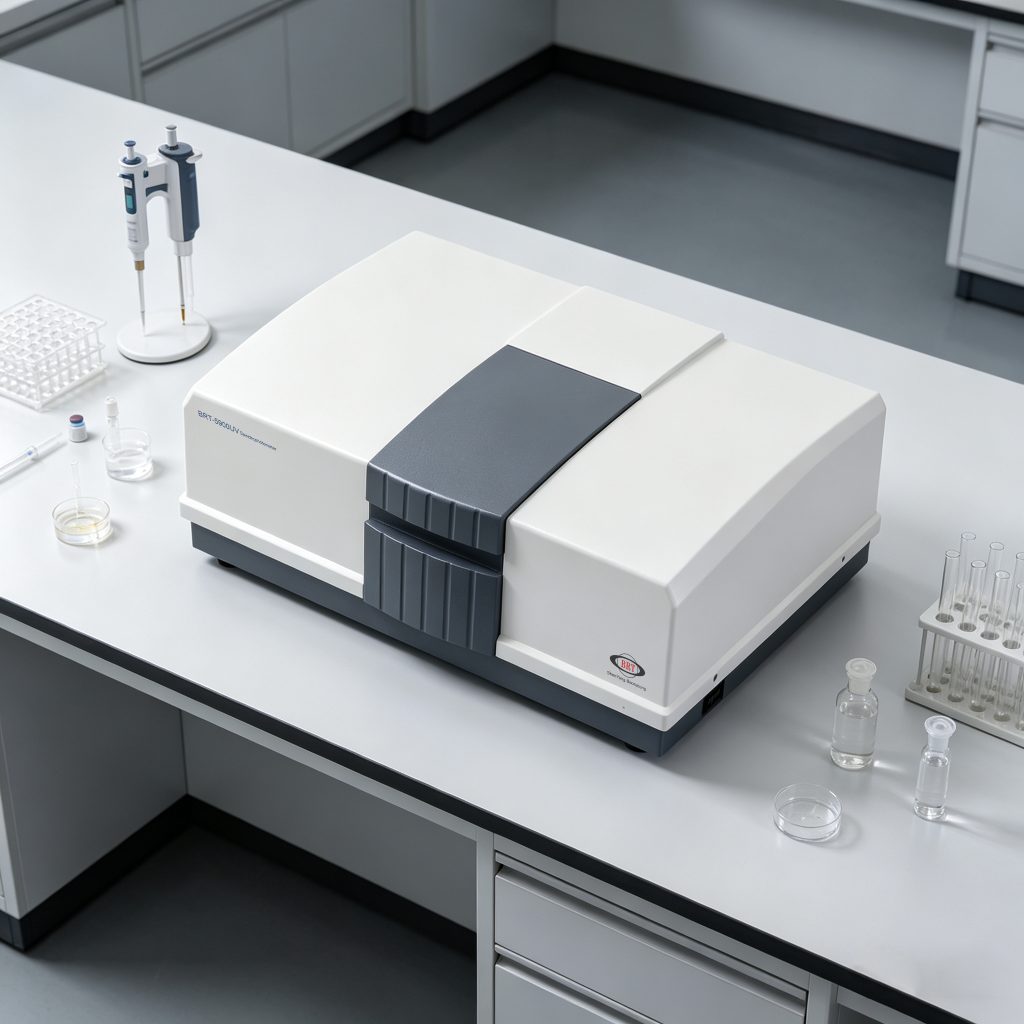
Laboratory professionals selecting equipment in 2026 must balance sensitivity, throughput requirements and data compliance features to ensure long-term operational efficiency. With leading instruments on the market priced from roughly 7,000to7,000to29,000 USD, the choice can feel overwhelming. This guide explains what really matters when buying a UV-Vis spectrophotometer — and introduces a high-precision double-beam instrument that delivers professional-grade performance at a sensible investment: the BRT-5900UV from Baoruitong Automation Equipment Co., Ltd. (BRT).
What to Look For When Buying a UV-Vis Spectrophotometer
Before comparing models, it pays to understand the five specs that decide whether an instrument will serve your lab well for years:
1. Wavelength range
Most modern UV-Vis spectrophotometers cover roughly 190–1100 nm, spanning the ultraviolet and visible spectrum. A wider range supports more applications — from nucleic acid and protein quantification in life sciences to color and concentration measurements in industrial QC. The 190–900 nm range of the BRT-5900UV covers the full UV-Vis analysis spectrum used in routine and research laboratories.
2. Resolution and bandwidth
Resolution determines how finely the instrument can distinguish adjacent spectral features. In practice, buyers should check both wavelength resolution and spectral bandwidth — narrower values mean finer detail and better separation of closely spaced peaks. The BRT-5900UV delivers a 0.05 nm wavelength resolution with 1.0 nm spectral bandwidth — performance that holds its own against instruments priced far higher.
3. Stray light
Stray light is the enemy of accurate absorbance readings: scattered light reaching the detector inflates measured values and ruins linearity at high absorbance. Premium instruments target stray light below 0.1%T — the BRT-5900UV achieves 0.015%T, giving high-accuracy measurements even at elevated absorbance levels.
4. Accuracy and repeatability
Wavelength accuracy (the deviation of reported vs. true wavelength) and repeatability (run-to-run consistency) determine whether your results are trustworthy and reproducible. The BRT-5900UV holds wavelength accuracy of ±0.3 nm with 0.1 nm repeatability and transmittance accuracy of ±0.3 %T.
5. Usability and data handling
Modern labs need instruments that are simple to operate and integrate with data systems. Built-in quantitative functions, automatic calibration, storage of standard curves and USB data export save hours every week — features the BRT-5900UV includes as standard.
Double-Beam Design: Why It Matters
The market’s top-tier instruments — including the Shimadzu UV-1900i Plus category leader reviewed in LabX’s 2026 buyer’s guide — are built on double-beam optics. In a double-beam system, light is split between the sample and a reference path, so lamp drift and environmental changes affect both paths equally and cancel out. The result is dramatically better baseline stability and accuracy than single-beam designs — essential for trace-level measurements and long-run quantitative work.
The BRT-5900UV is a true professional double-beam UV/Vis spectrophotometer: a C-T monochromator with a 1600 L/mm holographic grating and a high-sensitivity photomultiplier detector, paired with stable deuterium and tungsten light sources (with automatic lamp switching). This optical architecture delivers ultra-low drift and excellent baseline flatness (≤ ±0.001 Abs), keeping results consistent from sample to sample and day to day.
BRT-5900UV: Professional Features, Practical Design
- Wavelength range 190–900 nm, wavelength resolution 0.05 nm, spectral bandwidth 1.0 nm
- Wavelength accuracy ±0.3 nm, repeatability 0.1 nm, transmittance accuracy ±0.3 %T
- Stray light 0.015%T, baseline flatness ≤ ±0.001 Abs
- Measuring range 0–200%T, −4000–4.000 Abs, with photometric, quantitative and kinetic measurement functions
- Automatic wavelength calibration on startup, automatic 0A/100%T calibration, independent deuterium/tungsten lamp control with adjustable switching points
- Built-in quantitative function with spectrum display, regression equation and automatic curve saving — up to 200 data sets and standard curves stored on board
- Spacious sample chamber accepting cuvettes from 5 mm to 100 mm; supplied with 4 quartz cuvettes and 4 glass cuvettes (10 mm)
- USB data export compatible with optional professional analysis software; parallel port printing support
- LCD dot-matrix display simultaneously showing T and A; light-touch button interface for simple operation
- Compact footprint (620 × 510 × 245 mm, 30 kg)
Who Needs the BRT-5900UV?
- Pharmaceutical and chemical QC laboratories — concentration and purity testing with documented accuracy
- Life science research — nucleic acid and protein quantification, enzyme assays and kinetics
- Environmental and water testing labs — trace contaminant measurement
- Food and beverage analysis — quantitative composition testing
- University teaching and research laboratories — reliable, easy-to-operate photometry
FAQ
What is a UV-Vis spectrophotometer? A UV-Vis spectrophotometer measures the absorbance or transmittance of a sample across the ultraviolet and visible wavelength range, enabling quantitative analysis of concentration, purity and optical properties of substances — one of the most widely used instruments in laboratory analysis.
What is the difference between double-beam and single-beam spectrophotometers? A double-beam instrument splits light between sample and reference paths, cancelling out lamp drift and environmental interference for superior baseline stability and accuracy. Single-beam designs are simpler and lower-cost but more susceptible to drift over time.
Which specifications matter most when buying a spectrophotometer? Wavelength range, resolution and bandwidth, stray light, wavelength accuracy and repeatability, photometric range, and data handling features — these five factors determine measurement quality, reproducibility and long-term usability.
What is stray light and why does it matter? Stray light is unwanted scattered light reaching the detector, which inflates absorbance readings and ruins linearity at high concentrations. Lower stray light — such as the BRT-5900UV’s 0.015%T — means more accurate high-absorbance measurements.
What applications is the BRT-5900UV suitable for? Pharmaceutical and chemical QC, nucleic acid and protein quantification, environmental and water testing, food analysis, and university teaching and research — with photometric, quantitative and kinetic measurement functions and USB data export.
Get a Quote
Need a reliable UV-Vis spectrophotometer for your laboratory? Contact Shenyang Baoruitong Automation Equipment Co., Ltd. today for the BRT-5900UV datasheet and a customized quotation. Every BRT instrument is backed by a 1-year warranty, installation guidance, operation training and long-term after-sales support.
Email: info@brt-test.com | WhatsApp: +86 15604057553 | Web: www.brt-test.com