
The Many Applications of FTIR Spectroscopy: One Technique, Countless Industries
From a mine site in the outback to a museum vault in Europe, one analytical technique is quietly doing the same job: identifying what a material is made of.
Fourier Transform Infrared (FTIR) Spectroscopy is one of a handful of techniques commonly used to analyse the molecular structure of different materials. While its adoption may be more recent than other, similar techniques, its use has quickly become more widespread — largely due to the unique benefits that this type of analysis can provide.
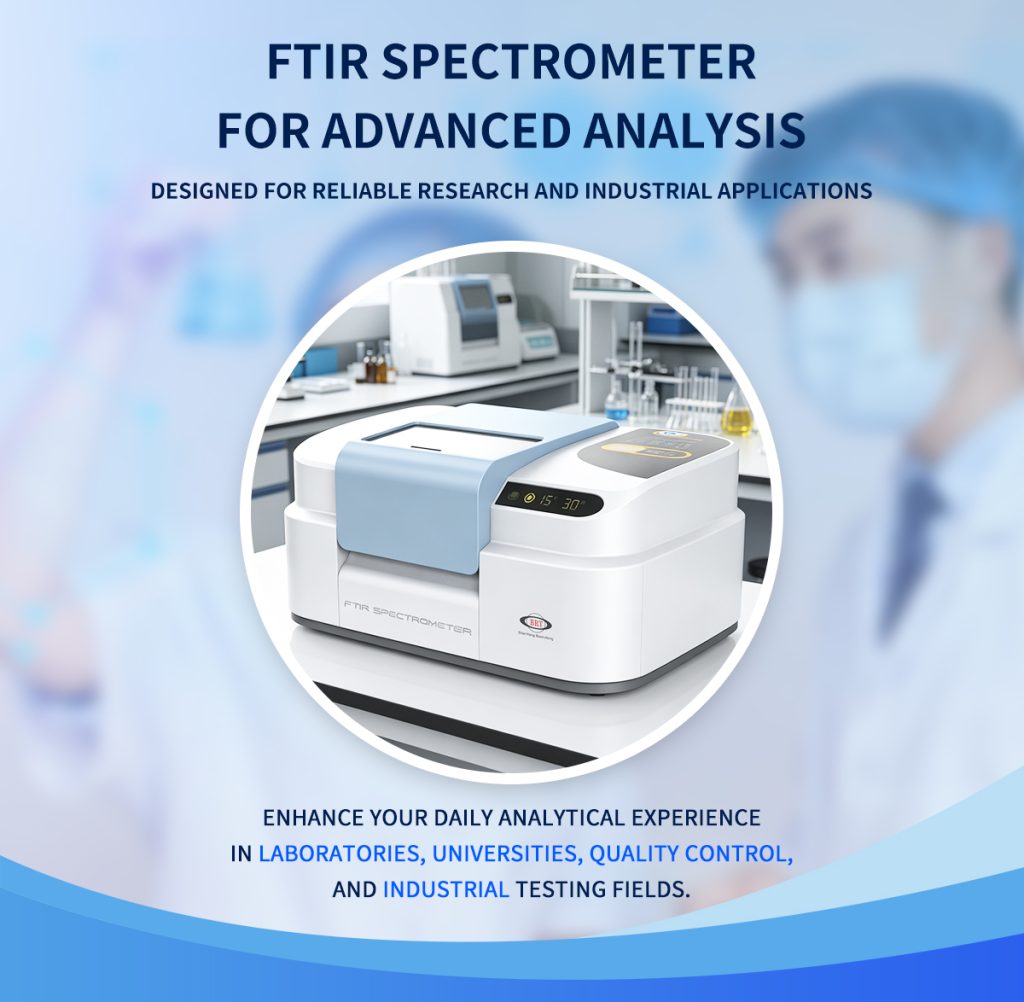
As a professional manufacturer of laboratory analysis instruments, Baoruitong Automation Equipment Co., Ltd. (BRT) presents this guide to the many applications of FTIR spectroscopy and its BRT-860 and BRT-890 FTIR Spectrometers — engineered for precise material identification, chemical testing and industrial quality control.
How Does FTIR Spectroscopy Work?
Every material interacts with different wavelengths of light in its own unique way. FTIR spectroscopy works by applying mid-infrared light (approximately 4000–400 cm⁻¹) to a sample. The absorption of different wavelengths is then measured and interpreted to provide a detailed analysis of the molecular composition.
As part of the interpretation, the Fourier transform mathematical function is used to convert the detector signal from a time domain to a frequency domain. This allows the entire spectrum to be analysed simultaneously, rather than on an individual wavelength basis.
Strengths of FTIR Spectroscopy
- Speed and efficiency — analysing the full spectrum simultaneously means a single FTIR test collects data that would require multiple readings with other techniques
- Accuracy — the breadth of analysis generally provides more accurate results than similar techniques
- Detail — provides a detailed breakdown of sample composition, including identification of the nature and concentration of trace elements and potential contaminants
- Non-destructive — FTIR testing can be performed without damaging the sample, which is critical for priceless objects
Applications of FTIR Spectroscopy
Identification of valuable minerals
In the high-risk, high-reward mining industry, reliable data on the mineral composition of a site is invaluable. During exploration, FTIR helps assess both the quality and quantity of valuable minerals present, supports calculation of the potential value of a deposit and planning of optimal extraction methods. Once mining has begun, regular FTIR testing tracks mineral concentration and purity in mined materials against projections.
Monitoring of quality in agricultural environments
FTIR spectroscopy provides an accurate assessment of the nutrient profile of soil, allowing producers to optimise activities and plan effective land management interventions. Its accuracy also means it can identify contaminants — including heavy metals and toxic chemicals — even at low levels, limiting the risk of harmful substances transferring to produce.
Testing of polymers and surface coatings
FTIR testing is used to understand the chemical composition of polymers for regulatory management, and supports quality assurance in polymer manufacturing — once a clear profile of the required composition is established, regular testing maintains that standard. It also supports early identification of harmful contaminants and helps determine material properties such as thermal stability.
Detection of degradation
As materials age, their chemical structure breaks down and produces degradation products. For example, paints degrade into metal soaps over time; metals and polymers lose density and form degradation products such as rust. FTIR testing helps identify early signs of degradation, informing conservation plans and proactive maintenance before failures pose safety risks.
Authenticating artworks and artefacts
With a significant share of “big name” artworks on sale at any given time suspected to be fakes, FTIR spectroscopy assists experts in confirming the age of objects and identifying restoration work — by analysing chemical makeup, testing allows experts to match materials with the alleged age of a piece. Because FTIR is non-destructive, this can be done without damaging potentially priceless objects.
BRT’s FTIR Spectrometer Solutions
To support these applications in the laboratory, Shenyang Baoruitong Automation Equipment Co., Ltd. (BRT) offers the BRT-860 and BRT-890 FTIR Spectrometers, both designed for precise, repeatable analysis across solid, liquid and gas samples.
BRT-860 FTIR Spectrometer — high performance for lab and industrial analysis
- Wavenumber range 7800–350 cm⁻¹ with resolution better than 1 cm⁻¹
- High signal-to-noise ratio of 30000:1 (P-P value, 4 cm⁻¹, 1 min scan)
- Wavelength repeatability better than 0.5 cm⁻¹; transmission accuracy better than 0.05%
- Sealed non-orthogonal Michelson interferometer with permanent alignment — excellent resistance to vibration and environmental interference
- High-resolution DLATGS detector with moisture-proof coating; KBr beamsplitter coated with Ge (Made in USA); long-life air-cooled IR light source
- Intelligent & automatic — real-time spectrum monitoring, automatic component identification, extensive spectral libraries and professional databases
- Compact footprint (450 × 350 × 210 mm, 14 kg) for efficient lab workspace use
BRT-890 FTIR Spectrometer — flagship precision for demanding applications
- 45000:1 signal-to-noise ratio with wavelength resolution better than 0.85 cm⁻¹
- DSP auto interferometer and humidity warning system for enhanced protection in demanding environments
- Same 7800–350 cm⁻¹ spectral range, ±0.05% transmission accuracy and sealed Michelson interferometer stability
- Advanced human-machine interaction with guided operation, one-click spectral library retrieval and intelligent analysis
- Applications: materials science, biopharmaceuticals, petrochemical, food safety, environmental testing, academic research and laboratory education
Both instruments deliver the accuracy, speed and detail that FTIR applications demand — from mineral analysis and polymer quality control to contaminant detection and degradation monitoring.
FAQ
What is FTIR spectroscopy? Fourier Transform Infrared (FTIR) spectroscopy is an analytical technique that applies mid-infrared light (4000–400 cm⁻¹) to a sample and measures how different wavelengths are absorbed, providing a detailed analysis of the material’s molecular composition.
What are the main applications of FTIR spectroscopy? FTIR spectroscopy is widely used for mineral identification in mining, soil and nutrient analysis in agriculture, polymer and coating testing, degradation detection in paints and metals, and authentication of artworks and artefacts — plus pharmaceutical, chemical, food safety and environmental analysis.
Why is FTIR faster and more accurate than other techniques? The Fourier transform converts the detector signal from time domain to frequency domain, allowing the entire spectrum to be analysed simultaneously instead of wavelength by wavelength. This makes FTIR faster, more accurate and capable of identifying trace elements and contaminants in detail.
Which BRT FTIR spectrometer should I choose? The BRT-860 offers 30000:1 SNR with better than 1 cm⁻¹ resolution for general lab and industrial analysis; the BRT-890 offers 45000:1 SNR with better than 0.85 cm⁻¹ resolution and a humidity warning system for demanding applications such as pharmaceutical and materials research.
Is FTIR testing destructive? No. FTIR spectroscopy is non-destructive — it can identify and analyse materials without damaging the sample, which is why it is used to authenticate priceless artworks and artefacts.
Get a Quote
Need a reliable FTIR spectrometer for material identification, polymer testing or chemical analysis? Contact Baoruitong Automation Equipment Co., Ltd. today for BRT-860/BRT-890 datasheets and a customized quotation. Every BRT instrument is backed by a 1-year warranty, installation guidance, operation training and long-term after-sales support.
Email: info@brt-test.com | WhatsApp: +86 15604057553 | Web: www.brt-test.com