
Single Burning Item (SBI) Test: How Building Material Fire Classification Works — BRT JCDT Apparatus
A flame in the corner of a room reveals a building material’s true colors.
News about a building facade catching fire tends to resurface every so often, and nearly every post-incident review circles back to the same question: how fast does the exterior material actually burn? That’s not something to guess at. The internationally accepted approach is to simulate a small fire as close to real conditions as possible — light a flame in the corner of a mock room and watch how it spreads across the material’s surface, how much heat it releases, how much smoke it produces. That is what the Single Burning Item (SBI) test is built to do, and it is one of the most authoritative fire classification methods recognized both in the EU and in China’s own building-material fire safety system.
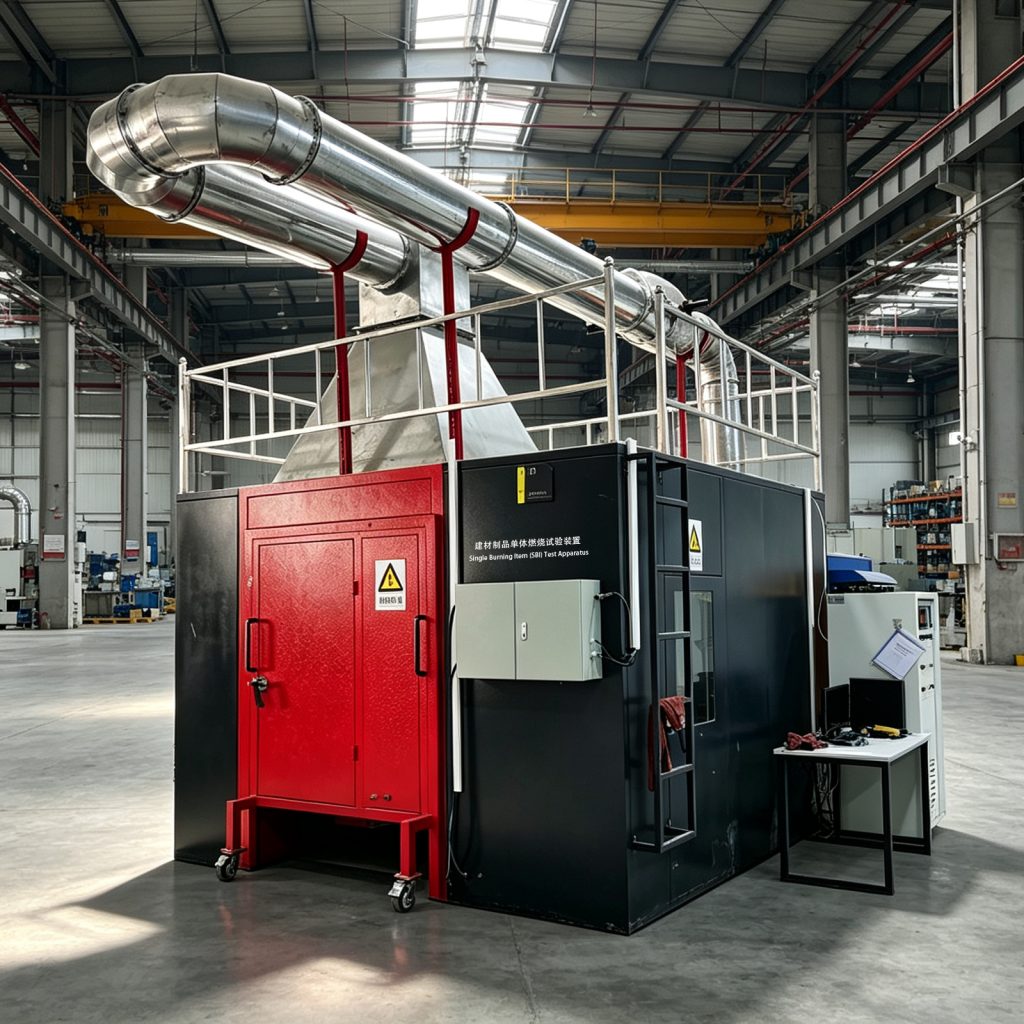
As a professional manufacturer of fire testing instruments, Baoruitong Automation Equipment Co., Ltd. (BRT) presents this guide to SBI testing and introduces the JCDT Single Burning Item Test Apparatus — engineered to turn “how dangerous is this material in a fire” into quantifiable, repeatable classification data.
What Is the Single Burning Item (SBI) Test?
The SBI test is the cornerstone of reaction-to-fire testing for construction products. What makes it valuable is that it comes far closer to a real fire scenario than a small-sample burn test ever could:
- A corner-configuration burner simulates a fire starting in the corner of a room
- A precision exhaust system collects the resulting smoke
- The system calculates the material’s heat release rate, THR600s (total heat release over 600 seconds), fire growth rate index (FIGRA) and smoke growth rate index (SMOGRA) in real time
- The results ultimately assign the material its fire classification — determining whether it can be used on high-rise facades and other applications with strict fire classification requirements
The test sounds sophisticated — and it is. But what actually determines whether the data can be trusted comes down to how precisely every variable is controlled: is the exhaust flow stable, are the thermocouples reading accurately, is the pressure sensor sensitive enough? Slip on any one of these, and the FIGRA and SMOGRA figures that come out may no longer reflect the material’s real fire performance.
JCDT: Built Around Getting the Details Right
The BRT JCDT Single Burning Item Test Apparatus was built around exactly these precision requirements, delivering a complete SBI test solution for building material manufacturers, research institutes and third-party testing bodies.
Precision exhaust and measurement system
- Automatically controlled exhaust flow rate of 0.5 to 0.65 m³/s, keeping smoke collection stable and repeatable
- High-precision pressure sensor rated 0–200 Pa at ±2 Pa accuracy, keeping smoke flow measurement reliable
- Imported K-type sheathed thermocouples with exhaust duct temperature accuracy held within ±0.5 °C
- Time recording accurate to 0.1 seconds, with data collected every 3 seconds for a complete fire development curve
Fully automated data acquisition and calculation
- The system automatically logs output from the mass flow controller, pressure probe, thermocouples, gas analyzer and white-light smoke measurement system
- The computer calculates heat release rate, FIGRA and SMOGRA on its own — no manual post-processing needed, which naturally keeps error to a minimum and delivers audit-ready, certification-grade data
Service-friendly structural design
- The combustion chamber sits on a detachable, assembled cabinet frame for easier maintenance and part replacement
- The exhaust duct, collection hood and collector all use double-layer insulation, keeping data collection from being thrown off by outside temperature swings
- The combustion control system runs a dedicated solenoid valve alongside proportional combustion and automatic furnace-pressure regulation, giving the fire source noticeably steadier behavior than older-style units
- The exterior design draws on lessons from comparable products at home and abroad — compact, clean-looking, and reported by many customers to swap in for imported equipment without any compromise
Who Needs the JCDT SBI Test Apparatus?
- Building material manufacturers verifying fire classification of facade panels, insulation materials, boards and composite materials
- Research institutes studying reaction-to-fire performance of construction products
- Third-party testing bodies performing accredited fire classification testing under EN 13823 / GB/T 20284
- Projects for high-rise building facades and other applications with strict fire classification requirements
For these users, what this equipment really solves is turning a vague question — how dangerous is this material once it catches fire — into quantifiable, repeatable classification data, which directly determines whether a product can enter the market for critical applications.
FAQ
What is the SBI test? The Single Burning Item (SBI) test is a reaction-to-fire test method that simulates a fire starting in the corner of a room to measure how a building material contributes to fire growth, including heat release rate, THR600s, fire growth rate index (FIGRA) and smoke growth rate index (SMOGRA). It is the basis for fire classification of construction products under EN 13823 / GB/T 20284.
What is FIGRA? FIGRA (fire growth rate index) is a key SBI test parameter that measures how quickly a material’s heat release rate grows during the test. A lower FIGRA value indicates slower fire growth and better fire performance — a critical input for assigning fire classification.
What is SMOGRA? SMOGRA (smoke growth rate index) measures how rapidly a material produces smoke during a fire. Smoke is a major hazard in building fires, so SMOGRA directly influences the smoke classification of construction products.
Which standards use the SBI test? The SBI test is defined in EN 13823 in Europe and GB/T 20284 in China, and feeds into fire classification systems such as EN 13501-1 and GB 8624 for building materials and facades.
Why is SBI testing important for building facades? Building facade fires can spread rapidly across exterior surfaces. SBI testing provides quantified, standardized data on heat release and smoke production, helping regulators and engineers select materials with the fire classification required for high-rise buildings and other strict applications.
Get a Quote
Need a reliable SBI test apparatus for building material fire classification testing? Contact Shenyang Baoruitong Automation Equipment Co., Ltd. today for the JCDT datasheet, test procedure guidance and a customized quotation. Every BRT instrument is backed by a 1-year warranty, installation guidance, operation training and long-term after-sales support.
Email: info@brt-test.com | WhatsApp: +86 15604057553 | Web: www.brt-test.com