
UV-VIS vs VIS Spectrophotometer: Key Differences and Application Scenarios Explained
News Release — Shenyang, China — Shenyang Baoruitong Automation Equipment Co., Ltd., a professional manufacturer of laboratory test instruments and combustion testing equipment, today published an industry insight report on UV-VIS and VIS spectrophotometers — the two most widely used types of molecular absorption instruments in modern laboratories. Although their names look similar, they cover different wavelength ranges, use different components and serve different application scenarios. Choosing the right one determines whether your laboratory gets accurate results at the right cost. Every Baoruitong spectrophotometer is backed by a one-year warranty service period.
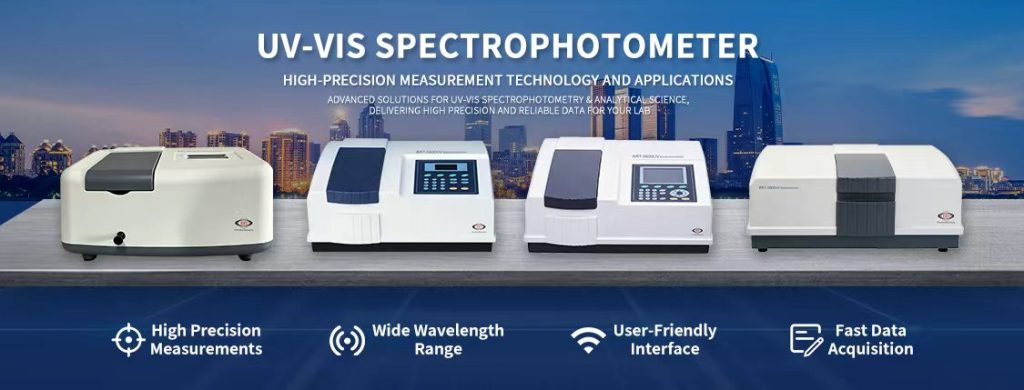
What Is the Difference Between UV-VIS and VIS Spectrophotometers?
The core difference lies in the wavelength range each instrument covers, which in turn determines the light source, optical components and applications.
| Aspect | UV-VIS Spectrophotometer | VIS Spectrophotometer |
|---|---|---|
| Wavelength range | Ultraviolet + visible, typically 190–900 nm (UV: 190–400 nm; Vis: 400–780 nm) | Visible range only, typically 320/340–780/900 nm |
| Light source | Deuterium lamp (UV) + tungsten-halogen lamp (visible) | Tungsten-halogen lamp only |
| Cuvette compatibility | Quartz cuvettes required for UV transmission; glass/plastic for visible | Glass or plastic cuvettes are sufficient |
| Monochromator design | Dual-source optical system with UV-capable optics | Single-source visible optical system |
| Measurement capability | Absorbance in UV and visible — including compounds with no visible color | Absorbance of colored solutions in visible light |
| Relative cost | Higher | More economical |
A UV-VIS spectrophotometer illuminates the sample across the full ultraviolet-visible range (typically 190 to 900 nm), allowing measurement of substances that absorb in the UV region — even when they are completely invisible to the eye. A VIS spectrophotometer (visible-light spectrophotometer) measures only in the visible region, where many substances do not absorb light unless they are colored or form colored complexes with reagents.
Application Scenarios: UV-VIS Spectrophotometers
Because UV-VIS instruments measure UV absorption, they are essential wherever compounds absorb light below 400 nm — a capability visible-only instruments cannot offer:
- Nucleic acid and protein quantification — measuring DNA, RNA and protein concentration and purity at 260 nm and 280 nm (the classic 260/280 ratio) for molecular biology and qPCR workflows
- Pharmaceutical quality control — assay and purity testing of drug substances, including aromatic and unsaturated compounds that absorb strongly in the UV
- Environmental and water quality analysis — detecting organic matter at 254 nm (UV254), nitrate, dissolved organic carbon and other water parameters
- Organic chemistry and R&D — characterizing chromophores, reaction monitoring and purity assessment of organic molecules
- Clinical diagnostics — enzyme assays and biochemical measurements based on UV absorbance
Application Scenarios: VIS Spectrophotometers
VIS-only instruments excel at colorimetric analysis — measuring solutions that are colored or become colored through chemical reactions:
- Colorimetric chemical analysis — quantifying metal ions (iron, copper, manganese), phosphates and other analytes that form colored complexes with reagents
- COD and water testing — chemical oxygen demand analysis and nutrient testing using color-forming reactions
- Food and beverage testing — color measurement of beverages, oils and food products; sugar and additive quantification
- Textile and dye industries — dye concentration measurement and color matching
- Education and training — cost-effective spectrophotometry instruction in schools and basic laboratories
- Quality control of colored products — paints, inks, cosmetics and plastics color verification

Which One Should Your Laboratory Choose?
The decision depends on the samples you measure and the analytical methods you run:
- Choose a UV-VIS spectrophotometer if you measure nucleic acids, proteins, pharmaceuticals, aromatic compounds or water quality parameters such as UV254 — or if your methods require UV wavelengths (190–400 nm). Its dual light source (deuterium + tungsten-halogen) and quartz cuvette optics deliver the full measurement capability.
- Choose a VIS spectrophotometer if all your methods are colorimetric — colored solutions, reagent-based color reactions, color matching or teaching applications. You gain the same reliable visible-range measurement at a lower acquisition cost and simpler maintenance.
For laboratories planning to grow, a UV-VIS spectrophotometer is the more future-proof investment, since it performs every visible-range test plus UV analysis — one instrument covering both application scenarios.
Why Choose Shenyang Baoruitong for Spectrophotometry
- Reliable measurement performance — accurate, repeatable absorbance measurement for confident analytical results
- Application-matched configuration — UV-VIS and VIS models to suit molecular biology, pharmaceutical, environmental and colorimetric workflows
- One-year warranty service period — professional after-sales support, calibration guidance and technical consultation included
- Laboratory instrumentation expertise — a manufacturer committed to precision engineering and international standard compliance
About Shenyang Baoruitong Automation Equipment Co., Ltd.
Shenyang Baoruitong Automation Equipment Co., Ltd. is a professional manufacturer of combustion testing instruments and laboratory equipment for the plastics, foam, textile, paper and building materials industries. Headquartered in Shenyang, China, the company is committed to precision engineering and international standard compliance, helping manufacturers worldwide verify product safety, improve quality control and meet regulatory requirements. Every instrument is backed by technical consultation, calibration guidance, after-sales support and a one-year warranty service period.
For more information about Shenyang Baoruitong’s spectrophotometers and laboratory instruments, pricing or a quotation, please contact our sales team or visit our website.
FAQ
Q1: What is the difference between UV-VIS and VIS spectrophotometers? UV-VIS spectrophotometers measure in both the ultraviolet (190–400 nm) and visible (400–780 nm) regions using deuterium and tungsten-halogen lamps, while VIS spectrophotometers measure only visible light using a tungsten-halogen lamp.
Q2: Why does a UV-VIS spectrophotometer need a deuterium lamp? The deuterium lamp provides continuous light in the ultraviolet region (below 400 nm), where the tungsten-halogen lamp cannot emit sufficient intensity — enabling UV absorbance measurements.
Q3: Do I need quartz cuvettes for a VIS spectrophotometer? No. Glass or plastic cuvettes are sufficient for visible-range measurements. Quartz cuvettes are required only when measuring UV wavelengths below approximately 340 nm.
Q4: What applications require a UV-VIS spectrophotometer instead of a VIS-only instrument? Nucleic acid and protein quantification (260/280 nm), pharmaceutical QC, water quality analysis (UV254) and organic compound characterization all require UV measurement capability — these are impossible with a VIS-only instrument.
Q5: Which spectrophotometer should a new laboratory buy? If budget allows, a UV-VIS spectrophotometer is the more future-proof choice: it covers all visible-range colorimetric methods plus UV analysis, serving both application scenarios with a single instrument.