
Cable Fire Testing: IEC 60332 Flame Propagation and IEC 60331 Circuit Integrity Explained
News Release — Shenyang, China — Shenyang Baoruitong Automation Equipment Co., Ltd., a professional manufacturer of combustion testing instruments and laboratory equipment, today published an industry insight report on cable fire testing and the laboratory capabilities behind IEC 60332, IEC 60331 and related fire-resistance standards. Cable fire safety is an important compliance consideration for building wiring, fire alarm circuits, emergency power systems, transportation infrastructure and industrial facilities — where cable behaviour during fire can directly affect system safety (source: KingPo Technology).
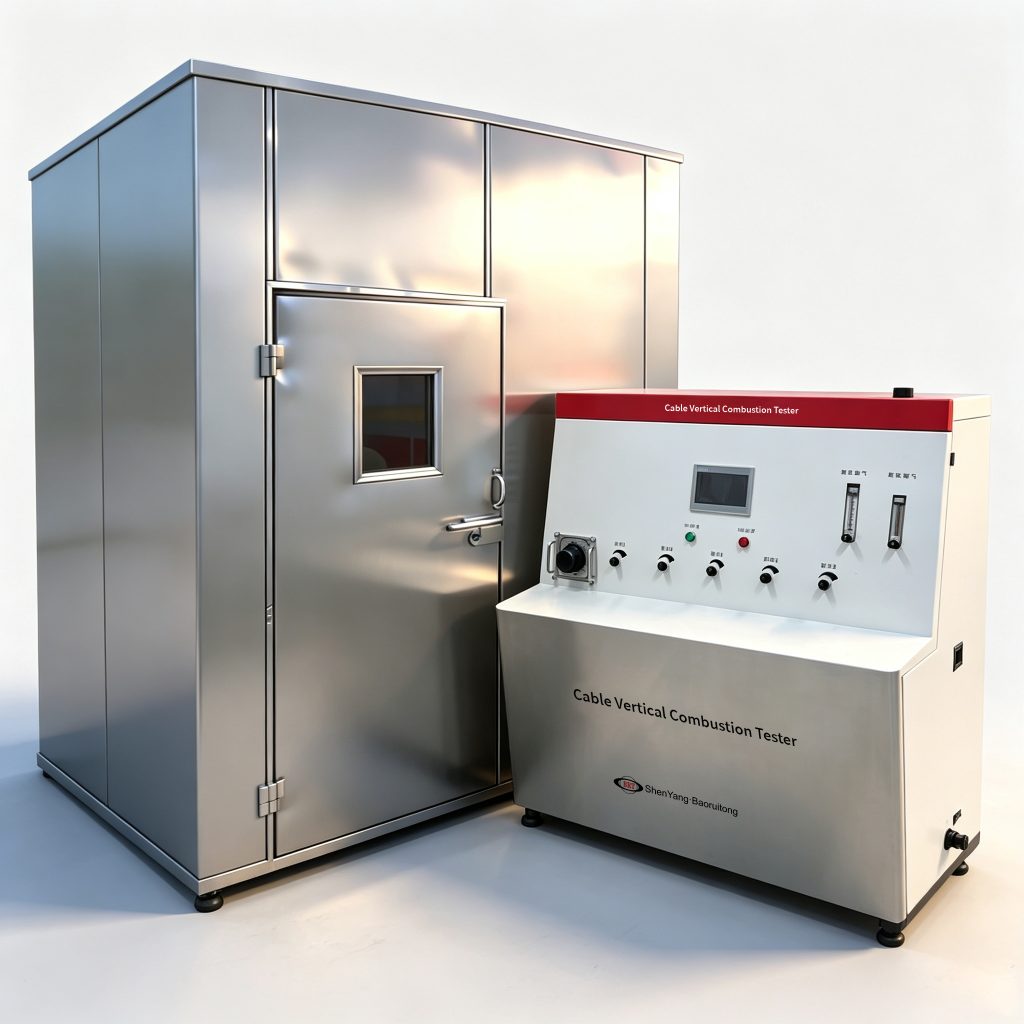
One Term, Many Different Tests
For cable manufacturers and laboratory engineers, the most important point about “cable fire testing” is that it does not describe one test, one standard or one machine. Two standards families address fundamentally different fire-safety questions:
- IEC 60332 primarily evaluates reaction to fire and flame propagation
- IEC 60331 addresses a different performance objective: whether a cable can maintain circuit integrity while exposed to specified fire conditions, sometimes combined with mechanical shock or water
The first engineering decision in a cable fire laboratory project should therefore be based on the required performance question — not simply on a standard number in a purchase request.
Key Standards for Cable Fire Testing
| Engineering Question | Typical Standard | Primary Evaluation |
|---|---|---|
| How far does flame propagate on one cable? | IEC 60332-1 | Single-cable vertical flame propagation |
| How does fire spread through multiple cables? | IEC 60332-3 | Bunched-cable vertical flame spread |
| How much smoke is generated? | IEC 61034 | Smoke density |
| What combustion gases are evolved? | IEC 60754 | Halogen acid gas, acidity and conductivity |
| Does the electrical circuit continue operating during fire? | IEC 60331 | Circuit integrity |
| Can the cable operate during fire and mechanical disturbance? | Applicable IEC 60331 part | Fire + mechanical shock |
IEC 60332-1: Single-Cable Vertical Flame Propagation
The IEC 60332-1 series addresses fire testing of a single insulated conductor, cable or optical fibre cable under defined flame exposure. IEC 60332-1-2:2025 specifies the procedure for testing resistance to vertical flame propagation using a 1 kW pre-mixed flame, with the associated apparatus defined by IEC 60332-1-1.
One important limitation: successful performance in a single-cable test does not demonstrate the behaviour of cables installed together as a group. Bunched-cable installations are addressed separately by IEC 60332-3.
Key engineering checks for an IEC 60332-1 tester include specimen support geometry, burner construction and positioning, stable propane and air supply, repeatable flame calibration, accurate flame-application timing, clear flame and damaged-length observation, controlled chamber ventilation, and safe post-test exhaust and gas shut-off.
IEC 60332-3: Bunched-Cable Flame Spread Testing
When several cables are installed together, their combined non-metallic material, spacing, mounting arrangement and airflow can produce substantially different fire behaviour from a single isolated cable. IEC 60332-3-10 defines the apparatus and arrangement for assessing vertical flame spread of vertically mounted bunched cables.
In practical terms, this is no longer a compact cabinet test: the system typically requires a large test enclosure, vertical cable ladder, defined specimen loading, burner system, controlled air supply and substantially greater exhaust capacity — often making it a laboratory engineering project rather than an individual equipment purchase.
UL 1581 VW-1 and CSA FT1 for North American Markets
Laboratories serving exporters to North America may also require vertical wire and cable flame testing per UL 1581 VW-1 and CSA FT1 methods. These should not be treated as interchangeable with IEC 60332 simply because all involve a flame and a vertically mounted specimen — burner configuration, flame-application sequence, specimen arrangement, timing, observation method and acceptance criteria must follow the exact referenced standard.
Smoke Density and Combustion-Gas Testing
Flame spread is only one aspect of cable fire performance. Burning polymeric cable materials can also produce dense smoke and corrosive combustion products that affect visibility, evacuation, sensitive equipment and occupied spaces.
- IEC 61034 (smoke density) requires a dedicated smoke-density chamber with an optical measurement path
- IEC 60754 (gases evolved during combustion) evaluates halogen acid gas content (Part 1) and corrosivity through acidity and conductivity (Part 2), using a different measurement chain of controlled combustion, gas capture and analytical measurement
A complete cable fire laboratory may therefore require several dedicated test stations rather than one universal combustion tester.
IEC 60331: Circuit Integrity — Fire Resistance Is Not Flame Retardancy
This distinction is particularly important for fire alarm circuits, emergency lighting, evacuation systems and critical control systems where electrical operation may need to continue after a fire has started. IEC 60331 asks: can the cable continue performing its required electrical function while exposed to the specified fire condition? The specimen’s electrical function is monitored during the test — not simply burned and inspected afterwards.
The IEC 60331 family covers different cable types:
- IEC 60331-1:2018 — circuit integrity under fire with mechanical shock, cables with overall diameter greater than 20 mm (up to 0.6/1.0 kV)
- IEC 60331-2:2018 — same for cables with overall diameter not exceeding 20 mm
- IEC 60331-3:2018 — fire and mechanical shock testing using a metal enclosure
- IEC 60331-4:2024 — circuit integrity for higher-voltage power cables above 0.6/1.0 kV up to 18/30 kV, including fire, mechanical-shock and optional water protocols
A circuit-integrity system is an integrated test system combining thermal exposure, electrical monitoring and, depending on the method, mechanical functions — including burner and flame-temperature control, energized test circuits, continuity monitoring, automatic failure-time detection, mechanical shock mechanism, safety interlocks and combustion exhaust.
Fire, Mechanical Shock and Water Scenarios
Real fire conditions can involve more than direct flame exposure: emergency circuits may need to function while structures are subjected to mechanical disturbance or while sprinkler systems operate. Capabilities include fire alone, fire with water, fire with mechanical shock, and fire with both — the exact scenario must be determined from the specific IEC, EN, BS or project requirement.
Designing a Cable Fire Testing Laboratory
The most common mistake in a cable fire laboratory project is completing the equipment list before utilities, safety systems and test-room infrastructure are defined. Key engineering considerations:
- Combustion gas and burner control — pressure regulation, calibrated flow meters and flame-verification equipment
- Exhaust and ventilation — sized at the design stage, protecting personnel without altering airflow around the specimen
- Electrical continuity monitoring — defined voltage source, multiple channels, automatic failure detection
- Mechanical shock system — compliant impact energy, sequence and timing
- Water spray, jet and drainage — controlled flow, pressure, nozzle positioning and electrical isolation
- Safety interlocks — coordinated gas shut-off, flame detection, door monitoring and emergency stop
- Data acquisition and traceability — structured electronic test records for certification and QC
What This Means for Cable Manufacturers and Laboratories
For manufacturers, certification bodies and testing laboratories serving infrastructure, transportation, emergency systems and international cable markets, the correct engineering sequence is: identify the required fire scenario first, determine the applicable standard and test method second, and only then define equipment, utility and safety-system requirements. A cable fire testing laboratory should be designed around the required fire scenario, specimen and compliance objective — not around a single test machine.
Why Choose Shenyang Baoruitong for Cable Fire Testing Equipment
- Standards-first engineering — flame testers and test systems for IEC 60332, IEC 61034, IEC 60754, IEC 60331, UL 1581 VW-1 and CSA FT1 workflows
- From single testers to laboratory systems — equipment and configuration support for cable fire laboratory projects
- One-year warranty service period — professional after-sales support, calibration guidance and technical consultation included
- Combustion testing expertise — a dedicated manufacturer of fire testing instruments for the cable, plastics, textile and building materials industries
About Shenyang Baoruitong Automation Equipment Co., Ltd.
Shenyang Baoruitong Automation Equipment Co., Ltd. is a professional manufacturer of combustion testing instruments and laboratory equipment for the plastics, foam, textile, paper and building materials industries. Headquartered in Shenyang, China, the company is committed to precision engineering and international standard compliance, helping manufacturers worldwide verify flame retardancy, improve product safety and meet regulatory requirements. Every instrument is backed by technical consultation, calibration guidance, after-sales support and a one-year warranty service period.
For more information about Shenyang Baoruitong’s cable fire testing equipment, pricing or a quotation, please contact our sales team or visit our website.
FAQ
Q1: What is the difference between IEC 60332 and IEC 60331? IEC 60332 evaluates reaction to fire and flame propagation of cables (single or bunched), while IEC 60331 tests circuit integrity — whether a cable continues to perform its electrical function while exposed to fire.
Q2: What is the IEC 60332-1 test? IEC 60332-1 tests resistance to vertical flame propagation of a single insulated cable or optical fibre cable using a 1 kW pre-mixed flame, as specified in IEC 60332-1-2.
Q3: What is IEC 60332-3 bunched cable testing? IEC 60332-3 assesses vertical flame spread of vertically mounted bunched cables, requiring a large test enclosure, cable ladder, controlled air supply and substantial exhaust capacity.
Q4: Why is smoke and gas testing important for cables? Burning cable materials produce dense smoke and corrosive gases that affect visibility, evacuation and sensitive equipment. IEC 61034 measures smoke density and IEC 60754 evaluates halogen acid gas content, acidity and conductivity.
Q5: What does IEC 60331 circuit integrity testing involve? IEC 60331 verifies that a cable maintains electrical continuity during fire — with mechanical shock and optional water scenarios — while its electrical function is monitored continuously. Parts 1–4 cover different cable diameters and voltage ratings.