
Drop Weight Impact Testers: The Complete Guide to Plastic and PVC Pipe Impact Testing
News Release — Shenyang, China — Shenyang Baoruitong Automation Equipment Co., Ltd., a professional manufacturer of plastics testing instruments and laboratory equipment, today published an industry insight report on drop weight impact testers — essential instruments for evaluating the impact resistance of plastic and PVC pipes. By dropping a precisely calibrated weight from a predetermined height onto a test sample, these machines verify that pipes can withstand external impacts during handling, transportation and installation without compromising their structural integrity (source: World of Test).
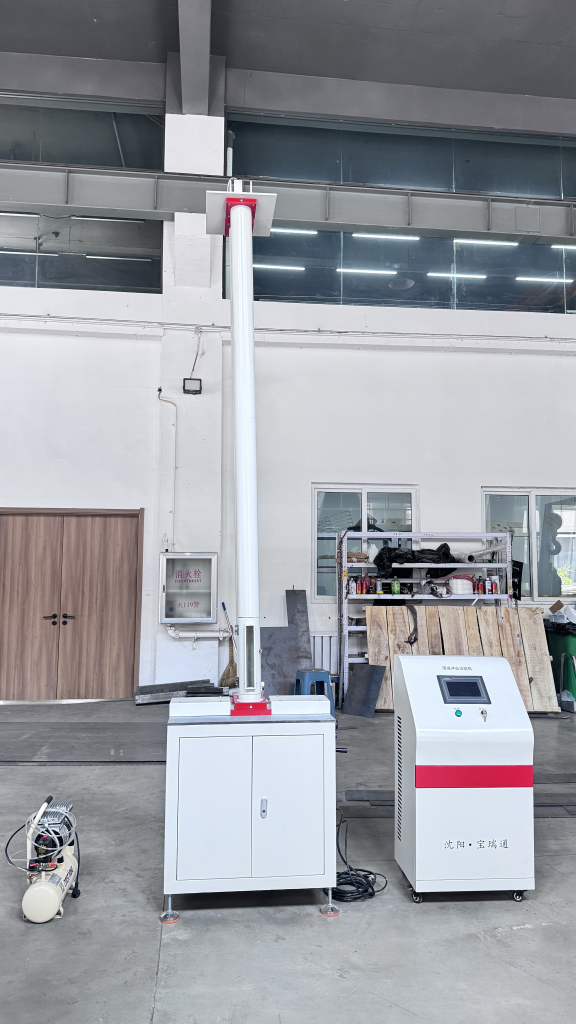
What Is a Drop Weight Impact Tester?
A drop weight impact tester — also known as a falling weight impact tester — is used to perform impact tests on plastic pipes, determining the true impact resistance of a batch or production run directly from the extruder. The tester drops a specified weight (a “tup”) from a controlled height onto the pipe sample, evaluating whether thermoplastic pipes and fittings meet the required impact resistance under specified test conditions.
These instruments are widely used across industries that require durable and reliable plastic or PVC materials:
- Plastic pipe and PVC pipe manufacturing — verifying durability and toughness for plumbing, drainage and industrial piping
- Quality control laboratories — consistent quality assurance in material production
- Research and development — assessing new materials and formulations for impact resistance
- Building and construction — ensuring compliance with safety and performance standards
Typical test samples include PVC and HDPE pipes, plastic sheets and panels, and other thermoplastic components.
How Drop Weight Testing Works
The core concept is elegantly simple: a substantial mass of metal — a precisely calibrated tup — is raised to a specific height using adjustable lift mechanisms, then released. The stored potential energy becomes a high-velocity descent, and on contact, the force is absorbed by the pipe test piece. Whether the polymer deflects slightly or shatters completely, the recorded data reveals exactly how much stress the material can withstand before reaching its limit.
The genuine engineering value lies in ensuring flawless, repeatable results: striker nose geometry, weight calibration and specimen clamping must all be precisely controlled so that measurements are clean, accurate and free of signal noise.
Full Standards Coverage for Pipe Impact Testing
Drop weight impact testers adhere to a broad family of international standards to ensure accuracy and reliability. A standards-compliant tester should cover:
| Standard | Scope |
|---|---|
| ASTM D2444 | Impact resistance of thermoplastic pipe and fittings by means of a tup (drop weight) — the core US standard for pipe impact testing |
| ISO 3127 | External impact resistance of unplasticized PVC (PVC-U), polyethylene (PE) and polypropylene (PP) pipes |
| ISO 4422 | Impact testing of PVC-U pipes for potable water supply |
| EN 744 | Impact resistance of thermoplastic pipes by the drop weight method |
| EN 1411 | Impact testing of PVC-U pipes used in sewer and drainage applications |
| DIN 30670 | Impact resistance of polyethylene coatings on steel pipes |
| BS EN 12061 | Impact strength testing of plastic piping systems |
| BS 5480 | Impact resistance testing of unplasticized PVC pipe systems for water supply |
| UL 651A | Performance requirements for rigid PVC conduit and fittings, including impact resistance in electrical installations |
Measurement Methodologies: Direct vs. Indirect
Advanced drop weight testers offer two complementary approaches to capturing impact data:
- Direct method — sensors placed inside the striking head catch the exact moment of contact, revealing the material’s full performance history. Striker head geometry must be carefully controlled for accurate results.
- Indirect method — instead of tracking the hit directly, the system measures the velocity of the falling weight or the reaction of the support base, requiring more analytical processing but providing an independent confirmation of measurement validity.
Configurations for Different Standards and Pipe Types
Because standard plumbing pipes do not fail the same way as thick electrical conduits, a falling weight impact tester must be configurable for what is on the test stand:
- ISO 3127 configurations — deliver consistent blows to circular cross-sections for external impact resistance testing of PE, PP and PVC-U pipes
- ASTM D2444 configurations — support tup weights of 6, 12, 20 or 30 lbs so thermoplastic fittings receive the exact force required by regulatory standards
- UL 651A high-density conduit configurations — handle heavy masses (up to 34 kg) on thick HDPE conduit while maintaining calibration under intense strikes
Key Features of a Quality Drop Weight Impact Tester
A dependable instrument combines precision mechanics with practical usability:
- High-precision weight drop mechanism — consistent results across multiple tests
- Customizable drop heights — adjustable settings for various test conditions
- Flexible weight system — calibrated striker noses and extra weights from 0.5 kg up to 16 kg for a full range of test forces
- Robust construction — engineered for durability in demanding production environments
- Advanced data recording — seamless test data acquisition and reporting
About Shenyang Baoruitong Automation Equipment Co., Ltd.
Shenyang Baoruitong Automation Equipment Co., Ltd. is a professional manufacturer of combustion testing instruments and laboratory equipment for the plastics, foam, textile, paper and building materials industries. Headquartered in Shenyang, China, the company is committed to precision engineering and international standard compliance, helping manufacturers worldwide verify product safety, improve quality control and meet regulatory requirements. The company provides installation guidance, technical consultation and after-sales support to ensure reliable, long-term operation of its testing instruments.
For more information about Shenyang Baoruitong’s drop weight impact testers and pipe testing instruments, pricing or a quotation, please contact our sales team or visit our website.
FAQ
Q1: What is a drop weight impact tester? A drop weight impact tester (falling weight impact tester) drops a precisely calibrated weight from a controlled height onto a pipe or material sample to evaluate its impact resistance against cracking or breaking under real-world conditions.
Q2: Which standards apply to drop weight impact testing of pipes? Key standards include ASTM D2444, ISO 3127, ISO 4422, EN 744, EN 1411, DIN 30670, BS EN 12061, BS 5480 and UL 651A, covering thermoplastic, PVC-U, PE and PP pipes and fittings.
Q3: What materials can be tested? Typical test samples include PVC and HDPE pipes, plastic sheets and panels, and other thermoplastic components used in plumbing, drainage, industrial piping and electrical conduit applications.
Q4: What is the difference between direct and indirect impact measurement? The direct method uses sensors in the striking head to capture the moment of contact, while the indirect method derives impact data from the falling weight’s velocity or the support base’s reaction — offering an independent validity check.
Q5: How do I choose the right impact tester configuration? Choose the configuration to match the standards you must comply with: ISO 3127 configurations suit circular pipe sections, ASTM D2444 configurations support standard tup weights (6–30 lbs), and UL 651A configurations handle heavy masses for thick HDPE conduit.