
The Cone Calorimeter: The Most Important Tool in Fire Safety Science
News Release — Shenyang, China — Shenyang Baoruitong Automation Equipment Co., Ltd., a professional manufacturer of combustion testing instruments and laboratory equipment, today published an industry insight report on the cone calorimeter — described by fire safety experts as “the most important tool ever created in the field of fire safety science” (source: NIST).
The cone calorimeter is an accurate instrument for measuring the fire safety properties of burning materials, including oxygen consumption, heat release rate, and smoke and toxic gas production. Since its invention in 1982, the cone calorimeter has helped reduce deaths by fire through the development of fire-resistant materials and fire safety standards used around the world.
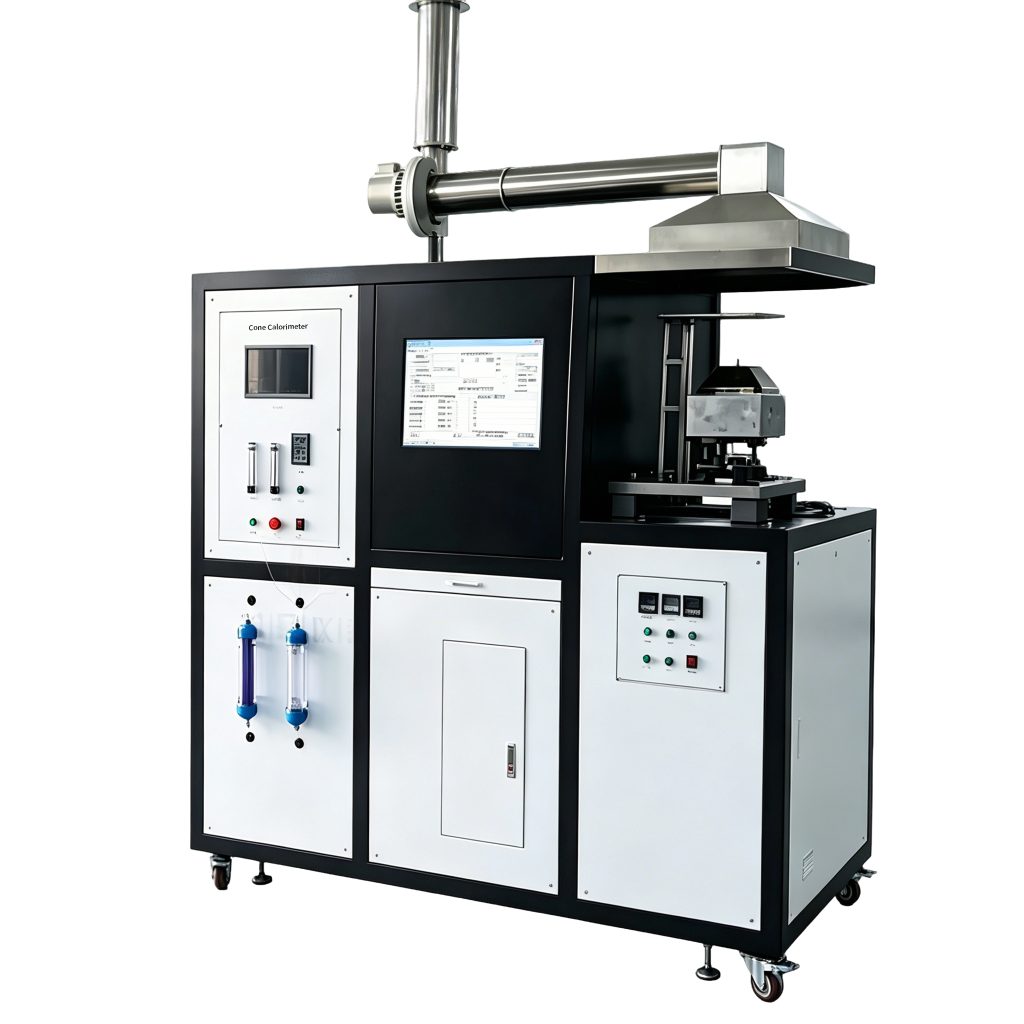
What Is a Cone Calorimeter?
The cone calorimeter is a bench-scale, reliable instrument that measures the flammability of materials using the technique of oxygen consumption calorimetry (OCC) — determining the heat release rate of a fire by measuring the amount of oxygen the fire consumes.
The instrument is named for its most distinctive component: the open-ended cone-shaped electric heater, which ignites the sample material under test. Key measurement principles:
- The test sample rests on a sensitive scale to measure the loss of mass during combustion
- Products of the fire flow into an exhaust system where instruments measure oxygen consumption and thus heat release rate
- The same system simultaneously measures a host of additional properties, including smoke production and toxic gas generation
Why Heat Release Rate Matters Most
Heat release rate is the most important thing to know about a fire — it determines the size of the fire, how quickly the fire will spread, and how rapidly the fire will produce dangerous gases. Earlier methods of measuring heat release rate by temperature and gas flow were prone to error, difficult to perform and of low accuracy. Oxygen consumption calorimetry is easier to accomplish and delivers far more accurate results.
A History of Fire Safety Science Innovation
The cone calorimeter’s story spans more than a century of fire science:
- 1917 — William Thornton of Armstrong College (now Newcastle University) recognized the relationship between oxygen consumption and heat release rate
- 1959 — Harvard University’s Howard Emmons highlighted the need for accurate heat release rate measurement in fire safety research
- Late 1970s–early 1980s — NIST researchers William Parker and Clayton Huggett provided the scientific foundations for oxygen consumption calorimetry
- November 1982 — NIST fire research engineer Vytenis Babrauskas first described the cone calorimeter instrument, assisted by NIST technicians Dave Swanson, Randy Shields and Bill Twilley
Key Measurement Capabilities
The cone calorimeter quantifies the fire threats of a wide range of materials, including solid plastics, wire and cable materials, aerospace composites, carpeting, fabrics, furniture and just about any modern material in use today. Its core measurement capabilities:
- Heat release rate (HRR) — the critical parameter defining fire size and spread
- Oxygen consumption — the basis of accurate OCC measurement
- Mass loss rate — sample degradation during combustion
- Smoke production — visibility and smoke hazard assessment
- Toxic gas production — gas toxicity evaluation for life safety
The Cone Calorimeter’s Impact on Fire Safety
The cone calorimeter became the standard test instrument that the world’s fire safety research community uses to select and develop materials that meet regulations, standards and codes for the fire performance of products. Its impact has been profound:
- Reduced fire deaths — over its 40-year lifespan (1982–2022), deaths due to fire in homes have been reduced, thanks in part to new fire-resistant materials and safety standards developed using the cone calorimeter
- Global standards adoption — cone calorimeters are now commercially produced based on NIST’s original design and used in numerous national and international fire safety testing standards
- Universal applicability — from everyday furniture and fabrics to aerospace composites and wire-and-cable insulation
What This Means for Fire Safety Testing
For manufacturers of plastics, composites, building materials, textiles and electrical products, cone calorimeter testing delivers decisive value:
- Scientific credibility — the most respected instrument in fire safety science, developed and validated by NIST
- Comprehensive fire risk data — heat release rate, smoke and toxic gas in a single bench-scale test
- Regulatory readiness — data that supports fire performance standards, codes and product certifications
- Material development power — quantify how flame-retardant formulations change fire behavior before full-scale testing
About Shenyang Baoruitong Automation Equipment Co., Ltd.
Shenyang Baoruitong Automation Equipment Co., Ltd. is a professional manufacturer of combustion testing instruments and laboratory equipment for the plastics, foam, textile, paper and building materials industries. Headquartered in Shenyang, China, the company is committed to precision engineering and international standard compliance, helping manufacturers worldwide verify flame retardancy, improve product safety and meet regulatory requirements.
For more information about Shenyang Baoruitong’s fire testing instruments, pricing or a quotation, please contact our sales team or visit our website.
FAQ
Q1: What is a cone calorimeter? A cone calorimeter is a bench-scale fire testing instrument that measures the flammability of materials, including heat release rate, oxygen consumption, smoke production and toxic gas generation, based on the principle of oxygen consumption calorimetry.
Q2: Why is heat release rate important in fire testing? Heat release rate determines the size of a fire, how quickly it spreads, and how rapidly it produces dangerous gases — making it the single most important parameter for understanding fire behavior.
Q3: Who invented the cone calorimeter? The cone calorimeter was invented by NIST (National Institute of Standards and Technology) in 1982, first described by fire research engineer Vytenis Babrauskas and developed with NIST technicians.
Q4: What materials can be tested with a cone calorimeter? The cone calorimeter can quantify the fire threats of solid plastics, wire and cable materials, aerospace composites, carpeting, fabrics, furniture and most modern materials.
Q5: Why is the cone calorimeter important for fire safety? It became the standard test instrument used worldwide to develop fire-resistant materials and fire safety standards, contributing to significant reductions in fire deaths over its 40 years of use.