
Water Quality Monitoring with UV-Vis Spectroscopy: Real-Time, Reagent-Free Analysis from Source to Tap
News Release — Shenyang, China — Shenyang Baoruitong Automation Equipment Co., Ltd., a professional manufacturer of laboratory test instruments and combustion testing equipment, today published an industry insight report on water quality monitoring and the role of UV-Vis spectroscopy in transforming water analysis. As population growth, agricultural fertilizer use and industrial discharge continue to pressure water resources, real-time, accurate and cost-effective water quality monitoring has become essential for both environmental monitoring and drinking water quality monitoring (source: Hamamatsu Photonics, November 2023).
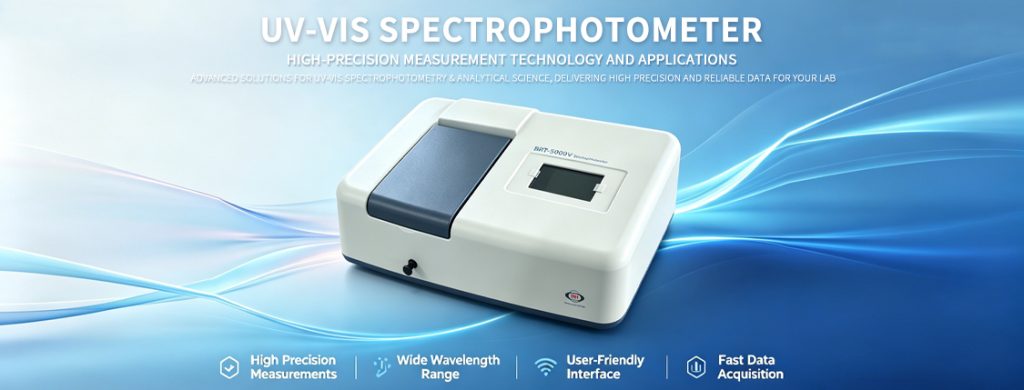

Why Water Quality Monitoring Matters More Than Ever
Water is vital for human survival, and its quality is critical for human health, environmental conservation and food security. When a body of water becomes too rich in nutrients such as nitrogen and phosphorus, oxygen levels drop and aquatic life dies — threatening conservation efforts and food supply. Water quality monitoring serves two key purposes:
- Early detection of pollution events — from concentrated antibiotic wastewater discharged by hospitals and pharmaceutical plants to agricultural runoff
- Continuous regulatory compliance — ensuring treatment facilities meet discharge standards and drinking-water utilities satisfy World Health Organization (WHO) drinking water quality guidelines
The Limits of Conventional Water Analysis Methods
Traditional water quality monitoring relies on routine sampling programs: collecting and transporting water samples to a laboratory for analysis. This approach only partially explains water quality over time, may miss short-term fluctuations, and suffers from delayed feedback that makes rapid response to water incidents difficult.
Conventional methods fall into three categories:
- Chemical methods (titration analysis, electrochemical analysis) — accurate but require bulky, expensive equipment, large reagent volumes, and can cause secondary pollution
- Biological methods (enrichment analysis, biosensor technology) — lower accuracy and sensitivity compared with other methods
- Physical methods (spectral remote sensing in UV and visible wavelengths) — the foundation of modern UV-Vis spectrophotometry
Critically, results from chemical and biological methods are generally not provided in real time.
UV-Vis Spectroscopy: The Key to Online Water Quality Monitoring
UV-Vis spectrophotometry relies on the correlation between the absorption of specific light wavelengths by a substance and its concentration. This principle enables a fundamentally different approach to water analysis, with decisive advantages for online water quality monitoring:
- Reagent-free measurement — no chemicals, no secondary pollution
- No sample filtration required — software particle compensation eliminates the filtration step
- Real-time results — fast measurements that capture short-term fluctuations
- Continuous operation — ideal for treatment process monitoring and early warning
In recent years, online UV-Vis spectrophotometers have been increasingly used for rapid water quality assessment across environmental monitoring and drinking water management.
Measurable Water Quality Parameters
UV-Vis spectrophotometers can measure a wide range of water quality parameters, including:
- Color and spectral absorption coefficient (SAC254, also known as UV254)
- Nitrate and nitrite concentrations
- Dissolved Organic Carbon (DOC) and Total Organic Carbon (TOC)
- Chemical Oxygen Demand (COD) in water bodies
- Dissolved organic matter
- Disinfectant residuals in drinking water
This multi-parameter capability makes UV-Vis spectroscopy one of the most versatile tools for comprehensive water quality assessment.
Single-Wavelength Sensors vs. Full-Spectrum Spectrophotometers
Two main types of spectral sensors are used in water analysis:
| Feature | Single-Wavelength (SW) Sensors | UV-Vis Spectrophotometers |
|---|---|---|
| Optical design | Bandpass-filtered single photodetector (Si or avalanche photodiode) + targeted light source | Broadband light source + diffraction grating + linear array photodetector |
| Measurement | Absorbance at one selected wavelength (UV254, nitrate, nitrite) | Full spectral fingerprints across a wavelength band |
| Particle compensation | Limited | Better, software-based compensation |
| Calibration | — | Can be calibrated to specific locations with higher accuracy |
| Best suited for | Parameter variation tracking | Precise applications such as real-time water and treatment process monitoring |
Full-spectrum UV-Vis spectrophotometers provide better particle compensation and higher accuracy, making them the preferred choice for precise, real-time water quality monitoring applications.
Choosing the Right Light Source: Xenon Flash Lamps vs. Deuterium Lamps
The performance of a UV-Vis spectral sensor depends critically on its broadband light source. Key requirements include a suitable spectrum, high brightness, flash-to-flash stability, short warm-up time, long lifetime, low power consumption and compactness.
Deuterium lamps offer lower peak-to-peak variation but are limited to 180–370 nm, require long warm-ups and have shorter lifetimes — making them best suited for laboratory benchtop devices.
Xenon flash lamps provide a wider wavelength range extending from the UV to the infrared, allowing more water parameters to be detected simultaneously. Their continuous emission spectrum, compact design and low heat generation make them the ideal light source for portable and online spectrophotometers deployed in the field.
What This Means for Water Utilities and Environmental Laboratories
For water utilities, environmental agencies and treatment plants, the shift to online UV-Vis spectroscopy delivers clear operational benefits:
- Faster response to pollution events through continuous, real-time data
- Lower operating costs by eliminating reagents and filtration consumables
- Broader parameter coverage — from UV254 and nitrate to COD, TOC and disinfectants
- Improved regulatory compliance with WHO-derived drinking water standards
- Reliable field deployment with compact, low-power, long-lifetime optical components
As technology advances and concerns about water quality grow, UV-Vis spectroscopy is expected to become an essential tool for water quality management worldwide.
About Shenyang Baoruitong Automation Equipment Co., Ltd.
Shenyang Baoruitong Automation Equipment Co., Ltd. is a professional manufacturer of combustion testing instruments and laboratory equipment for the plastics, foam, textile, paper and building materials industries. Headquartered in Shenyang, China, the company is committed to precision engineering and international standard compliance, helping manufacturers worldwide verify product safety, improve quality control and meet regulatory requirements.
For more information about Shenyang Baoruitong’s testing instruments, pricing or a quotation, please contact our sales team or visit our website.
FAQ
Q1: What is UV-Vis spectroscopy used for in water quality monitoring? UV-Vis spectroscopy measures how much ultraviolet and visible light is absorbed by water at specific wavelengths, enabling real-time detection of parameters such as nitrate, UV254/SAC254, chemical oxygen demand (COD), total organic carbon (TOC) and disinfectant residuals.
Q2: Why is online water quality monitoring better than laboratory sampling? Laboratory sampling only captures water quality at the moment of collection and delays feedback. Online UV-Vis spectrophotometers provide continuous, real-time measurements that capture short-term fluctuations and enable rapid response to pollution events.
Q3: Does UV-Vis water analysis require reagents or filtration? No. UV-Vis spectrophotometry is reagent-free and, thanks to software particle compensation, generally does not require sample filtration — reducing cost and avoiding secondary pollution.
Q4: What is UV254 or SAC254? UV254 (spectral absorption coefficient at 254 nm) is a widely used indicator of organic matter in water, commonly measured by online UV-Vis spectrophotometers for water quality assessment.
Q5: Which light source is best for UV-Vis water quality sensors? Xenon flash lamps are generally preferred for portable and online instruments because they offer a wide UV-to-IR spectrum, long lifetime (up to 10 billion flashes), fast warm-up and compact size, enabling simultaneous detection of multiple water parameters.
Source: “Monitoring water quality: a challenge for spectroscopic technology,” Hamamatsu Photonics, November 2023 (original article).
Keywords: water quality monitoring, online water quality monitoring, UV-Vis spectroscopy, UV-Vis spectrophotometer water analysis, drinking water quality monitoring, environmental monitoring, wastewater monitoring, UV254, SAC254, chemical oxygen demand COD, total organic carbon TOC, nitrate detection, real-time water quality sensor, water quality parameters, xenon flash lamp, deuterium lamp, water treatment process monitoring, water quality management, Shenyang Baoruitong