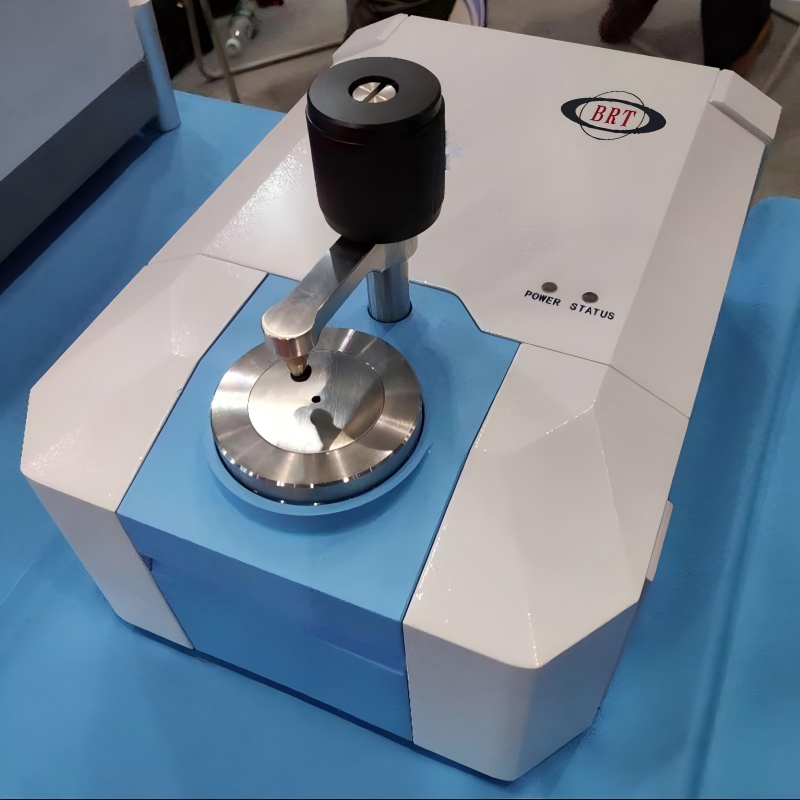
 How FTIR Reveals the Truth About a Diamond

To the eye, a natural diamond and a lab-grown one can look identical. The same fire, the same brilliance, the same flawless sparkle. But at the atomic level, they tell completely different stories — and Fourier-Transform Infrared Spectroscopy (FTIR) is how we read them. ✨
⚛️ Every Diamond Has an Infrared Fingerprint When infrared light passes through a diamond, the carbon lattice and its trace impurities absorb specific frequencies. The resulting absorption spectrum is a molecular fingerprint — and the fine details of that fingerprint reveal how, and where, the stone was formed.
🔍 What FTIR Can Tell You About a Diamond
🔹 Natural vs. lab-grown — Natural diamonds form over billions of years deep in the earth; lab-grown stones (HPHT or CVD) form in weeks. These different growth conditions leave different nitrogen and defect signatures in the infrared spectrum.
🔹 Diamond type classification — FTIR sorts diamonds into Type Ia, Ib, IIa, and IIb based on how nitrogen and boron sit within the lattice — a key step in identifying rare and potentially synthetic stones.
🔹 Treatment detection — HPHT treatment, irradiation, and other enhancements alter the spectrum in ways the naked eye, and even a loupe, can never catch.
🔹 Non-destructive analysis — The stone is never touched, heated, or altered. The light does all the work. 🛡️
⚙️ Why FTIR Is the Standard Because it’s fast, repeatable, and definitive. A complete spectrum takes seconds, the wavenumber scale is laser-calibrated for precision, and the result is an objective, documented answer — not a subjective judgment call. For gem labs and jewelers, that means confidence that holds up to scrutiny.
In a market where lab-grown stones are everywhere and increasingly convincing, knowing exactly what you’re holding isn’t a luxury — it’s the whole point. FTIR is how the industry knows for sure. 🚀
🏭 At Shenyang Baoruitong, we build FTIR systems designed for exactly this kind of reliable, everyday identification. 📧 info@brt-test.com | 🌐 https://brt-test.com