
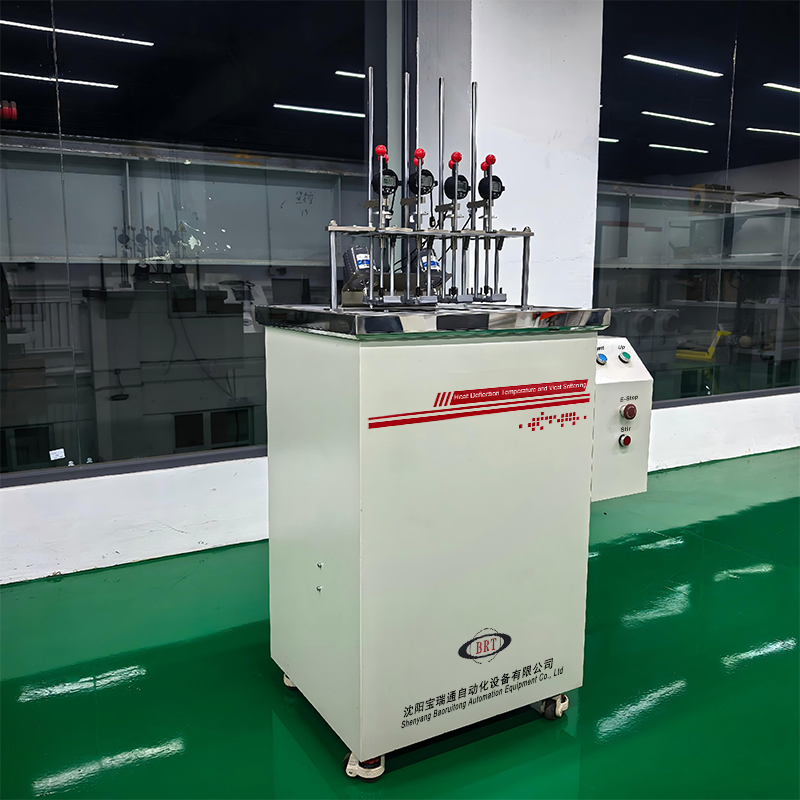
Vicat / HDT Testers: Performance Characteristics and How to Choose
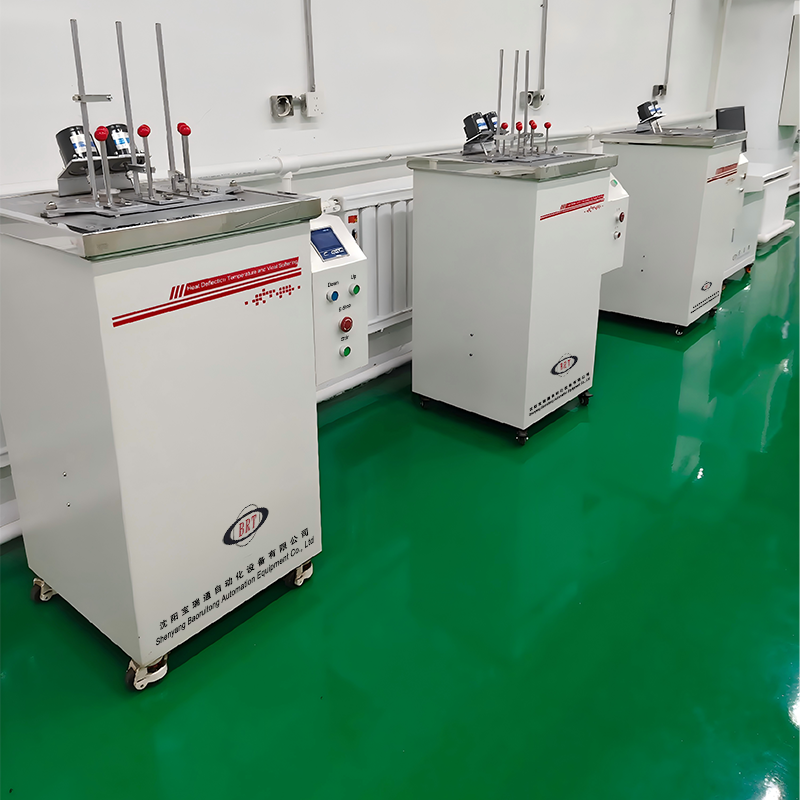
1. What This Instrument Actually Solves
Plastics have no sharp melting point — they soften gradually. What an engineer really wants to know is not “when does it melt” but “below what temperature will it still hold its shape.” A Vicat / HDT tester supplies exactly that: a number you can quantify, write into a specification, and compare across two different factories.
Put differently, the instrument does not measure a fundamental physical constant. It measures an agreed-upon reference temperature for service conditions. Once that is understood, a lot of confusion disappears — why the same resin gives different values under different standards, and why Vicat and HDT can differ by tens of degrees and both still be correct.
Shenyang Baoruitong builds its bench-top Vicat / HDT testers around this premise: the value of the machine lies in reproducibility under agreed conditions, not in chasing headline specifications.
2. Two Tests, Two Personalities
One machine, one change of fixture and criterion, and you have two different tests. Neither is more accurate than the other — they simply look at different things.
Dimension | Vicat Softening Point | Heat Deflection Temp (HDT) | What It Really Means |
Loading mode | Needle pressed straight down | Three-point bending load | One tests “puncture”, one tests “bend” |
Criterion | Penetration of 1 mm | Specified deflection reached | Different criteria — values are not interchangeable |
Sensitivity | Sensitive to surface condition | Sensitive to bulk stiffness | Surface treatment shifts Vicat results |
Typical value | Generally higher | Generally lower | Same material can differ by tens of degrees |
Common use | Incoming inspection, batch comparison | Structural material selection, certification | Purpose decides which test to run |
In one line: Vicat asks whether the surface holds up. HDT asks whether the whole part holds up.
3. Performance Advantages of the Instrument
3.1 Two tests, one machine
The bench-top configuration handles both Vicat and HDT; you simply swap the fixture. A laboratory does not need to buy two separate machines for two routine tests. For small R&D departments and university labs, this is the most immediate benefit of the Shenyang Baoruitong platform.
3.2 Oil bath heating, uniform temperature field
Silicone oil serves as the heat transfer medium, with stirring and circulation so that every part of the specimen sees the same temperature. Compared with forced-air heating, an oil bath has a far smaller thermal gradient — and that is precisely the physical basis on which repeatable results rest.
3.3 Multiple stations in parallel
Typical configurations hold several specimens at once. The standards require at least two specimens per sample, so multiple stations mean one heating run completes a full set — or compares several grades side by side. A heating run often takes tens of minutes, which makes station count a direct determinant of daily lab throughput.
3.4 Controlled, uniform heating rate
Programmed temperature control keeps the heating rate stable. Heating rate is the critical variable in this class of test: too fast and thermal lag pushes readings low; too slow and you waste hours. A rate that is both controlled and reproducible is what makes the data acceptable to your peers.
3.5 Automatic recording and judgement
A displacement sensor monitors deformation in real time, records the temperature the moment the criterion is met, and raises an alarm. This removes the fatigue error of watching a dial gauge by hand, and lets a long heating run proceed unattended.
4. When to Use It — and When Not To
Well suited to
- Incoming inspection: is this batch the same material as the last one
- Formulation development: how much did the filler or blend ratio actually improve heat resistance
- Material selection: this part runs at 90 °C — which grade can take it
- Quality arbitration: supplier and customer test to the same standard, so the numbers can settle a dispute
Not suited to
- Predicting long-term service temperature — this is a short-duration test and says nothing about creep or ageing over thousands of hours
- Inferring melting point or glass transition — use DSC or DMA for that
- Assessing outdoor weatherability — UV and humidity are an entirely separate test regime
- Substituting for real-world validation — no bench data equals actual in-service performance
5. The Hidden Variables Behind Your Results
Same machine, same resin, different operators, different numbers. The problem is usually not the instrument.
- Specimen machining quality: thickness tolerance, surface burrs, residual internal stress
- Moulding history: different cooling rates give different crystallinity, and therefore different heat resistance
- Conditioning: was the specimen held in a controlled temperature and humidity environment long enough before testing
- Silicone oil condition: viscosity rises with use, and heat transfer characteristics drift slowly with it
- Actual heating rate: the setpoint is not the measured value — verify it periodically
Of these, moulding history is the most consistently underestimated. Take one batch of pellets, change the injection parameters, and the result can move by several degrees.
6. Common Anomalies and Where to Look
Symptom | Likely Cause | Where to Look |
Large scatter between two specimens | Uneven thickness / burrs left from machining | Re-prepare specimens, check parallelism |
Results uniformly low | Heating rate too fast, thermal lag | Verify rate; confirm silicone oil is circulating |
Results uniformly high | Specimen not fully preheated | Ensure 35 mm immersion and adequate soak time |
Values drift batch to batch | Silicone oil aged, viscosity changed | Replace oil on a fixed schedule and log it |
Needle reading jumps | Poor contact between needle and surface | Check needle perpendicularity and specimen flatness |
7. Routine Maintenance
- Clear specimen debris after every run to keep the silicone oil clean
- Check oil level and colour regularly; replace once it darkens noticeably or shows precipitate
- Calibrate the displacement sensor and the indenter on a schedule — this is the root of data credibility
- Store weights separately so knocks and dents do not shift their mass
- Drain the oil circuit before long shutdowns to prevent gumming in the lines
8. Summary
The value of a Vicat / HDT tester is not that it delivers some exquisitely precise physical quantity. It is that it provides a ruler the whole industry shares. The graduations on that ruler are a convention — which is why strictly honouring the standard conditions (specimen, load, heating rate, immersion depth) matters far more than chasing instrument specifications.
Treat the machine as an arbiter that deserves care, rather than a black box that spits out a number when you press a button, and the data you get will mean something. That is the philosophy Shenyang Baoruitong recommends to every laboratory putting one of these instruments into service.