
ASTM D6413 Vertical Flame Test: The Complete Guide to Flame Resistance Testing of Textiles
Flame-resistant (FR) textiles are the last line of defense for workers facing electric arc and flash fire hazards. But how do manufacturers prove a fabric truly stops burning? The answer lies in one of the most widely used test methods in the industry: the ASTM D6413 vertical flame test.
As a professional manufacturer of fire safety and textile testing instruments, Baoruitong Automation Equipment Co., Ltd. (BRT) presents this expert guide to ASTM D6413 — the Standard Test Method for Flame Resistance of Textiles — and explains how modern vertical flammability testing equipment helps textile factories, third-party laboratories and FR clothing manufacturers deliver accurate, audit-ready results.
What Is ASTM D6413?
ASTM D6413 is the Standard Test Method for Flame Resistance of Textiles (vertical test). It is used to determine the flame resistance of fabrics that protect workers against both electric arc and flash fire hazards. It is the defining test method for compliance with OSHA 1910.269 and one of the most commonly used flame resistance tests on FR fabrics in the United States. Adopted from Federal Test Standard No. 191A, the vertical flame test is the ASTM version of Federal Test Method 5903.1.
The purpose of this test is simple but critical: determine whether a fabric will continue to burn after the source of ignition is removed.
How the ASTM D6413 Vertical Flame Test Works
- A 12-inch fabric specimen is suspended inside an enclosed chamber and secured on three sides.
- The cut edge at the bottom of the specimen is exposed to a controlled methane flame for 12 seconds.
- After flame exposure, three key indicators are measured:
- Afterflame time — the seconds during which a visible flame remains on the fabric.
- Afterglow time — the seconds during which a visible glow remains on the fabric.
- Char length — the length of fabric destroyed by the flame.
- The occurrence of melting or dripping, if any, is also recorded.
- Five tests are performed and the results are averaged and reported as the final test result.
Pass/Fail Criteria: ASTM F1506 vs. NFPA 2112
The ASTM D6413 test method provides the pass/fail criteria for garment standards including ASTM F1506 and NFPA 2112:
- ASTM F1506 — Standard Performance Specification for Flame Resistant and Arc Rated Textile Materials for Wearing Apparel for Electrical Workers — requires a maximum char length of 6 inches.
- NFPA 2112 — Standard on Flame Resistant Garments for Protection of Industrial Personnel Against Flash Fire — requires a maximum char length of 4 inches.
Garments that pass these tests help employers comply with NFPA 70E (Standard for Electrical Safety in the Workplace), OSHA 29 CFR 1910.269 (electric power generation, control, transformation, transmission and distribution) and the OSHA enforcement policy for flame-resistant clothing in oil and gas drilling, well servicing and production-related operations.
Why Accurate Flame Resistance Testing of Textiles Matters
For electric utilities, industrial electrical workers, oil & gas and petrochemical personnel, FR workwear is not optional — it is a compliance requirement and a life-saving investment. A reliable flammability tester ensures every production lot of fabric performs as expected, protecting workers and protecting manufacturers from liability, rejected shipments and failed audits. Whether you test flame retardant fabrics for arc flash clothing, flash fire garments or everyday FR workwear, accurate afterflame, afterglow and char length data is the foundation of certification.
BRT’s Testing Solution: FCZ-50 Textile Vertical Flammability Tester
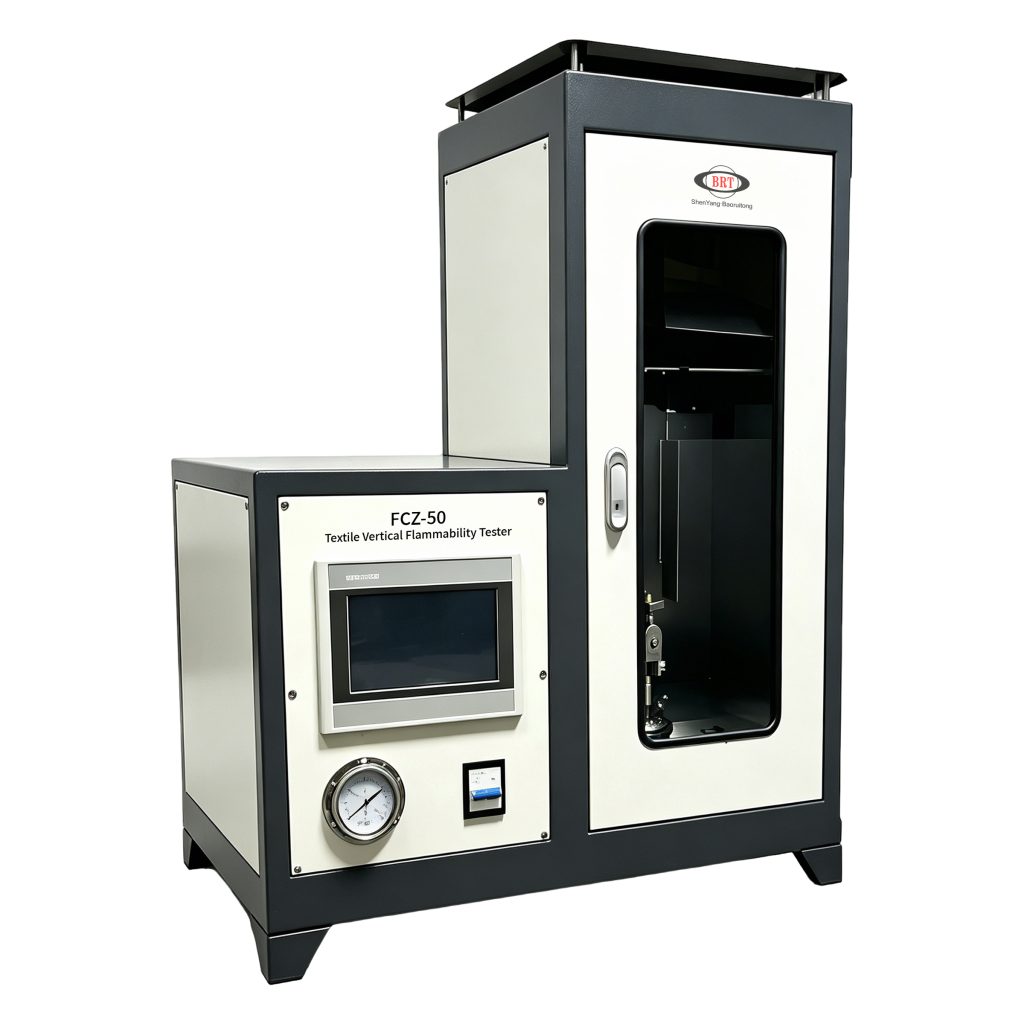
To help textile mills and FR garment manufacturers meet these testing requirements, Shenyang Baoruitong Automation Equipment Co., Ltd. (BRT) offers the FCZ-50 Textile Vertical Flammability Tester — a bench-top vertical burn test machine for fabrics designed in strict accordance with GB/T 5455-2014 (Textiles – Burning Behaviour – Determination of Damaged Length, Afterglow Time and Afterflame Time of Vertically Oriented Specimens), which follows the same vertical flame test methodology as ASTM D6413.
Product highlights:
- Fully enclosed transparent combustion cabinet — isolates flame and toxic fumes while allowing full visual observation of specimen burning status.
- Touch-screen control + real-time gas pressure gauge — automatic ignition and timing deliver repeatable, audit-ready test data and eliminate manual reading errors.
- High-precision measurement module — time accurate to 0.1 s, length accurate to 1 mm; auto-records afterflame time, afterglow time and damaged length.
- Two standard conditioning modes — standard atmosphere conditioning (12-second ignition) and oven drying conditioning (3-second ignition) to cover different test protocols.
- Complete counterweight set — standard weights from 54.5 g to 453.6 g matched to fabric areal density (≤101 g/m² up to ≥650 g/m²) for correct vertical sag testing.
- Compact desktop design — small lab footprint, low daily operating cost, easy to move and maintain.
Key technical parameters: combustion cabinet 329±2 mm × 329±2 mm × 767 mm; specimen holder 356 mm × 51 mm; standard Bunsen burner nozzle Ø11 mm; ambient 10–30 °C, RH 30–80 %; 220 V / 50 Hz, 100 W.
Main application scenarios:
- Quality control laboratories of apparel, home textile and automotive interior fabric manufacturers
- ISO 17025-accredited third-party fire safety certification institutions
- Flame retardant material R&D and testing centers
- University textile engineering and material science research laboratories
- Import & export textile inspection agencies for customs compliance testing
FAQ
What is ASTM D6413? ASTM D6413 is the Standard Test Method for Flame Resistance of Textiles (vertical test), used to determine whether a fabric continues to burn after the ignition source is removed. It is a key test method for fabrics used in electric arc and flash fire protection, and the defining test for OSHA 1910.269 compliance.
What is char length in flame testing? Char length is the length of fabric destroyed by the flame during the vertical flame test. Under ASTM D6413, ASTM F1506 requires a maximum char length of 6 inches, while NFPA 2112 requires a maximum of 4 inches.
What is the difference between afterflame and afterglow? Afterflame is the time in seconds during which a visible flame remains on the fabric after the ignition source is removed; afterglow is the time during which a visible glow remains. Both are measured and reported in the ASTM D6413 test.
How long is the flame applied in the ASTM D6413 test? A 12-inch fabric specimen is exposed to a controlled methane flame for 12 seconds. Five tests are performed and the results are averaged to obtain the final test result.
Which equipment can perform the textile vertical flame test? The FCZ-50 Textile Vertical Flammability Tester from Shenyang Baoruitong Automation Equipment Co., Ltd. performs vertical combustion testing of textiles in line with GB/T 5455-2014 and the vertical flame test methodology of ASTM D6413, automatically measuring afterflame time, afterglow time and damaged length.
Get a Quote
Need a reliable flammability tester for your FR fabric quality control or certification laboratory? Contact Shenyang Baoruitong Automation Equipment Co., Ltd. today for the FCZ-50 datasheet, standard operation manual and a customized quotation. Every BRT instrument is backed by a 1-year warranty, installation guidance, operation training and long-term after-sales support.
WhatsApp: +86 15604057553 | Email: info@brt-test.com | Web: www.brt-test.com