
CYD Smoke Toxicity Test Apparatus Supports Automated Fire-Effluent Toxicity Testing
Baoruitong Introduces a Controlled Smoke Toxicity Testing Solution
When materials burn, smoke and fire effluents can create serious safety concerns in buildings, transportation systems, electrical products, industrial materials, and other enclosed environments. Evaluating smoke toxicity is therefore an important part of fire-safety research, material development, quality control, and compliance preparation.
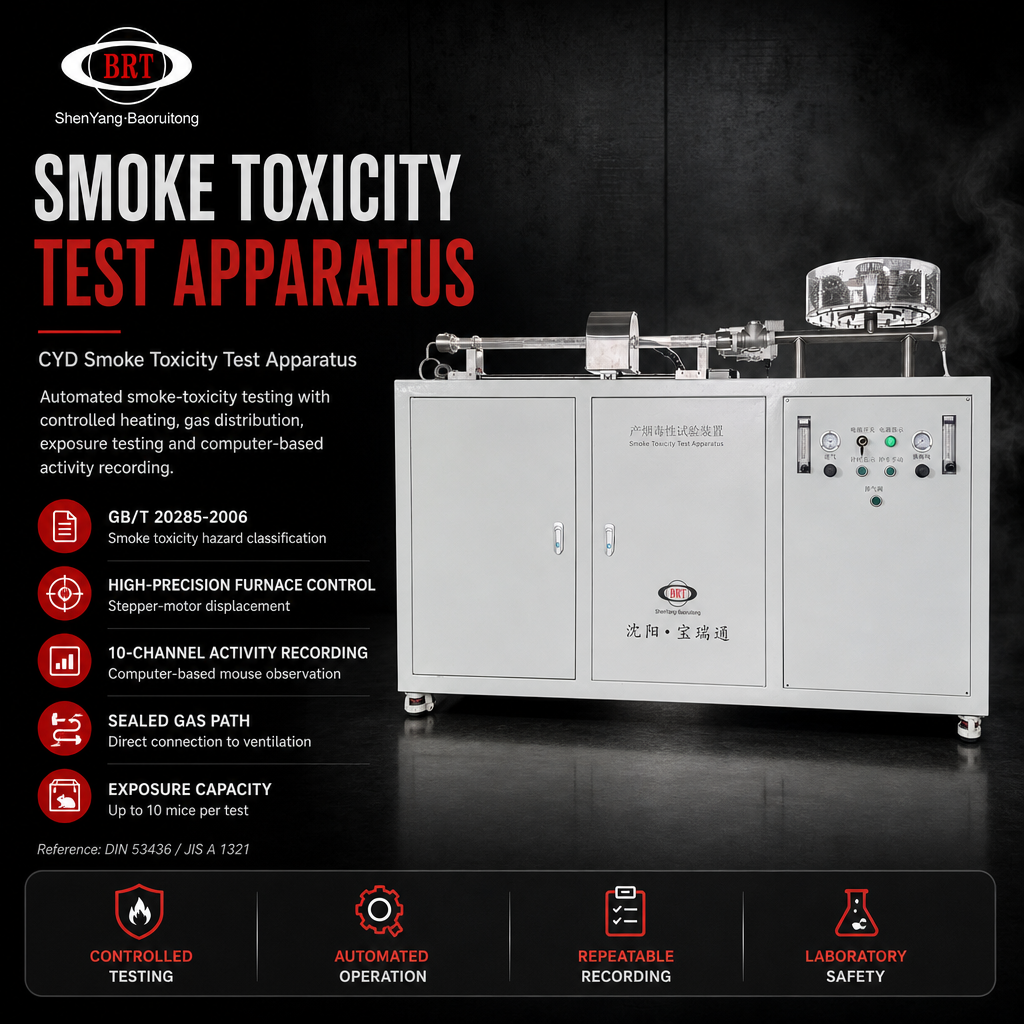
Baoruitong Automation Equipment Co., Ltd. presents the CYD Smoke Toxicity Test Apparatus, a laboratory solution for controlled smoke-toxicity testing. The apparatus is designed to support automated heating, controlled gas distribution, exposure testing, and computer-based activity recording for laboratory smoke toxicity evaluation.
The product image identifies GB/T 20285-2006 as the smoke-toxicity hazard classification reference and lists DIN 53436 and JIS A 1321 as reference methods. These standards and methods should be matched with the specimen type, laboratory procedure, equipment configuration, and applicable regulatory requirements before a formal compliance claim is made.
Why Smoke Toxicity Testing Matters
Fire safety is not determined only by whether a material ignites or how quickly a flame spreads. Smoke and combustion products may also affect occupant safety, emergency response, evacuation conditions, and the overall assessment of a material’s fire hazard.
Smoke toxicity testing can help laboratories study:
- Smoke toxicity from burning materials
- Fire effluent hazards
- Toxic gases generated during combustion
- Material smoke hazard classification
- Smoke exposure effects under controlled conditions
- Comparative performance of different formulations
- Fire-retardant material development
- Building material safety research
- Polymer, plastic, rubber, textile, and composite material evaluation
- Quality-control and compliance preparation
A smoke toxicity test is a controlled laboratory evaluation. Its results should be interpreted together with the applicable test method, specimen preparation requirements, exposure conditions, analytical procedure, and classification rules.
CYD Smoke Toxicity Test Apparatus: Key Features
Automated Smoke-Toxicity Testing
The CYD apparatus is designed for automated smoke-toxicity testing. Automation helps laboratories organize repeated test steps, reduce unnecessary manual intervention, and create a more consistent operating workflow.
The equipment can support a structured sequence that includes controlled heating, smoke generation, exposure, observation, and activity recording. The exact operating sequence depends on the selected method and the laboratory’s test protocol.
Controlled Heating and High-Precision Furnace Control
The product image highlights controlled heating and high-precision furnace control. The furnace uses stepper-motor displacement to support controlled movement during the heating and testing process.
Stable heating is important because smoke generation and combustion products can change with the heating condition. A controlled furnace helps laboratories apply a more consistent thermal process when comparing materials or repeating a test method.
The final temperature range, heating rate, furnace configuration, and control accuracy should be confirmed in the technical specification for the selected equipment configuration.
Controlled Gas Distribution
Gas distribution is another important part of smoke toxicity testing. The CYD apparatus is designed with a controlled gas-distribution system to support the selected exposure and test procedure.
Controlled gas handling can help laboratories maintain a more organized test environment and reduce variations caused by inconsistent gas routing. Before installation, users should confirm the required gas sources, laboratory ventilation, exhaust connection, and safety conditions.
Ten-Channel Activity Recording
The product image highlights 10-channel activity recording for computer-based mouse observation. This feature supports the recording and organization of activity-related observations during the exposure test.
Computer-based recording can make test data easier to review and compare. It also helps laboratories organize observations in a more structured format than manual recording alone.
The exact recording logic, software functions, data-storage format, and reporting output should be confirmed with Baoruitong according to the selected configuration and applicable test procedure.
Sealed Gas Path and Direct Ventilation Connection
The CYD apparatus includes a sealed gas path and is designed for direct connection to a ventilation system. A sealed gas route helps guide smoke and test gases through the intended path during operation.
A direct ventilation connection can support laboratory safety planning by allowing the exhaust arrangement to be integrated with the facility’s ventilation system. Installation must be completed according to the equipment manual, local laboratory safety rules, and the requirements of the selected test method.
Exposure Capacity of Up to Ten Mice per Test
The product image states an exposure capacity of up to 10 mice per test. This capacity is presented as an equipment feature for the specified smoke-toxicity exposure setup.
Users should confirm the applicable animal-testing protocol, ethical review requirements, specimen or exposure configuration, laboratory ventilation, and local regulations before operation. The stated capacity should not be interpreted as a universal requirement for every smoke toxicity test method.
Reference Standards and Test Methods
The CYD Smoke Toxicity Test Apparatus is associated with the following standards and reference methods in the supplied product information:
GB/T 20285-2006
GB/T 20285-2006 is identified in the product image as the reference for smoke-toxicity hazard classification. Laboratories should verify the current applicable edition, specimen requirements, exposure conditions, observation criteria, and reporting rules before testing.
DIN 53436
DIN 53436 is included as a reference method in the product information. It is associated with smoke toxicity testing and animal exposure evaluation under controlled laboratory conditions.
The equipment should only be marketed as compliant with DIN 53436 after the complete equipment configuration, test procedure, and verification requirements have been confirmed.
JIS A 1321
JIS A 1321 is also identified as a reference method. Its applicability depends on the material, test objective, specimen preparation, exposure arrangement, and required test outputs.
Baoruitong can help customers review the intended method and determine whether the requested configuration is appropriate for the planned laboratory application.
Applications of the CYD Smoke Toxicity Tester
The CYD Smoke Toxicity Test Apparatus can support research, development, and quality-control activities involving:
- Building materials
- Plastic materials
- Polymer materials
- Rubber products
- Textile materials
- Flame-retardant materials
- Electrical and electronic components
- Automotive interior materials
- Railway and transportation materials
- Composite materials
- Insulation materials
- Cable and cable-related materials
- Furniture and interior materials
- Industrial product materials
- Fire-retardant formulation development
- Fire safety laboratory research
The equipment is especially relevant when the testing objective includes smoke toxicity, combustion effluent, exposure observation, or smoke hazard classification rather than flame spread alone.
Benefits for Fire-Safety Laboratories
More Consistent Test Operation
Automated heating, controlled gas distribution, and computer-based recording help laboratories organize smoke toxicity tests in a more consistent manner.
Structured Observation and Data Recording
Ten-channel activity recording provides a structured way to collect and review computer-based observations during the exposure stage.
Laboratory Safety Planning
The sealed gas path and direct ventilation connection support a clearer approach to exhaust and laboratory safety planning. Proper installation and ventilation remain essential for safe operation.
Support for Material Development
Manufacturers can use smoke toxicity testing to compare material formulations, review flame-retardant systems, and identify potential combustion-effluent risks during product development.
Support for Compliance Preparation
The CYD apparatus can support testing and data collection for compliance preparation. It does not independently issue a certification or determine regulatory compliance. Final conclusions must be based on the applicable standard, verified procedure, test results, and the responsible evaluation organization.
Suggested Smoke Toxicity Testing Workflow
A typical laboratory workflow may include:
- Define the testing objective and applicable smoke-toxicity classification requirement.
- Identify the material, product, or formulation to be evaluated.
- Confirm the applicable standard or reference method.
- Prepare and condition specimens according to the selected procedure.
- Check the furnace, gas-distribution path, exposure chamber, ventilation connection, and recording system.
- Apply controlled heating and generate smoke under the specified conditions.
- Conduct the exposure test according to the approved laboratory protocol.
- Record activity observations through the computer-based recording system.
- Review the observations and test data against the applicable method.
- Prepare the test report with the specimen information, operating conditions, observations, and conclusion.
The exact test procedure, exposure conditions, animal-use requirements, gas arrangement, and reporting format must be confirmed before the equipment is used for official testing.
Baoruitong Technical Support and Service
Baoruitong Automation Equipment Co., Ltd. provides laboratory testing equipment and material-performance testing solutions for manufacturers, research institutions, inspection laboratories, universities, and quality-control departments.
For the CYD Smoke Toxicity Test Apparatus, Baoruitong can support customers with:
- Product selection guidance
- Smoke toxicity test-method communication
- Laboratory application review
- Equipment configuration discussion
- Gas and ventilation connection planning
- Technical documentation support
- Installation and operation guidance
- After-sales technical assistance
Customers should provide the material type, target standard, test purpose, laboratory conditions, ventilation arrangement, and required data output when requesting a quotation. This helps the technical team recommend a more suitable configuration.
FAQ
1. What is the CYD Smoke Toxicity Test Apparatus used for?
It is used for controlled laboratory smoke-toxicity testing, smoke hazard evaluation, combustion-effluent research, and related material fire-safety studies.
2. Which standards are associated with the CYD apparatus?
The supplied product information identifies GB/T 20285-2006 and references DIN 53436 and JIS A 1321. The applicable method must be confirmed for the material, equipment configuration, and test objective.
3. Does the apparatus automatically provide a certification?
No. The equipment supports testing and data recording. It does not independently issue a certification or guarantee a classification. Final conclusions depend on the applicable standard, test procedure, results, and authorized evaluation process.
4. How many mice can be exposed in one test?
The product image states an exposure capacity of up to 10 mice per test. Users must confirm the approved exposure protocol, ethical requirements, and local regulations before operation.
5. Does the equipment include a ventilation connection?
The product information highlights a sealed gas path with direct connection to ventilation. The actual installation requirements should be confirmed with the laboratory and Baoruitong before purchase.
6. Can the system record activity data by computer?
Yes. The product image highlights 10-channel activity recording with computer-based mouse observation. The exact software and reporting functions should be confirmed for the selected configuration.
7. What information is needed for a quotation?
Customers should provide the target standard or method, material type, test objective, specimen information, laboratory ventilation conditions, gas requirements, and required data output.