
Beyond Material Categories: How Application Defines Fire Testing Priorities for Walls, Floors, and Penetrations
In the field of fire safety engineering, a common misconception is that fire risk is determined solely by material category. However, the latest industry insights highlight a critical shift: Application Changes the Testing Focus. The same material can face vastly different fire risks depending on where and how it is installed.
Baoruitong Automation Equipment Co., Ltd., a premier provider of high-precision fire testing instrumentation, underscores the importance of choosing testing priorities based on real-world applications to ensure comprehensive safety and regulatory compliance.
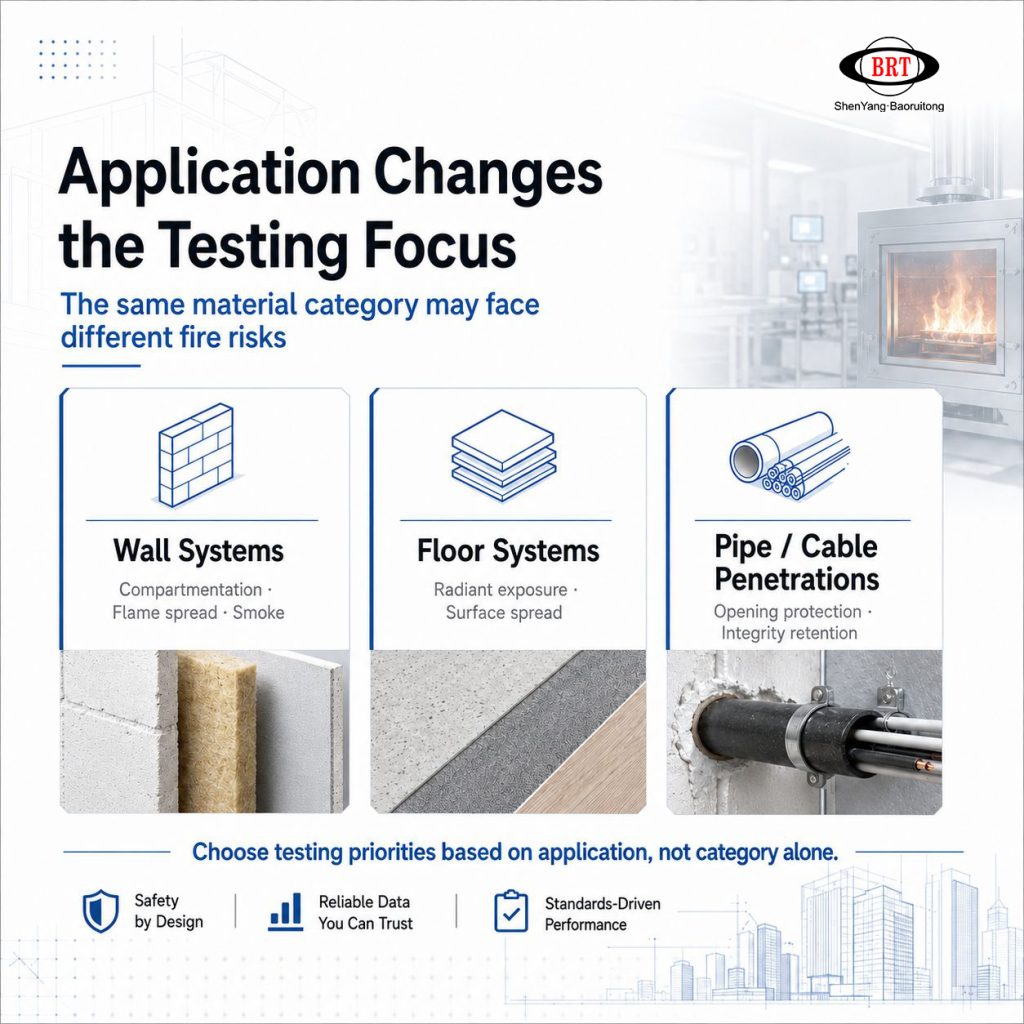
1. Wall Systems: The Focus on Compartmentation
In wall systems, the primary goal is fire compartmentation—preventing the fire from moving from one room to another. Testing for walls must prioritize:
- Flame Spread: Evaluating how quickly fire travels vertically and horizontally across the surface.
- Smoke Development: Measuring the density and toxicity of smoke produced, which is the leading cause of fire-related fatalities.
- Thermal Insulation: Ensuring the wall maintains its structural integrity and limits temperature rise on the unexposed side.
2. Floor Systems: Managing Radiant Heat Exposure
Unlike walls, flooring materials are subject to intense radiant heat from above. Testing for these systems focuses on:
- Radiant Exposure: Determining the “Critical Radiant Flux,” which is the minimum energy required to sustain a flame across the floor surface.
- Surface Spread: Assessing how the material contributes to the rapid escalation of a fire through floor-level propagation.
3. Pipe and Cable Penetrations: Protecting the Gaps
Penetrations for utilities are often the “weakest link” in a building’s fire defense. Fire testing for these systems is specialized to ensure:
- Opening Protection: Evaluating the effectiveness of firestop materials in sealing gaps created by pipes and cables.
- Integrity Retention: Ensuring the penetration seal remains intact and prevents the passage of flames and hot gases during a prolonged fire event.
Precision Engineering for Standards-Driven Performance
To meet these diverse application risks, Baoruitong Automation Equipment Co., Ltd. provides a comprehensive range of testing solutions. Our equipment is engineered for high repeatability and traceability, allowing laboratories to verify performance against international benchmarks such as ISO, ASTM, EN, and UL standards.
By focusing on “Safety by Design,” Baoruitong provides the reliable data that manufacturers, architects, and certification bodies trust to build safer environments.
Service Commitment: 1-Year Warranty
We believe that high-performance hardware deserves high-level support. All Baoruitong fire testing systems come with a comprehensive 1-year warranty. Our technical team provides global support, ensuring your laboratory equipment remains calibrated and operational for your most critical safety assessments.
FAQ
Q1: Why can’t I use the same fire test for a material used in both walls and floors?
A: Fire behavior differs by orientation and heat source. Walls are subject to vertical flame spread and convective heat, while floors primarily deal with horizontal spread and radiant heat. Using the wrong test can lead to inaccurate safety ratings.
Q2: What are the most common standards for testing wall systems?
A: The Single Burning Item (SBI) test (EN 13823) and the Steiner Tunnel test (ASTM E84) are the global benchmarks for evaluating flame spread and smoke development in wall and ceiling linings.
Q3: How do Baoruitong systems ensure data traceability?
A: Our systems feature integrated PLC and PC-based data acquisition software. Every test run logs time-stamped raw data, sensor calibrations, and environmental conditions, ensuring that results can be audited and reproduced.
Q4: Does the equipment support testing for “Zero Halogen” cable penetrations?
A: Yes. Our penetration and cable testing rigs can be equipped with gas analysis modules to measure corrosive gas release and smoke acidity, essential for certifying Low Smoke Zero Halogen (LSZH) materials.
Q5: How is technical support handled during the 1-year warranty period?
A: Baoruitong Automation Equipment Co., Ltd. offers remote diagnostic services, fast-tracked spare parts shipping, and expert technical guidance to ensure minimum downtime for your testing laboratory.