
Precision PPE Testing: Mastering ISO 11611 and ISO 11612 Standards for Industrial Heat and Flame Safety
In the high-stakes environments of metalworking, foundries, and petrochemical plants, the integrity of Personal Protective Equipment (PPE) is the final line of defense against life-threatening hazards. Baoruitong Automation Equipment Co., Ltd., a specialist in advanced safety instrumentation, is highlighting the critical role of automated testing systems in validating PPE compliance with the essential ISO 11611 and ISO 11612 international standards.
Validating Welding Protection: The ISO 11611 Standard
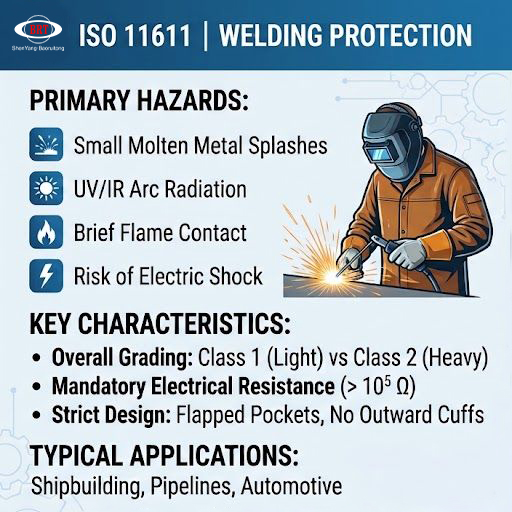
Welding operations expose workers to a unique combination of risks, including small molten metal splashes, intense UV/IR arc radiation, and the risk of electric shock. To ensure safety, protective clothing must undergo rigorous testing to meet ISO 11611 criteria.
Key Testing Characteristics:
- Grading Precision: Testing equipment evaluates materials to classify them into Class 1 (Light) for less hazardous welding techniques or Class 2 (Heavy) for high-spatter operations.
- Electrical Resistance: Systems verify that the material maintains a mandatory electrical resistance of > 105Ω105Ω, protecting the wearer against accidental contact with live electrical conductors.
- Design Validation: Beyond material properties, testing ensures garment designs—such as flapped pockets and the absence of outward cuffs—prevent the trapping of molten droplets.
These tests are vital for materials destined for the shipbuilding, pipeline, and automotive industries, where welding precision is paramount.
Comprehensive Heat & Flame Resistance: The ISO 11612 Modular Approach
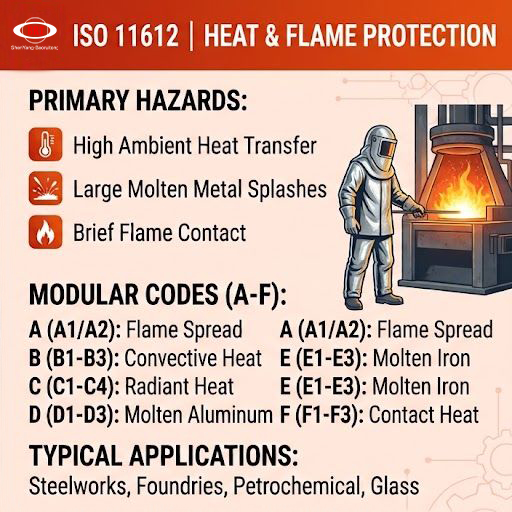
For workers in steelworks and foundries, protection against ambient heat and large molten metal splashes is a daily necessity. The ISO 11612 standard uses a modular coding system (A through F) to quantify the level of protection provided by industrial garments.
Modular Testing Codes (A-F):
- Code A (A1/A2): Evaluates Flame Spread to ensure the material does not continue to burn after ignition.
- Code B (B1-B3): Measures resistance to Convective Heat.
- Code C (C1-C4): Assesses protection against Radiant Heat.
- Code D & E: Quantifies resistance to Molten Aluminum (D) and Molten Iron (E) splashes.
- Code F (F1-F3): Tests resistance to Contact Heat transfer.
By utilizing high-precision testing chambers, manufacturers in the petrochemical, glass, and foundry sectors can guarantee their products meet specific modular performance levels required for extreme industrial applications.
Why Choose Baoruitong Testing Solutions?
Baoruitong Automation Equipment Co., Ltd. provides the high-precision sensors and automated control systems necessary to conduct these complex fire and heat resistance evaluations. Our equipment ensures that every data point—from heat transfer indices to char length—is captured with scientific accuracy.
- Accurate Compliance: Our systems are designed to match the latest updates to ISO and EN testing protocols.
- Durable Engineering: Built to withstand the harsh conditions of flame and splash testing laboratories.
- 1-Year Warranty: We stand by the reliability of our instrumentation. Baoruitong provides a 1-year comprehensive warranty on all testing apparatus, backed by expert technical support to ensure your laboratory stays operational.
FAQ
Q1: What is the main difference between ISO 11611 and ISO 11612?
A: ISO 11611 is specifically for welding and allied processes, focusing on spark resistance and electrical insulation. ISO 11612 is a broader standard for industrial heat and flame protection, covering radiant, convective, and contact heat in environments like steel mills and chemical plants.
Q2: Can one piece of equipment test for both standards?
A: While some components (like flame spread burners) are used in both, the specific modules for radiant heat (ISO 11612) and electrical resistance (ISO 11611) usually require specialized attachments or separate testing stations within the laboratory.
Q3: Why are modular codes (A-F) important in ISO 11612?
A: They allow safety managers to choose the correct level of protection based on their specific environment. For example, a worker in a glass factory might need a high “Code C” (Radiant Heat) rating, while someone in a foundry requires a high “Code E” (Molten Iron) rating.
Q4: How does the “1-year warranty” benefit global buyers?
A: Our 1-year warranty covers all mechanical and electronic failures under normal laboratory use. Baoruitong provides remote diagnostics and fast-tracked replacement parts to ensure minimum downtime for your quality control process.
Q5: Are these testers suitable for both fabric and finished garments?
A: Yes. The testing apparatus can accommodate fabric swatches for modular certification and can also be used to verify the performance of hardware like zippers and seams in accordance with the standards.