
How Airflow Rate Affects Cone Calorimeter Test Results: ZXLR Supports More Controlled Fire-Performance Testing
Baoruitong Explains the Role of Airflow in Cone Calorimeter Testing
Airflow is an important factor in cone calorimeter testing. It carries combustion products away from the specimen, influences the supply and dilution of gases, and can affect the combustion zone around the sample. If airflow is not controlled and standardized according to the applicable test method, the measured heat release rate, mass loss rate, and smoke production may become difficult to compare.
To help laboratories obtain meaningful fire-performance data, Baoruitong Automation Equipment Co., Ltd. supplies the ZXLR Cone Calorimeter, manufactured in accordance with GB/T 16172-2026 and ISO 5660-1. The instrument is designed to determine the heat release rate of building-material specimens during combustion under specified thermal-radiation conditions.
The ZXLR Cone Calorimeter is suited to building-material manufacturers, fire-testing laboratories, research institutions, and quality-control teams that need a controlled platform for measuring combustion behavior and studying the effect of test conditions on material performance.
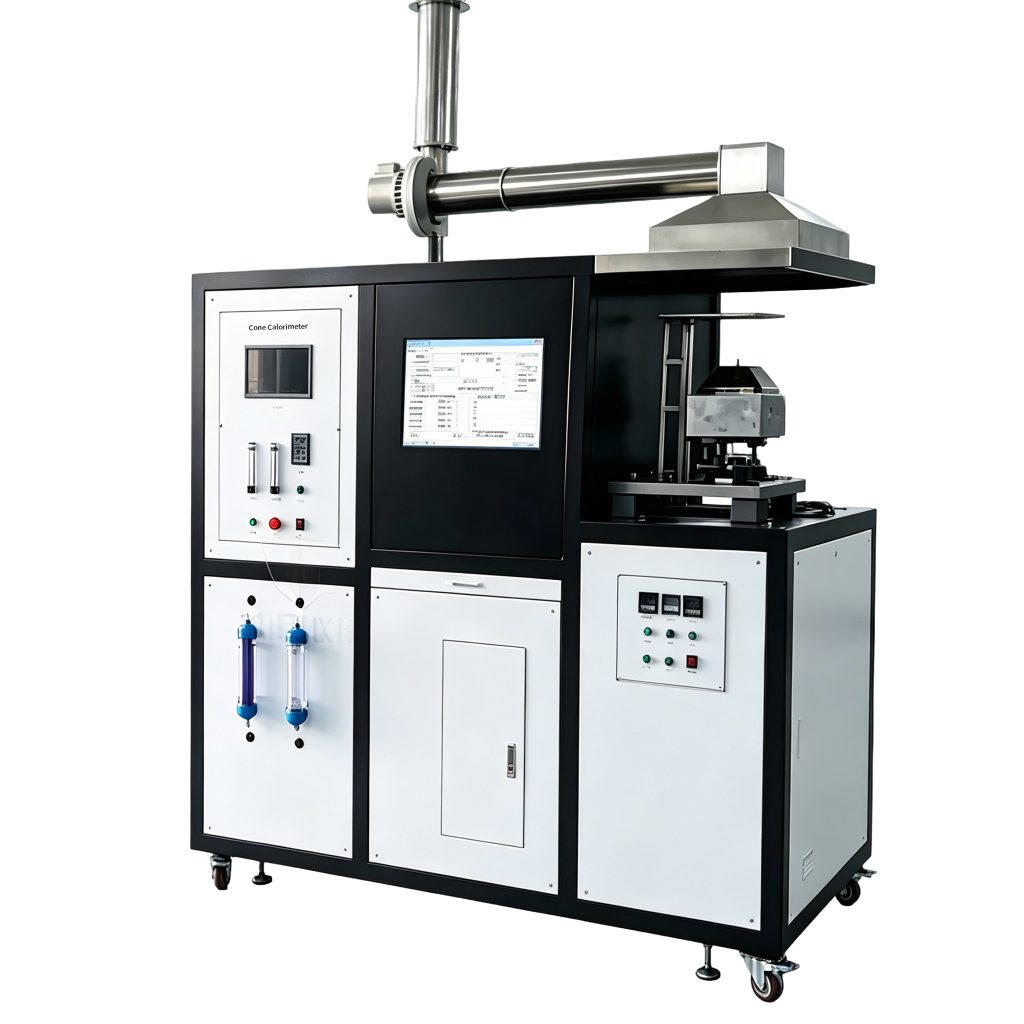
What Does a Cone Calorimeter Measure?
A cone calorimeter exposes a specimen to a controlled external heat flux and records important fire-performance indicators. The ZXLR product documentation identifies the following directly obtainable data categories:
- Heat release rate (HRR)
- Time to ignition
- Critical heat flux for ignition
- Mass loss rate
- Smoke release rate
- Effective heat of combustion
- Toxic-gas release rate, such as carbon oxides
These measurements help researchers compare building materials, evaluate flame-retardant treatments, investigate ignition behavior, and study the energy and smoke contribution of a material under specified laboratory conditions.
How Airflow Rate Can Change Cone Calorimeter Results
Airflow is not simply a background operating condition. It can influence the local combustion environment and the way combustion products move through the test system. The effect should therefore be considered when planning, calibrating, and interpreting cone calorimeter tests.
Airflow and Heat Release Rate
Heat release rate is one of the most important cone calorimeter measurements. When airflow is too low, the combustion zone may not receive the same oxygen and product-removal conditions intended by the test method. Incomplete combustion or the accumulation of volatile products can affect the measured HRR.
When airflow is too high, the sample and flame zone may be cooled. Excessive air movement can change the interaction between the flame and specimen and may carry combustion products away too quickly. The measured heat release profile may therefore differ from the result obtained under the prescribed airflow condition.
For building-material fire testing, the practical objective is not simply to maximize or minimize airflow. The objective is to maintain the airflow condition required by the applicable standard and test configuration so that HRR data remain comparable.
Airflow and Mass Loss Rate
Mass loss rate indicates how quickly the specimen is consumed during combustion. Insufficient airflow may allow volatile pyrolysis products to remain near the sample, potentially changing combustion behavior and slowing the removal of gases from the specimen area.
A higher airflow can improve the removal of volatile products, but an excessive flow may also alter heat transfer and flame behavior. Because the weighing system records specimen mass changes, airflow control and mass-loss measurement should be considered together when reviewing cone calorimeter data.
Airflow and Smoke Release Rate
Smoke production is another important fire-safety indicator. Low airflow may allow smoke and combustion products to accumulate in the test path, increasing local concentration. Very high airflow can disperse or transport smoke more quickly and may change the concentration measured by downstream detection equipment.
For this reason, smoke release rate results should be interpreted with reference to the airflow condition, exhaust arrangement, calibration, and applicable test standard. A smoke value obtained under one airflow setup should not automatically be compared with a result from a different setup.
Airflow and Combustion-Gas Measurement
Airflow affects the transport and dilution of combustion gases. This is especially relevant when a test program includes toxic-gas release rate or carbon-oxide-related measurements. The gas-analysis configuration, sampling position, flow condition, and calibration procedure should be confirmed for the intended test method.
The ZXLR product documentation lists toxic-gas release rate as a data category. It does not specify a universal airflow rate or gas-analysis configuration for every application. Customers should confirm the required measurement setup with Shenyang Baoruitong before ordering.
Why Airflow Standardization Is Essential
Reliable cone calorimeter testing requires more than a radiant heater and a weighing device. The heat flux, specimen position, radiation shield, oxygen-consumption measurement, exhaust path, airflow, and data-processing procedure all contribute to the final result.
Standardized airflow helps laboratories:
- Reduce variation between repeated tests
- Compare different building materials more fairly
- Improve the interpretation of heat release rate data
- Review mass loss and smoke results in context
- Support method-specific calibration and reporting
- Avoid attributing airflow-related variation to material performance
The airflow value must be selected according to the applicable standard and test apparatus configuration. The commonly referenced value in a specific method should not be treated as a universal specification for every cone calorimeter or every test program.
ZXLR Cone Calorimeter Features for Controlled Testing
Adjustable Radiant Heat Flux
The ZXLR uses an imported electric heating tube in a radiant cone. The rated radiant-cone power is 5000 W, and the heat-output range is 0–100 kW/m². The incident heat-flux intensity can be selected according to different test requirements.
This adjustable heat exposure allows laboratories to investigate material ignition and combustion behavior under defined thermal-radiation conditions while maintaining a clear distinction between heat-flux control and airflow control.
Uniform Radiant Intensity
The electric heating tube is tightly wound into a truncated-cone shape and assembled inside a double-layer heat-resistant cone jacket. The cone shells are filled with heat-resistant fiber with a nominal thickness of 13 mm and nominal density of 100 kg/m³.
The radiant intensity is uniform relative to the radiation at the center, with a deviation not exceeding ±2%. The radiant cone is equipped with three K-type stainless-steel-sheathed thermocouples for temperature measurement; each exposed hot junction has an outer diameter of 3.0 mm. Stable radiant exposure provides a consistent thermal input while the laboratory manages airflow and other method-specific test variables.
PID + SSR Control
The ZXLR uses PID + SSR control to regulate radiant intensity and automatically adjust the radiant cone to the preset value. The setting resolution and temperature-control accuracy are both ±10°C.
The control system helps operators maintain the selected thermal-radiation condition and reduces unnecessary manual adjustment during cone calorimeter testing.
Automatic Radiation Shield
The radiation shield is made of 6 mm non-water-cooled stainless steel. A computer program controls the shield and performs rapid insert-and-withdraw movement.
Automatic shield operation helps define the start of specimen exposure and supports a more repeatable test sequence. This is important when laboratories are comparing ignition time, HRR curves, mass loss, or smoke release under the same method conditions.
Integrated Weighing and Mass-Loss Measurement
The ZXLR incorporates an integrated weighing device designed to reflect specimen weight and mass-loss rate. Its double thermal-insulation structure helps keep the sensor at room temperature during testing.
The weighing system provides:
- Specimen weighing range: 0–1000 g
- Accuracy: 0.1 g
- Response time: less than 4 seconds
- Calibration stability: output drift no more than 1 g within 30 minutes
By combining mass measurement with controlled radiant heating, the system supports a more complete review of how material combustion changes under a specified test condition.
Airflow, HRR, Smoke, and Mass Loss: A Practical Review Framework
When evaluating cone calorimeter results, laboratories can review airflow-related variables alongside the main output data:
| Test consideration | Possible influence on results | Recommended review focus |
|---|---|---|
| Airflow too low | Reduced product removal, altered combustion, smoke accumulation | Confirm standard flow condition, exhaust path, and calibration |
| Airflow too high | Cooling of the sample or flame zone, rapid smoke transport | Check whether flow changes heat transfer or detection response |
| Inconsistent airflow | Poor repeatability between specimens | Record and control the test condition before comparison |
| Airflow not documented | Difficult interpretation of HRR and smoke data | Include method, apparatus, and calibration details in reports |
| Gas-analysis setup changed | Different dilution and sampling behavior | Confirm sampling location, flow condition, and measurement method |
This framework does not replace the applicable standard. It helps users identify airflow as a test-condition variable when analyzing material fire-performance data.
Building-Material and Industrial Applications
The ZXLR Cone Calorimeter can support fire-performance research and quality-control testing for:
- Building materials and construction products
- Wood and timber products
- Flame-retardant materials
- Plastics and polymer products
- Thermal insulation materials
- Composite materials
- Wall lining materials
- Roofing and flooring materials
- Coatings and surface treatments
- Wire and cable materials
- Railway vehicle materials
- Upholstered furniture and mattress components
- Marine and shipboard materials
For manufacturers, the system can support formulation comparison, flame-retardant development, product screening, and material quality control. For laboratories, it provides data for studying heat release, ignition, mass loss, smoke release, and effective heat of combustion under controlled thermal exposure.
Applicable Standards and Airflow-Related Test Planning
The ZXLR product documentation lists the following standards and related methods:
- GB/T 16172-2026 — Test method for heat release rate and smoke production rate of building materials
- ISO 5660-1 — Reaction-to-fire tests: Heat release rate of building products, cone calorimeter method
- ISO 5660-2 — Reaction-to-fire tests: Smoke production rate, dynamic measurement
- ASTM E1354 — Heat and visible smoke release rates using an oxygen-consumption calorimeter
- ASTM E1474 — Heat release rate of upholstered furniture and mattress components or composites using a bench-scale oxygen-consumption calorimeter
- ASTM E1740 — Interior wall lining materials
- ASTM D1550 — Institutional mattresses
- ASTM D6113 — Wire and cable
- BS 6873 — Railway vehicles
- IMO-related test methods of the International Maritime Organization
Before testing, laboratories should confirm the required airflow, exhaust, oxygen-consumption, smoke-measurement, gas-analysis, specimen, calibration, and reporting conditions for the selected standard. The ZXLR document does not state one universal airflow specification for all listed methods, so airflow requirements should be confirmed for the intended configuration.
Baoruitong Service and Warranty Support
Shenyang Baoruitong Automation Equipment Co., Ltd. supplies cone calorimeters and fire-testing equipment for industrial, research, and laboratory applications. Customers can contact the company for ZXLR product information, test-method consultation, configuration planning, technical specifications, and quotation support.
The ZXLR Cone Calorimeter includes a 1-year warranty service period. Customers should confirm the intended material, applicable standard, airflow and exhaust requirements, heat-flux range, smoke or gas measurement needs, specimen configuration, and optional accessories before ordering.
Improve Cone Calorimeter Test Interpretation with Better Airflow Control
Airflow rate can influence heat release rate, mass loss rate, smoke release rate, and combustion-gas measurement. Standardized test conditions make it easier to determine whether a change in results comes from the material or from the test environment.
With its 5000 W radiant cone, 0–100 kW/m² heat-output range, ±2% radiant-intensity deviation, PID + SSR control, automatic radiation shield, and 0–1000 g integrated weighing system, the ZXLR Cone Calorimeter provides a practical platform for building-material fire-performance research.
To learn more about the ZXLR Cone Calorimeter, ISO 5660 testing, GB/T 16172 testing, airflow-related test planning, heat release rate measurement, smoke release testing, mass loss analysis, and the 1-year warranty service, contact Baoruitong Automation Equipment Co., Ltd. for technical consultation and a quotation.