
Cone Calorimeter Helps Building-Material Manufacturers Measure Fire Performance More Precisely
Baoruitong Presents a Cone Calorimeter for Building-Material Fire Testing
Can a cone calorimeter be used to test the fire performance of building materials? Yes. A cone calorimeter applies a controlled external heat flux to a specimen and measures key combustion behavior, including heat release, ignition, mass loss, smoke production, and effective heat of combustion.
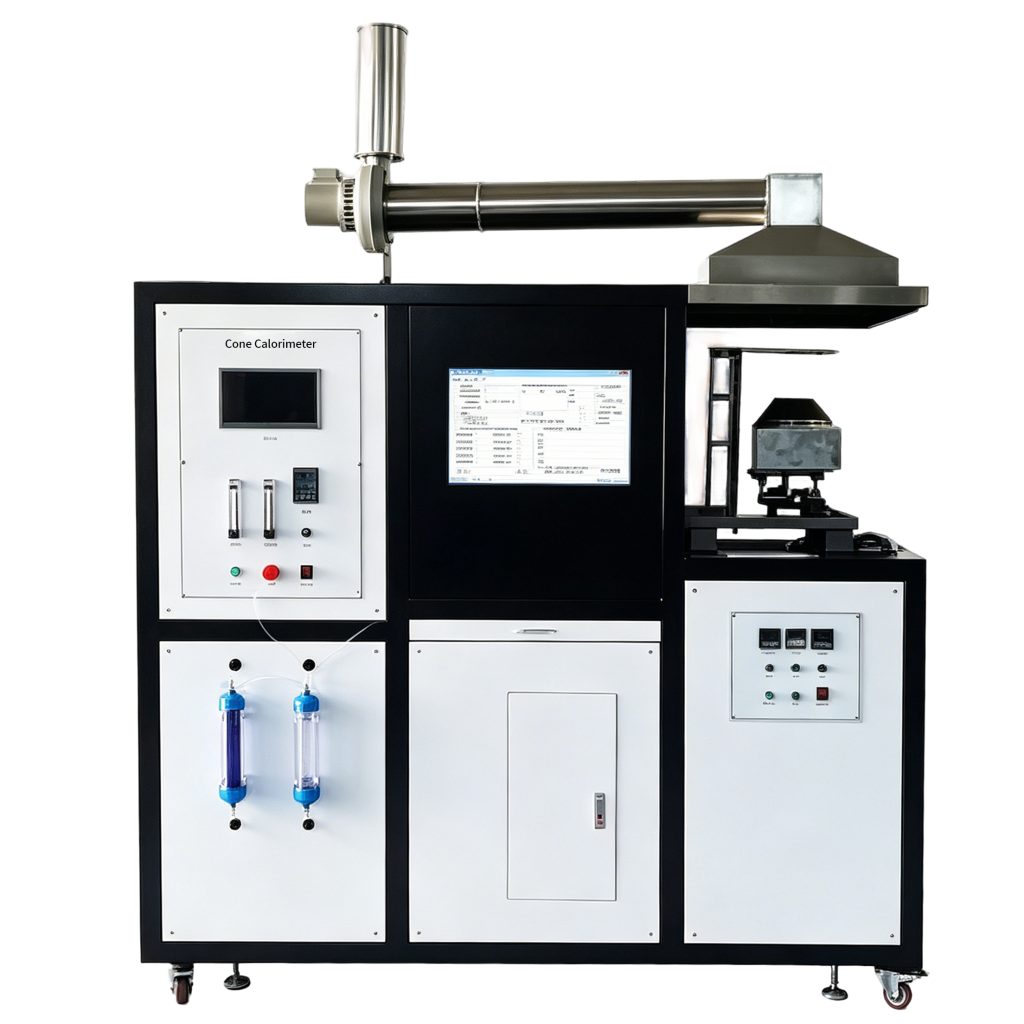
To support fire-performance research and material quality control, Baoruitong Automation Equipment Co., Ltd. supplies the ZXLR Cone Calorimeter, manufactured in accordance with GB/T 16172-2026 and ISO 5660-1. The instrument is designed to determine the heat release rate of building-material specimens during combustion under specified thermal-radiation conditions.
For building-material manufacturers, construction-material laboratories, fire-testing departments, and research institutions, the ZXLR Cone Calorimeter provides an integrated platform for measuring material response under controlled heat exposure.
Why Cone Calorimeter Testing Matters for Building Materials
The fire performance of a building material is not determined only by whether it ignites. Engineers and researchers also need to understand how quickly heat is released, how much mass is lost, how smoke develops, and whether combustion generates toxic gases.
The heat release rate (HRR) is one of the most important indicators in fire-performance testing. A material that releases heat rapidly may contribute more energy to fire growth. By measuring heat release behavior under controlled conditions, a cone calorimeter helps laboratories compare materials, study flame-retardant performance, and support more informed decisions in product development.
Cone calorimeter testing can also provide data related to:
- Time to ignition
- Critical heat flux for ignition
- Mass loss rate
- Smoke release rate
- Effective heat of combustion
- Toxic-gas release rate, including carbon oxides
The resulting data can support fire research and the evaluation of building products, while the test remains a controlled laboratory method rather than a complete simulation of every condition in a full-scale fire.
ZXLR Cone Calorimeter: Core Product Benefits
Controlled External Heat-Flux Testing
The ZXLR Cone Calorimeter uses a radiant cone to expose specimens to a selected incident heat-flux intensity. The rated radiant-cone power is 5000 W, with a heat-output range of 0–100 kW/m².
The incident heat-flux level can be selected according to the test requirements. This adjustable heat exposure helps laboratories investigate ignition and combustion behavior under different thermal-radiation conditions.
Uniform Radiant Heat Distribution
The electric heating tube is tightly wound into a truncated-cone shape and installed within a double-layer heat-resistant cone jacket. The inner and outer cone shells are filled with heat-resistant fiber with a nominal thickness of 13 mm and nominal density of 100 kg/m³.
The radiant intensity is designed to be uniform relative to the radiation at the center, with a deviation not exceeding ±2%. This supports consistent heat exposure across the specimen test area.
Three-Thermocouple Radiant-Cone Measurement
The radiant cone is equipped with three thermocouples for temperature measurement. A K-type stainless-steel-sheathed thermocouple is used for irradiance measurement, with an exposed hot junction and an outer diameter of 3.0 mm.
The three thermocouples are positioned symmetrically and make non-welded contact with the electric heating tube. This arrangement supports monitoring of the radiant-cone heating condition.
PID + SSR Temperature Control
The ZXLR Cone Calorimeter uses PID + SSR control to regulate radiant intensity and automatically adjust the radiant cone within the preset value. The setting resolution and temperature-control accuracy are both ±10°C.
This control architecture is designed to help maintain the selected thermal-radiation condition during cone calorimeter testing and provide a more manageable workflow for laboratory operators.
Automatic Radiation-Shield Operation
The radiation shield is made of 6 mm non-water-cooled stainless steel. Its operation is fully automatic: a computer program outputs the control signal and drives a rapid insert-and-withdraw action.
Automatic radiation-shield movement helps standardize the start of specimen exposure and reduces the need for repeated manual operation during testing.
Integrated Specimen Weighing System
The ZXLR Cone Calorimeter includes an integrated weighing design for monitoring specimen weight and mass-loss rate. A double thermal-insulation structure helps keep the sensor at room temperature, supporting sensor protection during high-temperature testing.
The weighing system provides:
- Specimen weighing range: 0–1000 g
- Accuracy: 0.1 g
- Response time: less than 4 seconds
- Stability: output drift of no more than 1 g within 30 minutes during calibration
These functions help laboratories capture mass-loss behavior as part of a broader fire-performance test record.
Data Available from Cone Calorimeter Testing
The ZXLR Cone Calorimeter can directly obtain data related to the following fire-performance indicators:
Heat Release Rate
Heat release rate describes the rate at which a burning material releases heat. It is central to fire-growth research and material comparison. The data can support analysis related to fire area, fire spread rate, smoke release, and toxic-gas release.
Time to Ignition
Time to ignition indicates how long a specimen takes to ignite under a specified thermal-radiation condition. It can help researchers compare the ignition response of wood, plastics, insulation, composites, polymer products, and other materials.
Critical Heat Flux for Ignition
Critical heat flux for ignition is related to the minimum incident heat exposure required for ignition under the relevant test conditions. This indicator can support studies of material ignitability and thermal response.
Mass Loss Rate
Mass loss rate provides information about how quickly specimen mass changes during combustion. Combined with heat release and ignition data, it helps laboratories study combustion behavior and flame-retardant treatment performance.
Smoke Release Rate
Smoke release rate is an important part of fire-performance assessment because smoke can reduce visibility and affect evacuation conditions. The ZXLR system is designed to obtain smoke-release-related data according to the applicable test setup.
Effective Heat of Combustion
Effective heat of combustion indicates the heat released per unit mass of material consumed during combustion. It provides another parameter for comparing the energy contribution of different specimens.
Toxic-Gas Release Rate
The product documentation identifies toxic-gas release rate, such as carbon oxides, as a data category that can be obtained by the cone calorimeter. Gas-analysis configuration and reporting should be confirmed according to the specific test method and laboratory requirements.
Applicable Standards and Testing Methods
The ZXLR Cone Calorimeter is manufactured in accordance with GB/T 16172-2026 and ISO 5660-1. The product documentation also lists the following applicable or related test methods:
- GB/T 16172-2026 — Test method for heat release rate and smoke production rate of building materials
- ISO 5660-1 — Reaction-to-fire tests: Heat release rate of building products, cone calorimeter method
- ISO 5660-2 — Reaction-to-fire tests: Smoke production rate, dynamic measurement
- ASTM E1354 — Heat and visible smoke release rates using an oxygen-consumption calorimeter
- ASTM E1474 — Heat release rate of upholstered furniture and mattress components or composites using a bench-scale oxygen-consumption calorimeter
- ASTM E1740 — Interior wall lining materials
- ASTM D1550 — Institutional mattresses
- ASTM D6113 — Wire and cable
- BS 6873 — Railway vehicles
- IMO-related test methods of the International Maritime Organization
The exact standard, specimen configuration, heat-flux setting, data-analysis procedure, and optional measurement configuration should be confirmed for the material and market being tested. Listing a test method does not by itself represent a claim that every configuration of the equipment is certified for every standard.
Building-Material Applications
The ZXLR Cone Calorimeter can support fire-performance research and quality-control work for a wide range of materials, including:
- Building materials
- Wood and timber products
- Flame-retardant materials
- Plastics and polymer products
- Thermal insulation materials
- Composite materials
- Interior wall lining materials
- Roofing and flooring materials
- Coatings and surface treatments
- Construction products
- Wire and cable materials
- Railway interior materials
- Upholstered furniture and mattress components
- Marine and shipboard material research
For manufacturers, cone calorimeter testing can support formulation comparison, flame-retardant development, incoming-material assessment, and product-performance documentation. For laboratories, the ZXLR offers a controlled bench-scale approach for collecting heat-release, ignition, smoke, and mass-loss data.
A Practical Workflow for Cone Calorimeter Testing
A typical laboratory workflow using a cone calorimeter includes:
- Select and prepare the specimen according to the applicable standard.
- Confirm the test heat-flux level and radiant-cone setup.
- Set the radiant cone using the PID + SSR control system.
- Position the specimen on the integrated weighing system.
- Use the automatic radiation shield to control the start of exposure.
- Record ignition, heat release, mass loss, smoke, and other selected data.
- Review the results for material comparison, research, or quality-control purposes.
The selected method should define specimen preparation, heat exposure, calibration, data processing, and reporting requirements. Cone calorimeter results provide valuable laboratory data, but they should be interpreted together with other applicable fire tests when a complete product assessment is required.
Baoruitong Service and Warranty Support
Shenyang Baoruitong Automation Equipment Co., Ltd. supplies fire-testing and material-performance testing equipment for industrial, research, and laboratory applications. Customers evaluating the ZXLR Cone Calorimeter can contact the company for product information, technical consultation, test-method planning, and quotation support.
The ZXLR Cone Calorimeter includes a 1-year warranty service period. Before ordering, customers should confirm the intended material type, applicable standard, heat-flux range, smoke and gas measurement requirements, specimen configuration, laboratory utilities, and any optional accessories.
Choose ZXLR for Building-Material Fire-Performance Research
A cone calorimeter helps transform material fire behavior into measurable laboratory data. With its 0–100 kW/m² heat-output range, 5000 W radiant cone, ±2% radiant-intensity deviation, PID + SSR control, automatic radiation shield, and 0–1000 g integrated weighing system, the ZXLR Cone Calorimeter is designed to support systematic research into the fire performance of building materials and other products.
To learn more about the ZXLR Cone Calorimeter, ISO 5660 testing, GB/T 16172 testing, ASTM E1354-related applications, heat release rate measurement, smoke release rate testing, mass loss analysis, and the 1-year warranty service, contact Baoruitong Automation Equipment Co., Ltd. for technical consultation and a quotation.