
Building Material Non-Combustibility Tester Supports Precise Fire-Performance Evaluation
Baoruitong Introduces the JBR20 Non-Combustibility Testing Solution
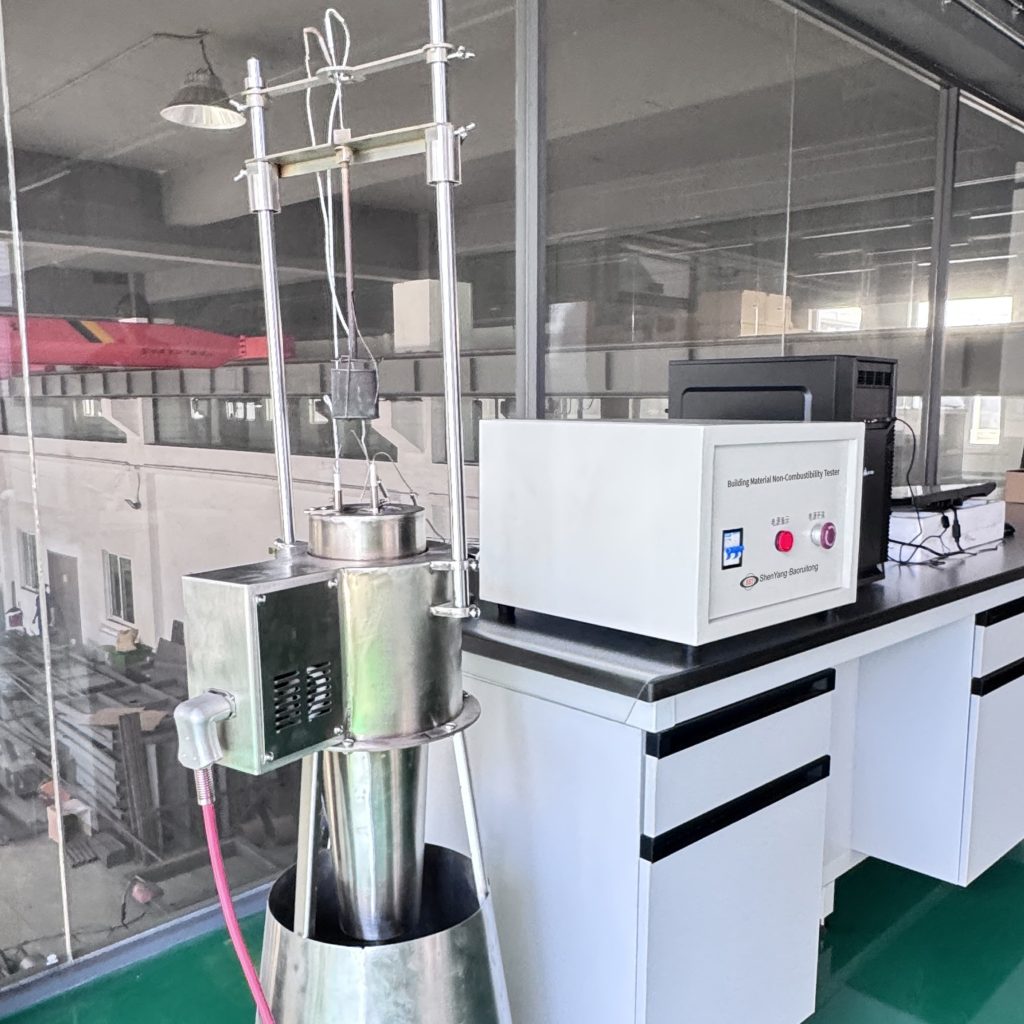
Fire performance is a critical consideration in the development, production, and quality control of modern building materials. To support reliable material evaluation under specified test conditions, Baoruitong Automation Equipment Co., Ltd. supplies the JBR20 Building Material Non-Combustibility Tester.
The JBR20 is designed to conduct non-combustibility tests on homogeneous building products and the main components of non-homogeneous building products. Used together with applicable building-material fire-classification requirements, the apparatus helps manufacturers and laboratories evaluate burning performance and support product quality control.
The tester is developed for applications related to GB/T 5464-2026, GB 8624-2025, GB/T 40238-2021, ISO 1182:2020, and EN 13238-2010, as specified in the product documentation. It provides a controlled furnace environment, multi-point temperature measurement, automated operation, and automatic data recording for building material non-combustibility testing.
Why Non-Combustibility Testing Matters for Building Products
Building products used in walls, roofs, floors, and other construction applications can have different reactions to fire. A non-combustibility test helps laboratories examine how a material behaves when exposed to a controlled high-temperature furnace environment.
For manufacturers, this type of fire reaction testing can support:
- Building material research and development
- Fire-performance comparison between formulations
- Incoming material inspection
- Production quality control
- Product classification preparation
- Laboratory testing and technical documentation
- Evaluation of homogeneous and non-homogeneous building products
The JBR20 Building Material Non-Combustibility Tester is designed to make this evaluation more controlled and more efficient by combining a high-temperature furnace, Type K thermocouples, computer-controlled operation, automatic timing, and test-result management.
Key Features of the JBR20 Non-Combustibility Tester
Designed for Building Material Non-Combustibility Testing
The JBR20 is purpose-built for non-combustibility tests of building products and their substantial components. Its design supports testing procedures associated with ISO 1182:2020 and the building-material standards listed in the product documentation.
The system can be used by building-material manufacturers, fire-testing laboratories, construction-material research centers, and quality-control departments that require a dedicated non-combustibility test apparatus.
Wide Heating Temperature Range up to 1000°C
The JBR20 provides a heating temperature range from ambient temperature to 1000°C, with a furnace power range of 0–1500 W and a heating voltage range of 0–100 V. This configuration supports controlled heating conditions for high-temperature building material fire testing.
Four-Thermocouple Temperature Measurement
The apparatus is equipped with four Type K thermocouples:
- Two furnace-temperature thermocouples
- One specimen-surface thermocouple
- One specimen-center thermocouple
The thermocouples use a 0.3 mm wire diameter, 1.5 mm outer diameter, and Class 1 accuracy. This multi-point arrangement provides temperature information from the furnace and specimen, supporting more complete observation of the test condition.
The stated temperature measurement accuracy is Class 1, with an accuracy of ±1.5°C or 0.4% of the measured temperature, whichever is greater.
Computer-Controlled Testing and Automatic Data Management
Computer-controlled operation enables high-frequency data sampling, fast system response, and automated data calculation. The JBR20 can automatically determine flame duration, eliminating the need for manual timing and helping prevent missed events during testing.
After testing, results are recorded automatically and can be queried and exported. This function helps laboratories organize test records, review material performance, and prepare internal quality-control documentation.
RS-485 Communication and Interference Resistance
The JBR20 uses a controller with RS-485 communication. The product documentation identifies strong interference immunity as one of the controller’s features, supporting stable communication between the control system and the testing equipment in laboratory environments.
All-Stainless-Steel Furnace Body
The furnace body is made of stainless steel. This design provides resistance to rust, corrosion, and high temperatures while giving the equipment a clean appearance for laboratory and industrial use.
Accurate Specimen Positioning
A height-positioning block is supplied as standard. It enables accurate and rapid positioning of the specimen holder’s lowering height, helping improve the consistency of specimen placement during non-combustibility testing.
Auxiliary thermocouples for specimen-center and specimen-surface measurements are also available according to the product documentation.
Continuous Testing Capability
The JBR20 supports continuous testing of multiple specimen sets. This feature can reduce reheating wait time between tests and improve laboratory throughput when repeated material evaluations are required.
For laboratories conducting comparative fire-performance testing, continuous operation can help increase equipment utilization and shorten the time between test batches.
Rapid Heating and Precise Temperature Control
The apparatus typically reaches a constant-temperature condition within 40–50 minutes and is then ready for testing. The stated temperature stabilization time from ambient temperature to stable operation at 750°C is 40–60 minutes.
The temperature-control algorithm has been optimized through multiple iterations and improved based on a British non-combustibility test furnace. The system can switch from constant-temperature mode to constant-power mode without manual intervention, making the test operation more convenient.
Dual-Loop Temperature and Power Control
The JBR20 uses dual-loop temperature and power control to improve voltage adaptability. During constant-power operation, power fluctuation is less than 1%, while the temperature deviation during empty-furnace operation is less than 2°C, according to the product documentation.
A power-compensation function automatically adjusts heating power when the mains voltage deviates. The soft-start function allows the software to control the heating rate automatically and regulate furnace temperature in stages, which can help extend the service life of the furnace core.
Technical Specifications
| Item | Specification |
|---|---|
| Product name | JBR20 Building Material Non-Combustibility Tester |
| Heating voltage | 0–100 V |
| Furnace power | 0–1500 W |
| Heating temperature range | Ambient temperature to 1000°C |
| Thermocouple type | Type K, Class 1 accuracy |
| Thermocouple dimensions | 0.3 mm wire diameter; 1.5 mm outer diameter |
| Number of thermocouples | 4: two furnace, one specimen surface, one specimen center |
| Temperature measurement accuracy | Class 1; ±1.5°C or 0.4% of measured temperature, whichever is greater |
| Specimen dimensions | Ø45 mm × 50 mm |
| Furnace tube height | 150 ± 1 mm |
| Furnace tube inner diameter | 75 ± 1 mm |
| Furnace tube wall thickness | 10 ± 1 mm |
| Temperature stabilization time | 40–60 min from ambient temperature to stable operation at 750°C |
| Operating environment | 23 ± 5°C; relative humidity 50 ± 20% |
| Room-temperature variation during testing | No more than 5°C |
| Power supply | Single-phase AC 220 V ± 5%, 50 Hz |
| Balance requirement | Readability of 0.01 g or better; supplied by the user |
| Communication | RS-485 controller communication |
Applicable Standards and Test-Method Keywords
The JBR20 product documentation identifies the following applicable standards and related requirements:
- GB/T 5464-2026 — Non-Combustibility Test Method for Building Materials
- GB 8624-2025 — Classification for Burning Behavior of Building Materials and Products
- GB/T 40238-2021 — Reaction-to-Fire Tests for Building Materials and Products: Selection of Substrates, Specimen Conditioning, and Mounting Requirements
- ISO 1182:2020 — Reaction to Fire Tests for Products: Non-Combustibility Test
- EN 13238-2010 — Reaction-to-Fire Tests for Building Products: Conditioning Procedures and General Rules for Selection of Substrates
For international search visibility, related industry terms may also include ASTM E2652 non-combustibility testing, non-combustibility furnace, IMO FTP Code Part 1 fire testing, and building product reaction-to-fire testing. The applicable standard should always be confirmed according to the product, market, specimen configuration, and laboratory testing plan.
Applications for Building Materials and Fire-Testing Laboratories
The JBR20 Building Material Non-Combustibility Tester is suitable for applications involving:
- Building products and construction materials
- Homogeneous building products
- Main components of non-homogeneous building products
- Wall lining materials
- Roofing products
- Flooring materials
- Mineral-based and inorganic building materials
- Fire-resistant and non-combustible material research
- Building product fire classification preparation
- Material formulation comparison
- Factory quality-control testing
- Third-party fire-testing laboratories
- Research and development laboratories
The apparatus can support engineers and laboratory technicians who need to evaluate material response under a controlled furnace condition, record temperature behavior, and manage test data efficiently.
A More Efficient Workflow for Material Fire-Performance Evaluation
The JBR20 combines hardware control and software functions in a single testing workflow:
- Prepare the specimen according to the applicable test standard.
- Condition the specimen in the required laboratory environment.
- Position the specimen holder using the standard height-positioning block.
- Heat the furnace and allow the system to reach stable operating conditions.
- Monitor furnace and specimen temperatures using the four thermocouples.
- Use computer-controlled sampling, automatic flame-duration determination, and data calculation.
- Record, query, and export the test results for quality control and technical review.
This integrated process helps reduce manual timing, supports repeatable specimen positioning, and provides organized records for product development and building-material fire testing.
Baoruitong Service and Warranty Support
Baoruitong Automation Equipment Co., Ltd. supplies fire-testing and material-testing equipment for industrial, research, and laboratory applications. For customers selecting a non-combustibility test furnace, the company can provide product information, technical consultation, application guidance, and quotation support based on the intended test standard and specimen requirements.
The JBR20 Building Material Non-Combustibility Tester includes a 1-year warranty service period. Customers should confirm the applicable standard, specimen type, laboratory environment, power supply, and any optional thermocouple requirements before placing an order.
Choose JBR20 for Controlled Building Material Fire Testing
Reliable non-combustibility testing supports better decisions in building-material development, production quality control, and fire-performance evaluation. With its 0–1000°C heating range, four-thermocouple configuration, computer-controlled operation, automated data management, stainless-steel furnace body, dual-loop control, power compensation, and continuous-testing capability, the JBR20 Building Material Non-Combustibility Tester provides a practical solution for laboratories and manufacturers.
To learn more about the JBR20 Building Material Non-Combustibility Tester, ISO 1182 testing, GB/T 5464 testing, GB 8624 building-material classification support, technical specifications, optional accessories, and the 1-year warranty service, contact Baoruitong Automation Equipment Co., Ltd. for product consultation and a quotation.