
The Science of FTIR Spectroscopy: Decoding Molecular Vibrations for Material Identification
This machine doesn’t just see molecules; it listens to their vibrations.
Fourier-Transform Infrared (FTIR) Spectroscopy is a powerful analytical technique used to identify chemical compounds and analyze molecular structures by probing how molecules interact with infrared light. Every chemical bond in a sample acts like a flexible spring, creating a unique vibrational fingerprint that scientists can use to identify substances with absolute certainty.
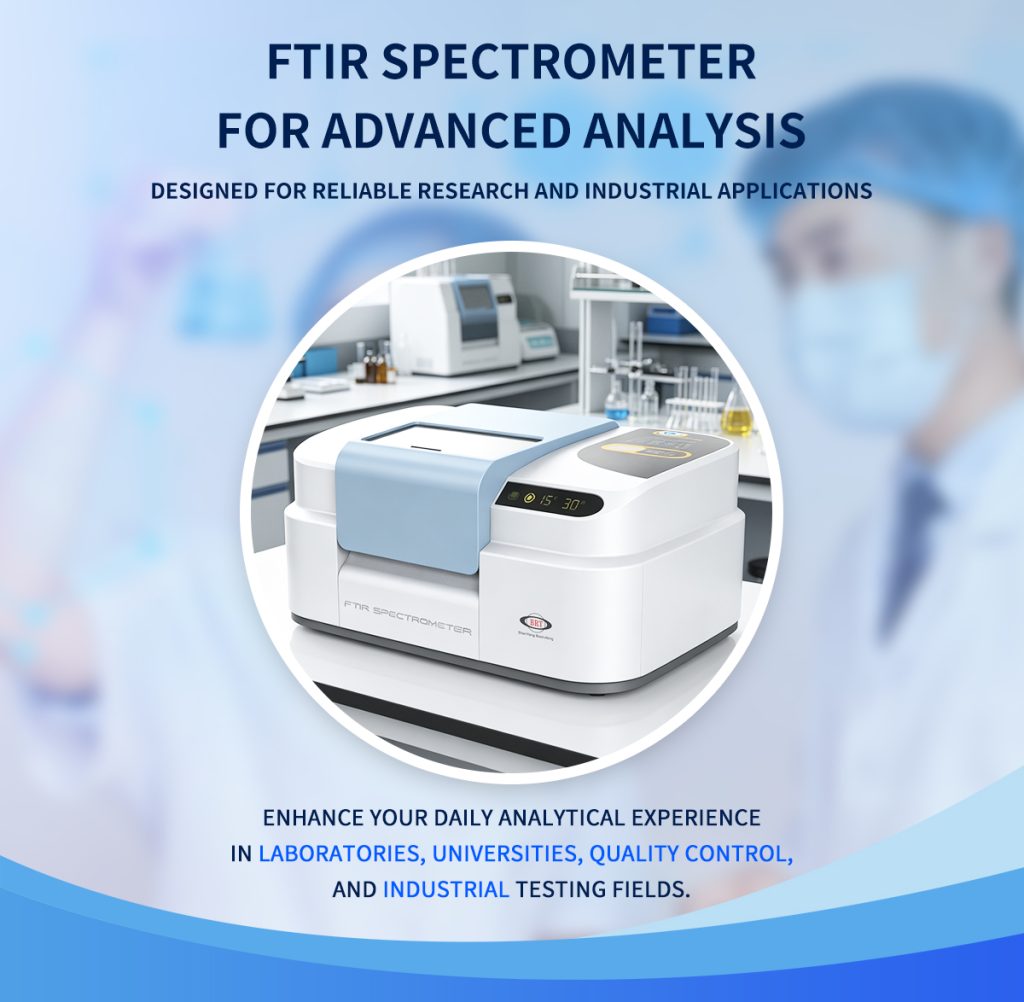
As a professional manufacturer of laboratory analysis instruments, Shenyang Baoruitong Automation Equipment Co., Ltd. (BRT) presents this expert guide to the science of FTIR spectroscopy and its BRT-860 and BRT-890 FTIR Spectrometers — engineered to turn molecular vibrations into clear, actionable data.
How FTIR Decoding Works: Molecular Vibrations & Absorption
When a sample is exposed to infrared radiation, its molecules absorb specific frequencies of light that match their natural vibrational frequencies. This process follows a few fundamental principles:
- Vibrational Modes: Chemical bonds undergo distinct movements, such as stretching (changes in bond length) and bending (changes in bond angle).
- Resonance Condition: Absorption occurs only when the frequency of the incoming infrared light matches the vibrational frequency of a specific bond that undergoes a change in its dipole moment.
- The Molecular Fingerprint: Different functional groups absorb light at characteristic wavenumbers. The resulting spectrum serves as a unique “infrared fingerprint,” enabling unambiguous identification of both organic and inorganic compounds.
- Michelson Interferometer Transformation: Modern instruments use a Michelson interferometer to acquire an interferogram (raw data) across all frequencies simultaneously. A Fourier transform algorithm then converts this pattern into a legible spectrum within seconds.
Why Industries Rely on FTIR Spectroscopy
Because FTIR provides rapid, non-destructive qualitative and quantitative analysis, it has become a cornerstone of modern industry:
- Pharmaceutical Quality Control: Verifying the purity of active pharmaceutical ingredients (APIs) and detecting trace impurities.
- Polymer & Materials Science: Identifying synthetic polymers, additives and detecting microplastics.
- Forensic Analysis: Characterizing unknown chemical substances, fibers, paints and explosives.
- Environmental Monitoring: Detecting atmospheric pollutants and water contaminants.
BRT’s Solution: High-Performance FTIR Spectrometers
To help laboratories across these sectors achieve the highest analytical precision, Shenyang Baoruitong Automation Equipment Co., Ltd. (BRT) offers two flagship FTIR solutions:
BRT-860 FTIR Spectrometer — stability for routine analysis
- High signal-to-noise ratio of 30000:1, capturing even minor thermal signals.
- Wavenumber range 7800–350 cm⁻¹ with resolution better than 1 cm⁻¹.
- Sealed Michelson interferometer with permanent alignment for excellent vibration resistance.
- High-resolution DLATGS detector with moisture-proof coating for long-term reliability.
BRT-890 FTIR Spectrometer — precision for flagship research
- Enhanced 45000:1 signal-to-noise ratio with resolution better than 0.85 cm⁻¹.
- DSP auto interferometer and integrated humidity warning system for maximum protection.
- Intelligent human-machine interaction with guided operation and extensive spectral libraries (220,000+ spectra).
- Ideal for biopharmaceuticals, petrochemical analysis and materials research.
FAQ
What is FTIR spectroscopy? Fourier-Transform Infrared (FTIR) spectroscopy is an analytical technique that uses infrared light to measure the vibrations of chemical bonds, creating a unique “molecular fingerprint” used to identify compounds and analyze their structure.
How does an FTIR spectrometer work? It uses a Michelson interferometer to shine infrared light on a sample and record the interference pattern (interferogram). A Fourier transform algorithm then processes this data into a spectrum showing which frequencies were absorbed by the molecular bonds.
What are the main advantages of FTIR? FTIR is fast (analysing full spectra simultaneously), highly accurate, capable of detecting trace contaminants, and non-destructive — meaning the sample remains intact after testing.
What is the difference between the BRT-860 and BRT-890? The BRT-860 is a high-performance unit with 30000:1 SNR for routine lab use. The BRT-890 is our flagship model with 45000:1 SNR, finer resolution and an intelligent humidity alarm for demanding research environments.
What applications is the BRT FTIR range suitable for? Pharmaceutical QC, polymer identification, petrochemical analysis, forensic chemistry, environmental monitoring and academic research in material science.
Get a Quote
Ready to decode the molecular vibrations in your samples? Contact Shenyang Baoruitong Automation Equipment Co., Ltd. today for detailed datasheets, spectral library options and a customized quotation. Every BRT instrument comes with a 1-year warranty and expert technical support.
Email: info@brt-test.com | WhatsApp: +86 15604057553 | Web: www.brt-test.com